D&D One-Shots, Part 2: Absolute Beginners

Here I talked about why we should be running D&D one-shots; I shared some pregens here (there will be more of them later); and I talked about the start of sessions here. In this post I’m going to offer some tips from experience for running for a table that are entirely new to tabletop RPGs. Some of this advice will be D&D focused, but a lot of it goes for any system where you have a lot of players who are new to the hobby.
20190812_1721532071750066900064083.jpg

Best advice for running D&D for new players

Bring All The Stuff, Make Friends

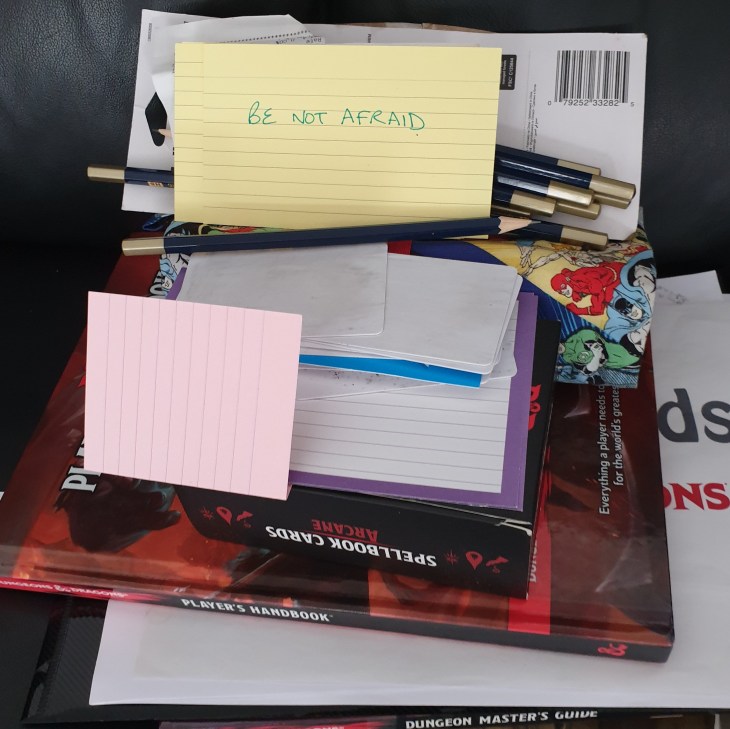
You will need dice for everyone. You will need pencils for everyone. You will need an index card for each player to make a name tent (with their character and ‘real’ name on, if the group doesn’t know one another). Do introductions. Be nice to people. Be aware that if this is a new group, weird social dynamics can emerge, and you share some responsibility for making sure that people don’t dominate or shy away.

1st Level is Fine

With more experienced players, or in a convention slot, I’d probably want to start at least at 2nd level, to give players a range of options. With new players, I take advantage of D&D’s training levels and stick to level 1. Why?

  • there’s an obvious action each round so they don’t have to worry about ‘doing the right thing’
  • the mental arithmetic is easier with fewer hit points and options
  • there are less ‘rules exceptions’ – rules that change other rules, that are really confusing if you’ve not used the actual rules before

Keep it As Simple As You Can

The pregen sheets I used (in the same format as the 2nd level characters here) are here. From the feedback of my six new players, they were easily complex enough – in fact they couldn’t believe that the actual character sheets were more complicated than this, until I showed them the one in the back of the Player’s Handbook.

I had spell cards for the sorcerer in the game, and I’d recommend having them ready, and introducing that PC as the most challenging. In my game I nudged the sorcerer towards the one player who had his own set of dice – that seemed to indicate he’d be down for a bit more processing, even though he hadn’t played before.

Teach Core Concepts First

After a quick tour of the character sheets, I’d recommend teaching the core concept of D&D. The core concept, in case you are wondering, isn’t “roll 1d20 and add a bonus,” the core concept is this:

Say what your character does, and we’ll work out what happens from there.

The reference point I used was videogame RPGs, as that was one point of reference they were all familiar with. Saying it’s like you have dialogue options, except you can say whatever you want, and I’ll say what the NPC says, helped, as did referring to combat as being turn-based like Final Fantasy.

Model What To Do

So, as I talked about here and here, I like to do a bit of an introduction for a one-shot to bind the PCs together. This felt a bit like throwing them in at the deep end, so I just asked for a brief description of what their character looked like and acted.

I modelled this first myself by describing the merchants who had hired them – the confident, worldly wife and her feckless moustached husband who didn’t understand why they needed to hire adventurers for support as he could deal with any bandits himself. They then went round and, following my lead, described their PCs in a similar amount of detail. I did some interjecting, like “I’m thinking you’re a pretty wide-eyed and innocent…” and giving positive feedback while they did this.

This was absolutely crucial to the action that followed. When their cart was inevitably attacked by some bandits, one of the fighter’s first actions was of course to check on the female merchant in the cart that she was OK – while the sneaky sorcerer hid under the cart and hoped he wasn’t noticed until it was obvious he had been.

Get the Action / Roleplay Balance Right

I think this varies for each game, but for D&D I was certain I was going to use a proper dungeon – so I started with Dyson Logos’ excellent Goblin Gully, and added an inciting event (the aforementioned bandit attack, and then some investigation in town) before they ventured to the dungeon. Prioritising the roleplay and being your character meant that, even in combat, everyone was describing their awesome (or not so awesome) moves. I’ll be sharing my notes on how exactly I did this, and my D&D5 conversion for it, in a later post.

Minis: You Do You

I didn’t use minis, because they aren’t me. I never really use them – even when I played in a mini-campaign of Pathfinder, we managed to muddle through (I’m not a fan of the term “Theatre of the Mind,” either, as it just sounds pretentious).

But if you’re a GM who uses minis, by all means crack them out – props are good, and they provide a good focus for the play. I would definitely have had less swashbuckling derring-do from my PCs with a map, but that’s just my tastes I think.

Enjoy it!

Running D&D for six complete newcomers is one of my most exhilarating experiences at the table this year. I can’t recommend it enough – not just for bringing new people into the hobby, but for the enjoyment yourself of seeing them grow in confidence through the game. And, despite what I’m saying in a lot of these D&D posts, after a few games of D&D it might be time to talk to them about other games – and see if they want to give, say, Star Wars a try.

Have you run games for complete beginners? How did it go? In future posts I’ll expand on how I opened out Goblin Gully, and give my own approach to balancing encounters and timings for D&D5.
D&D5e One-Shots, Part 1: Getting Started

Previously, I told everyone they should be running D&D5e one-shots. Here, I shared some of my techniques for pregens, as well as some actual pregens. In the next few posts, I’m going to actually talk about what techniques and tricks I use to make D&D5e one-shots sing, starting with the start of the session. For this post, I’m assuming that you’re running for players who have played D&D or another tabletop RPG before – my next post will be about players who are completely brand new.

Pregens / Characters

D&D5e is unusual in that, thanks to Adventurer’s League, often players will expect to be able to bring their own characters to the table. Also, if they have D&D Beyond, they can probably whip up a character in 10 minutes to your spec. I try to embrace this as much as I can – if I advertise a game, I’ll be clear that although I’ll bring pregens, if they’ve got (standard array) characters at the right level, I’m happy to have them instead. They do have to meet that spec though – no “I randomly rolled these stats,” or “My sorcerer is 4th level instead of 2nd, is that still ok?” – again, with the app it’s really easy to make those adjustments, so they should be at least initially balanced to the other PCs.

I usually turn up with a selection of my own pregens, a few extras from the excellent FastCharacter website, and let them pick. Running D&D, of course, that you might well have players who really know the system – so if they want to adapt or change stuff from a pregen, they can usually just go ahead and do it.

Forming a Party

This does mean that you can often have a fairly disparate band of PCs at the start of the session. I’m blogged here about using charged questions to help bring groups together, but I’ve recently started using Backstory Cards, and these have worked really well to not only tie a group together but also tie them to the setting.

With Backstory Cards, you have a few lists of individuals, groups, and locations, and then ask questions of the players to establish some shared history. With a set of cards, they can be drawn at random by the players, but I just pick some interesting questions from the cards and my lists, and manage it so that everyone gets some screen time.

Example questions might include:

  • Pools, you and Fuuwde did something in Hightower that at least one of you regrets, or is ashamed of. What lengths will you go to hide it?
  • Van Erp, your allegiances aren’t clear when it comes to the Dock Rats thieves’ guild. How did Jansora find out? What don’t they know?

As you can see the questions are pretty multi-levelled – I’m not too bothered if we don’t get right to the bottom of the question – just spitballing a heist in Hightower that went wrong will be enough to bond the players together. I use a mixture of groups, individuals and places from the one-shot itself, and peripheral to it – so, although the city watch might not specifically be mentioned in the scenario, they are around, and having some history with them means they can be on stage during scenes as much as the players (and I) want.

I do this straight after an introduction – so the start of the session looks like this:

  • players go round the table and introduce their PC’s name, race, class, and anything obvious they have set in their mind about them
  • we do the backstory cards – making sure that each PC gets some screen time. I’ll use this to drip-feed anything important about the setting, too, as they do this – sometimes I’ll amend my prep notes as well if something particularly juicy comes out
  • players introduce their PCs properly. I get them to do this like an opening montage in a cheesy TV series, like Robin of Sherwood or Quantum Leap – we see each PC in the middle of an action scene from a previous (or future) adventure, doing something that defines them in some way

This all of course takes a bit of time, but it’s well spent. At the end of this process (which I normally budget about 30 minutes for, longer if players faff around with their characters) you should have an adventuring party, rather than a collection of individuals. I’ve lost count of how many one-shots (and D&D is over-represented here) where half an hour in I still didn’t know the character names of my fellow PCs.

So that’s my approach for the start of the session. In my next post, I’ll talk about running D&D one-shots for players that are completely brand new to Tabletop RPGs, which simplifies some of these ideas a bit.

Why Aren’t You Running D&D One Shots?

Periodically, a discussion starts online like this –

“I have a friend / colleague / partner / child who wants to try D&D. What should I run for them that’s a good introduction to the hobby?”

…and the discussion then proceeds with lots of helpful advice about what system to use, people suggesting their favourites – D100 because the probabilities are easy, Fate because the narrative aspects are easy to grab, Fighting Fantasy because they’ll know the system from the books, that sort of thing.

And they’re all wrong.

If somebody wants to play D&D, you should run D&D for them. It’s not complex, and is (finally – in its current edition) a really intuitive, straightforward, balanced system. As a wider hobby, those of us who run non-D&D games need to get over ourselves that D&D can’t be as good as our favourite game just because it’s popular, and maybe consider that actually that popularity might be in fact because it’s really quite good.

For the first time in the history of the hobby, it’s staggeringly easy to ‘get into’ D&D – Critical Role and similar AP series have made people realise how much fun it can be, and it gets generally sympathetic media coverage. So, we should just accept that D&D is a good entry point to the hobby – yes, of course, there are other games, but D&D is one of those games.

But everybody else runs D&D!

Unless your local area has a flourishing, and welcoming, D&D Adventurers League, I’d counter this that there aren’t all that many people running D&D One-Shots. There are lots of D&D Campaigns going on, but even a quick review of Adventurer’s League shows that the vast majority of adventures featured are designed to be slotted into an ongoing campaign. As previously discussed, the one-shot format (and ideally the short-one-shot format) is an easier way for newcomers to access the hobby.

But I don’t like D&D!

Don’t you? How much D&D5e have you played, or run? I know people who aren’t keen on the fantasy genre, which is fair enough, but a lot of people who claim to not like D&D tend to hold this view from previous editions. I mean, certainly, don’t run the game if you don’t like it, but be open about that, and tell your potential hobbyist that your reluctance to run D&D is because of your own tastes, and not that…

But D&D Is Rubbish! It’s not as good / realistic / fun as Runequest / Fate / Dungeon World!

Look, D&D doesn’t do all genres well. But it does do D&D Fantasy very well – as you might expect. It emulates its own genre perfectly, if you like. Sure, see previous answer, but if you have somebody who is keen to engage with the hobby, telling them that the one thing they are interested in isn’t as good as another game with lower exposure isn’t going to draw them into the hobby. Run D&D first. Then you can tell them about Runequest, if they’re into ducks.

D&D Is Too Complicated!

character sheet comparison

It’s not. One of the great design aspects in D&D5e is that the first two levels are training levels for each of the classes. First level D&D is really easy to play, 2nd level adds in one or two more options, and it’s not until 3rd that PCs really start to get some complexity and depth. Even then, it’s a nice balance where system mastery is much less important than in many other games, so it’s much more forgiving for the new player to pick up.

I do think that a lot of D&D Character Sheets look too complicated – I’ve been working on my own designs that look like the picture here (I copied them off (I think) someone from Critical Role who posted a photo of their sheets for a one-shot) – and will be posting more on this site over the next few weeks.

So Run Some D&D

So, if I can implore you, rather than complain about everyone wanting to play D&D and how they aren’t interested in your favourite system, just run some D&D. In my next post, I’ll cover some ways to make it work – because of the exposure and expected play styles, D&D one shots are a little bit different to other games.

And don’t look down your noses at D&D – it’s not becoming for the hobby for us to throw our game vs. game wars at newcomers, and as well D&D5e is really really good. I’m spending some time over the summer making sure I always have some D&D ready to run – in part because I have a few friends who are interested, and I want their first D&D experience – and their first TTRPG experience – to be awesome.

Review: Legend of the Five Rings Beginner Game

After writing about the Call of Cthulhu Starter Set, I thought I’d look at some other starter sets to compare how useful they are for the one-shot GM. Legend of the Five Rings (L5R) is a ‘classic’ system of Samurai action, where warring clans battle against taint and shadow (and each other) while labouring under the demands of Bushido. It’s a complex setting, and one that treads a careful line between authenticity and excitement; in previous editions, combat was lethal and fast, with a very ‘trad’ take on the realism of action. FFG’s new edition takes all that and adds, naturally, funky dice, and a variant of the Roll & Keep system. Hard core fantasy samurai intrigue may not be your thing, but the L5R Beginner Game is really good at one thing – in that it presents a tutorial level for the game.


The box itself contains a Rule Book, an Adventure Book, four very pretty pregen booklets (another three are available online for free at FFG’s website, under Player Resources), a nice map of Rokugan (the land of L5R) and a card set of counters with 59 counters for PCs and NPCs from the game. There are also, of course, a set of the dice – black d6s and white d12s for Rings and Skills respectively.

The Fluff

It’s like Feudal Japan, but every clan has easily-interpreted animal names, have a history of war and rebellion where they all maintain their stereotyped positions as their fortunes wax and wane. There are shugenja, tattooed monks, and ninja. Magic is dealing with Kami and learning spells if you’re a goody, consorting with demons and Tainted Shadow if you’re a baddy.

The clans have a long and storied history of who used to be in charge and who is now in charge – I remember starting to read the previous edition’s history chapter before remembering that this all comes from a CCG – clan loyalties, powers and even abilities were re-imagined for every new release. I’d ignore it if I were you and concentrate on skewering dishonor with a well-hewn katana.

The Beginner Game tackles head on one of L5R’s setting conundrums – the game is clearly designed to have a mixture of Clans in each party, but also begs the question of why they would work together? Some Clans are allied, some are rivals – there’s a challenge inherent in the setting as to why, say, your Dragon Clan Agasha Mystic is throwing in their lot with a brutal Crab Clan Hida Defender. It does this by taking a staple of the fiction and using it in a very efficient way – the PCs are to compete in the Topaz Championship, a chance for young Samurai to test themselves against one another and the best of all the Clans. Of course, intrigue ensues, and there are additional supplements that detail how the PCs can end up as Emerald Magistrates – roving Mouse Guard-like problem solvers – but the starter adventure throws them together and gives them a reason to stick together.

The Crunch

Where the Beginner Box really shines is in using the Topaz Championship to teach the rules. There’s a minor roleplay encounter first, without any dice rolling, before a short encounter that can be resolved with a simple skill test. There are contests (the Championship itself) and then a low-stakes ‘brawl’ before the PCs “level up” to the strength of full starter PCs (replacing their training swords with katana) and have to deal with the real problems.

This is structured in such a clever way that it could be the blueprint for a crunch-heavy one-shot. In teaching the system step by step, it manages to introduce a fairly complex and unforgiving rules set in a manageable way. Along the way, it manages to teach parts of the setting, which – as you may have gathered – is a little complicated as well.

Without turning this into a full review of the system, there’s an awful lot I like about the new L5R rules. Strife, for example – it accumulates as a result of complications on tests, and when you hit your Composure total you suffer an ‘Unmasking’ and you break what’s expected of you. This might mean you lash out angrily with a hard word – each PC has a suggested Unmasking action. It’s a clever way of reinforcing the expectations of Bushido, and gives a mechanical way to let players rub against it in a dramatic way.

The gradual introduction of rules is necessary, I think – there are some parts of the system that take some mastery. Dice pools are assembled from an Approach- the Attributes of the game, or Rings – and a Skill (of which I am pleased to say there are a relatively small number). There is usually more than one way to skin a cat when you make a skill roll – literally, I’d say, in that case – it’s probably Fire + Survival as you wouldn’t normally skin such an animal, but a case could be made for Earth, Water, or even Void if you’re skinning it to placate a Kami nearby. I think the best way to play this is to be flexible to the players, letting them negotiate which to use if they can make a case for it while being wary of players rolling their best Approach all the time.

The One Shot

If you’re looking to teach the rules of L5R in order to put a campaign together, this is brilliant. If you’re looking for a convention game to offer where some players may already be familiar with the system (even from earlier editions) – this may not be usable as-is. Buy it and read it, though – this is an excellent example of how to structure a complex system in a one-shot (I did talk a bit about this in this post, as well).

It’s also great for showing how to structure a ‘contest’ one-shot – from medieval jousts to Quidditch championships, it shows how to structure a game around this that lets players both compete in the events and investigate what is happening around them. And it’s great to pick up the rules for L5R yourself, too – I sometimes wish more adventures were around that spelled out the rules as they are introduced – but that might just be because I’m looking at lots of Starter Sets at the moment.

Myself, for a L5R one-shot I’d use a similar structure, maybe starting with a low-stakes social conflict, and use full starting PCs – they have a deal more flexibility than the 0-level pregens provided. I’d probably limit my pregens to two or three clans, and try and highlight the differences between them – zoom in on the conflict and different approaches of the two Clans’ traditional approaches to the problem. When I’ve prepped it, I’ll post it on here. I’ve never managed to get into an L5R one-shot at conventions – if you’ve run one, feel free to comment below about it – for this or an earlier edition.

Spotlight Maintenance and the Three-Skill Trick: A One-Shot Prep Technique

After several cons in the last few weeks, I’ve come to realise how important spotlight sharing is in One-Shot games. In some games, a structured turn helps to make this happen naturally, especially in combat; in D&D, for instance, everyone has a role to play in combat, so generally a fight has the spotlight shared reasonably equally. But in games that are less combat-centric, such as investigative games, it can be easy to neglect some characters and favour others. And even in D&D, outside of combat it can be easy to make the game focus more on some PCs and not others.

So, in thinking about this, I present…

The Three-Skill Trick

You do this at some point in your prep after you have your pregens ready. You might only have the bare bones of your plot – in which case this might take you in unexpected directions – or you might have the game basically prepped – in which case this will add detail and options that will check that everyone has plenty to do.

Start by looking at your pregens and working out what they are really good at – this will include their “Apex skill,” whatever they are best at, but also anything that they have a Talent/Stunt/whatever your system calls them that can boost it. Sometimes talents can have specific instances – for instance in FFG Star Wars Talents sometimes just remove penalty dice – so consider if those instances can occur in the game.

Then list three places in the scenario for each pregen where these skills can shine. Make sure these are skill uses that hinge on success – passing them adds significant value and plot leverage to the game.

Why three? Well, not all of them may come up, no matter how obvious you think they might be. By having three, you’re guaranteeing as close as you can that it’ll come up at least once. This is easier to illustrate with an example, so let’s look at a classic/boring adventure structure, and let’s stick to D&D, the “Bandits on the Road” adventure.

Imagine this is as far as our prep goes for this 1st level D&D adventure: the PCs are hired to escort a caravan through the dangerous woods; part way through they are ambushed by bandits, who run off with a vital item. The PCs are offered double their fee to track the bandits and recover the item, from which they can then return to civilisation.

Just to stick to the cliche, let’s assume a bog-standard D&D party of Fighter, Magic-User, Thief, and Cleric, and let’s make them good at standard 1st Edition AD&D things – the Cleric can heal and speak to people, the Fighter can, er, Bend Bars and Lift Gates, and hit things with his sword; you get the idea.

Let’s look at each PC in turn and look at what we can add to give them a proper spotlight.

Fighter

  • during the ambush, the caravan is forced into a rut and loses a wheel – it needs lifting up and repairing
  • during the ambush, one of the bandits is carrying a shield bearing the heraldic crest of the Duke’s bastard son – foreshadowing that…
  • the bandits have a champion, the Duke’s disgraced bastard son, who seeks to duel the fighter in single combat

Thief

  • The camp is nestled up a cliffside – by climbing the (fairly easy) cliffs it can be scouted and alarms cut off
  • The bandits around the camp (or even during the ambush) carry obvious keys that can be pickpocketed from them
  • The camp has tripwire traps all around the approach to the forest

Cleric

  • At the start of the ambush, the merchant’s wife is shot and dangerously wounded – she needs healing
  • During the night – during which the PCs must travel to get to the bandit camp – restless spirits and ghosts stalk the forest
  • There are druids in the forest who are none too happy about the caravans coming through, but a friendly approach leads to their help against the bandits, who they are equally displeased with

Magic-User

  • the stolen item is an arcane box that can be magically tracked
  • during the camp ambush, there are lots of braziers and pots of oil (that can easily be mage hand-ed to cause distraction)
  • from the ambush, they find a map to the bandit camp – but it is in code

Obviously, this isn’t quite game-ready, but I’d argue it’s a significant improvement on the standard adventure already. All it needs is a re-arranging into order and a few stats and names, and it’s a pretty serviceable one-shot. Watch this space and I might even do that – after all, I did try and chisel a decent one-shot out of another classic/corny adventure plot, “The Orc And The Pie.”

What are your tricks for managing spotlight in one-shots? Have you tried a similar technique? And watch out for Part 2, where I’ll apply it to a more complex base adventure.

Ravnica Airship Heist – a 3rd level D&D One-Shot

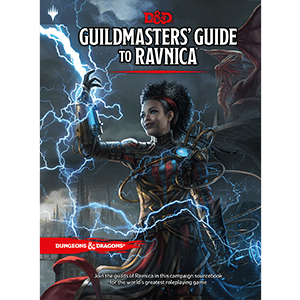
In my review of the Guildmaster’s Guide to Ravnica, I talked about it’s amazing steampunky setting – and it made me think immediately of an airship heist. Well, I went ahead and designed one, and have run it twice now – once at Go Play Leeds and once at the excellent Airecon convention in Harrogate.

While you’re reading this, I should tell you about my Patreon. Patrons get access to content 7 days before they hit this site, the chance to request articles or content, and the chance to play in one-shot games, for a very reasonable backer level. If you like what you read, want to support the blog, and have the funds for it, please consider supporting here.

airship pic

Airship by Jonny Gray

It’s presented in fairly loose note form below (and here as a .pdf) – and in this post I’ve got links to the pregens that I used for it. You can probably get an idea about how I tend to run D&D5e from it – there’s no maps, for instance, and in particular the part of the one-shot where the PCs have to source flying mounts is left intentionally vague. In both occasions of running it, the Goblin player has decided instead to have his own experimental flying machine.

Let me know any feedback – particularly if you run it, or part of it.

Ravnica Airship Heist

(An Azorius Senate Ravnica One-Shot for five 3rd level PCs)

Background

There’s one airship out of the Tenth District that you need to get to; it’s got Lady Saves on it, a wanted Simic Combine ‘disappearer’ who is wanted for multiple Guildpact violations. She’s gone into deep hiding, but you know she’s still in the Tenth District, and you’re going to capture her.

She knows the Azorius are on to her, though, and has made plans. After exhausting a number of avenues, she has kidnapped Izzet league goblin inventor Grizmalgun and forced him to steal and pilot an airship for her. With this, she will flee to the faraway Sixth District and start her experiments again!

Setup

This one-shot assumes that the PCs are working with, or allied to, the Azorius Senate, and begins at the finale of their investigations into her practices. The adventure begins at the finale of their investigations into her – they have tracked her down to her laboratory on the edge of Zonot Seven, in Precinct Five of the Tenth District. Her crimes – kidnapping, experimentation without consent – are so foul that even the Simic Combine has stopped defending her, and so the Azorius have a warrant for her arrest.

With each PC, ask why they are dedicated to finding Lady Saves – what has she done to them, their Guild or their family. Let them know the terms of the warrant – it applies within the Tenth District, and so it is imperative that they don’t let her escape.

Then ask them which PC they have worked with before – what case they worked on, and what they thought of them.

Cast

Lady Saves is a cruel, heartless Simic biomancer who seeks only to further her own glory by a series of increasingly dangerous experiments. She appears as a beautiful, if otherworldly, woman, and has a thin pair of butterfly wings that are usually kept folded and hidden behind her back. Likewise, if she needs it, a pair of concealed tentacles can emerge from her body.

Grizmalgun is a scatterbrained and disorganised goblin inventor who usually works in the harnessing of elemental powers. He has worked many times on maintaining the Tenth District’s airships, and so is in a prime position to steal one. While he has no time for Lady Saves, the chance to actually fly one of his creations has made him relatively sympathetic to her cause – and the chance to start again in the Sixth District also appeals, as he has a long list of debts from previous experiments.

Scene 1 – Dawn Raid on Growth Chamber Alpha-3

The PCs enter the Growth Chamber to find it apparently deserted – there are two greenish pools in front of them, beyond which a desk of apparatus and notes lies in disarray. Another doorway leads to some abandoned living quarters All through the room is the thick smell of acid which stings the eyes. Within the pools, two Category 1 Krasis (p210 GGR) (both with the Acidic Skin power) lie ready to attacl the PCs. They will try to wait until the PCs have started to investigate the desk, trapping them in the chamber, but if anyone tries to explore the pools they will attack.

A thorough search of the chamber reveals –

  • A detailed plan for airship piloting, which has had several notes left in it
  • A list of Izzet league contacts – with notes next to them, each crossed out. Only one, Grizmalgun, a goblin airship inventor, remains
  • A guide book to the Sixth District, far across Ravnica

If Lady Saves makes it to the Sixth District, she will be well away from her crimes here – even the Guildpact takes a long time to enforce, and she belongs in your jurisdiction! They can follow up the leads

Airships

Research about airships shows that they are likely to be from the Airpship Station at the centre of Tenth District. They are slow but easily obtained with the right contacts, and asking around will reveal that there are unscrupulous Izzet Leaguers who are prepared to bypass security and wards and help people get them.

Scene Two – Grizmalgun’s Workshop

Grizmalgun is long gone, but Lady Saves’ Simic allies have left traps just in case somebody tries to come after him. A Hybrid Shocker and two Hybrid Spies (GGR p218) are hidden in the alleyways around the workshop – test the Spys’ stealth of +5 against the PC’s Passive Perception to see if they are detected, unless they search the outside thoroughly.

Upon entry, the Workshop is a two-story affair – you can use the map on p145 of GGR for it – but much of the walkways around the ground level above the generator have been removed or destroyed. A tripwire near entry triggers the first (mechanical) trap – the lower level begins to flood with water. Whoever enters first must make a DC15 Perception to spot the tripwire, followed by a DC15 Acrobatics to avoid being tipped into the lower level for 1d6 damage and to be within the water. The lower level will fill up within two rounds, and then begin to flood the ground floor. There is a cut-off switch on the far side of the basement floor – from which the water floods – which can be reached and turned off with a DC10 Athletics check.

When the trap is triggered, or when the PCs enter the workshop without it triggering, the Simic will attack. The Shocker can target everyone in the water with their Shocking Touch attack or Electrified Body reaction.

Upon questioning the Simic, they can reveal that Lady Saves is long gone – she is already on board the airship. Similarly, a thorough search of the workshop finds evidence of a fight – and calculations for a flight path and route. Checking the wind speeds and timings, the airship is already airborne – there is no time to lose to catch it!

Scene Three – Airborne Steeds

They need to use their contacts to get hold of either Griffins or Skyjek Rocs to ride onto the Airship, if they want to try and attack aerially. If any of the group have Izzet league contacts, they may be able to find their own Airships. Allow the players to make whatever plans they have for this – a skill check is only needed if you want to determine who has the best-maintained Griffin and who has a grimy beakless nag!

(optional) Scene Four – Aerial Battle

If you have time (allow about an hour for the final confrontation), have the PCs encounter some interference on their way to the fight. Three Harpies (MM p181)have been bribed by Lady Saves to run interference in case they are followed.

An appropriate Animal Handling check can make their Rocs or Griffins sing, which will counteract the Luring Song of the Harpies. As all combatants are mounted, feel free to use – or not use – the Mounted Combat rules, depending on your table preferences.

Scene Five – Airship Heist

On board the airship, there are Lady Saves – stats as a Cult Fanatic (MM p345 – but with a Flight speed of 40ft if she needs it), a Krasis Stage 1 (with Flight – p210 GGR), and Four Simic Thugs (MM p350). There’s also a very frightened-looking Grizmalgun (stats as Counterflux Blastseeker, p242 GGR) who is chained to a cage at the front of the Airship. He can be persuaded to help with an appropriate social skill, and joins in on the PCs side. This can be a difficult battle – particularly if anyone falls off their mounts – but the PCs have access to Grizmalgun, and also their Rocs / Griffons to help that they should be able to make use of.

Scene Six – Airship Crash!

As the battle rages, the Airship begins to pitch and toss, and if the fight is going against her, Lady Saves is likely to pull the bomb mechanism that Grizmalgun has installed and cut the cables. The mechanisms within the airship begin to whirr and the airship begins to lose altitude.

To level it out and crash-land the airship will take a series of skill checks. They need to get to 4 (same as no. of PCs) successes before they reach 3 failures, using a range of skills (generally DC is 10)

  • Use Dexterity (Thieve’s Tools) to repair the rigging
  • Use Intelligence (Arcana) to repair the air elemental holding wards
  • Use Strength (Athletics) to climb onto the rigging and hold it in place
  • Use Charisma (Persuasion) to get Grizmalgun to help – once the bomb goes off he is very keen on observing the carnage instead of helping
  • …and so on

With success, the ship crashes gently into a Rubble Pit – and with it come a group of Gruul. Judicious use of social skills, and explaining Lady Saves’ crimes, should enable them to get out successfully, and they can bring her to justice.

Review: Guildmaster’s Guide to Ravnica (D&D5)

Let me begin with a disclaimer. I do not play, follow, or even really understand Magic: The Gathering. I understand that Ravnica is a setting in Magic, where some of their cards are set (?),  and that Wizards of the Coast own both properties, so it makes logical sense to bring a D&D supplement covering it as a game world. I had written this off as a game supplement I did not have to get into – that it would be much more useful to players in the intersect of the Venn diagram of RPG/Card gamers. And I’m not a massive fan of high-magic kitchen-sink setttings, so Ravnica probably wasn’t for me. (M:TG has got to be high-magic, yeah? It’s in the name).

GGRThen I browsed the book, and saw it had steampunk mad scientist goblins and anthro elephant men and centaurs and mushroom druids, and shrugged my shoulders and bought it. I’m glad I did. It’s a funky and original setting that shakes up some D&D expectations, and it’s also ideal for one-shot play.

The Fluff

Ravnica is a world-sized city; an entirely urban game world. What areas of ‘wilderness’ there are are rubble pits, ruined parts of the city, or ancient catacombs. It’s steampunky; there’s underground trains, bio-engineered human hybrids, and a scientific approach to magic from many of the guilds that bicker and fuel much of the conflict in the setting. There are ten guilds, each ostensibly running a part of the city’s functions, but also at each other’s throats. A tenuous Guildpact keeps them from open warfare, but it is currently manifested as an actual person, who keeps wandering off onto other plains, so it’s policed unreliably.

The guilds themselves are at the centre of play in Ravnica, and they range from the fairly vanilla (the Azorius Senate are the city watch, the Boros Legion are the army/mercenaries) to the interesting (the Cult of Radkos, led by an actual demon, provide performance and entertainment like bloodthirsty court jesters), to the brilliantly gonzo (the Simic Combine use bioengineering to augment evolution, the Orzhov Syndicate are a combination church/bank/thieves-guild led by a cabal of ghosts).

There’s a chapter covering in just the right amount of detail (for me at least) the Tenth District of the city, with lots of stuff for players to do and trouble for them to get into, and each guild gets a set of random mission tables, an iconic location mapped out, and a bunch of monsters and NPCs. The NPCs are great – the Izzet League, mad scientists and experimenters, have several NPCs who are basically flamethrower-wielding guards. D&D5 could use more NPC stat blocks, and this chapter is full of interesting ones, and they are easily adaptable to other settings.

The Crunch

You get six new races – Centaurs, Goblins, Loxodon (elephant-men), Minotaurs, Simic Hybrids (bioengineered humanoids), and Vedalkin (blue-skinned semi-aquatic humans). There’s an extra Cleric Domain (“Order,” yawn) and the Circle of Spores for druids, as well as detailed guidance for which classes and races would fit for each guild. Each guild also comes with a default Background option that links the PC into the Guild they serve.

There’s lots and lots of random tables. D&D5 has really embraced these and I think it’s a good thing. Where previous D&D settings sometimes left me feeling stifled at the weight of background needed to navigate it consistently (Forgotten Realms in particular), distilling implied setting into random tables is a much clearer way to set your imagination running. If you’re not convinced, you can listen the The Smart Party here use the DMG to create a random adventure, and see what I mean.

The One Shot

While there’s some discussion of how PCs from different guilds could work together, I can see lots of great one-shot play emerging with the PCs working for just one guild. The structure of the guild interactions, and the resources provided for each of them, mean it’s easy to think up some exciting scenarios – pick a Guild for the PCs, pick the Guild they are up against and a villain’s nefarious plan, and then throw in another Guild with perpendicular interests to get in the way and complicate matters.

There’s enough variety within each guild to make a sufficiently distinct group of PCs, and the mission-based structure works really well for a tight opening to your one-shot and an obvious climax. Conversely, the urban environment and the option to move around the city quickly make it easy to have multiple resolution options in the middle of your one-shot (the swell, which I talk about here). It even comes with a sample adventure, which is good (but not Great – I’d have preferred a more exciting enemy than a Goblin gang-lord, and you could fairly easily set most of the adventure in Waterdeep or Sharn), but it gives a good framework as an introduction to the setting. Of course, it’s written more as an intro to the setting than a one-shot, and so provides leads at the end for the PCs to follow up, but having an adventure as a matter of course in a setting book is a good thing generally.

In general, I’m really pleased with Ravnica as an addition to the D&D stable, and I think it’ll make for some excellent one-shot play. Now, how’s about Spelljammer and Dark Sun?

Review: Warhammer Fantasy Role Play (4e)

WarhammerFor a certain demographic of gamer, Warhammer Fantasy Role Play (WFRP) will always have a special place in their heart. The first edition was the very first RPG I owned, probably bought with some Christmas money, and first read sat on a crowded diesel train back from Leeds, rat-catchers, road wardens, and stevedores pressed up to my eager eyes.

If you’re not familiar with the hold WFRP has over gamers, you could do well to listen to the Grognard Files episodes about it. It’s history is storied; it was a lumpy, workable but odd (although it felt fine at the time) 1st Edition, and a tidied-up and well-supported (which also took some magic out of it) 2nd edition, before Fantasy Flight debuted the funky-dice shenanigans they would later scale down for Star Wars with a massive boxed set of 3rd edition. The system was completely different (although recognisable now with FFG Star Wars being a stripped-down variant) and the idea of £70 for a base game was sniffed at by many in the hobby. Oh, those innocent years, before slipcases and Invisible Sun and kickstarter add-ons (and postage) made such a price seem mainstream.

But, anyway, the 4th edition is out, from Cubicle 7, and it stays closer to the original system while tidying it up and making it work. A few key design tweaks make it a much better game, in my opinion, and it’s crawling with C7’s usual high presentation standards. But is it one-shot suitable? Let’s see…

The Fluff

This is proper grimdark fantasy. Late medieval pseudo-europe is great for a one-shot, and all the Germanic names give plenty opportunity for accents at the table (always a winner form me). Elves, Dwarves, Halflings, and an assortment of colourful Careers make characters easy to inhabit for players, and the setting is realistically grimy while still leaving plenty to do for erstwhile protagonists. The 1st edition supplements are now available in .pdf, which detail locations full of plot hooks, and there are rumours that the classic Enemy Within campaign is to be updated for 4th edition.

It’s a great example of system wedded to setting; it’s clear when you look at a WFRP pregen what kind of world they’ll be adventuring in. The Reikland (the default setting) is beset on all sides by skaven, orcs and goblins, and the insidious taint of chaos in the form of beastmen and chaos cultists, so there’s lots of obvious opportunities for adventure and low-down heroics. And, as you’d expect from C7, the book is a thing of beauty – the art is lovely and harks back to the old 1st edition illustrations.

The Crunch

WFRP has always been a percentile system; where it differs from other D100 games is that you roll against characteristics, with bonuses for skills, rather than skills themselves. Historically combat in particular could be a drag; when you’ve both got a 30% chance to hit and a 30% chance to parry it can take a while for somebody to score a blow. A small tweak has solved all of that and made combat much more exciting – it is now opposed rolls, so you only have to score a better success (or a less-worse miss) than your opponent to make contact. Degrees of success determine damage, so no extra dice roll, and damage takes from Wounds until those are used up and a set of amusingly lethal critical hit tables are rolled on.

Combat is lethal, and rightly so, but it plays out as giving plenty of options in the game. PCs have a Career rather than a Class, and these ground them very much in medieval society rather than setting them up for orcslaying (excepting the Slayer, of course). In contrast to previous editions, each Career is given 4 levels of expertise, so your Townsman can progress from a lowly Clerk to a powerful Burgomeister. Each level unlocks new Talents and Skills, and manages to capture a level of progression while still remaining very much low fantasy.

The One-Shot

There’s a few reasons why you might think is a long-form game rather than a one-shot; the richness of career progression, the wealth of lore about the world, and the prospect of the legendary Enemy Within campaign being some of them. But I’d urge you to try it as a one-shot too. I played it at Grogmeet run by Evilgaz of the Smart Party and it was an excellent game.

Firstly, the setting is so familiar and cosy to so many gamers it really does feel like slipping on a comfortable pair of slippers to adventure in the Old World. Having so much of the setting baked into the characters makes it easy for players to inhabit the setting, and the streamlined combat system of opposed rolls makes combat fun and fast. And never mind Enemy Within, C7 have released Night of Blood, a classic one-shot from the days of old White Dwarf, as a free download, with more to come.

So I’d heartily recommend a doom-laden adventure with WHFRP. It’s definitely something I’ll be bringing to the table soon at Go Play Leeds, and you should too.