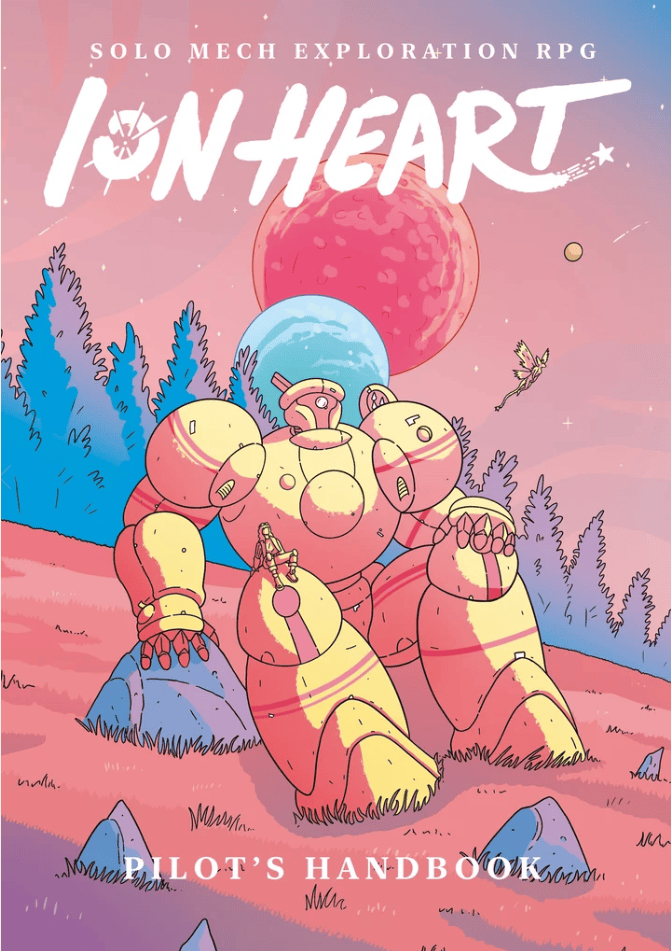
As you know, I’m a big fan of the power of solo gaming as a prep technique. And Ion Heart, a solo mech exploration RPG from Parable Games, has a structure for its missions that we can certainly re-skin for group games – and one that is especially suitable for one-shot gaming: Story Circuits.
While you’re reading this, I should tell you about my Patreon. Patrons get access to content 7 days before they hit this site, and the chance to request articles or content, for a very reasonable backer level of £2 per month. If you like what you read, want to support the blog, and have the funds for it, please consider supporting here. Telling people about the blog, and sharing links/retweeting is much appreciated also – thanks!
What’s Ion Heart?
In Ion Heart, you play a Pilot and their Mech exploring a galaxy where a long war has finally ended. The remains of this conflict still linger, but it’s generally hopeful – and there’s a real mixture of ‘cosy’ and ‘perilous’ missions for play. The system is really simple – as solo games often need to be – but the prepared missions are where it really sings; and they are structured as “Story Circuits.”
What are Story Circuits?
Each mission has a Start, a D6 table of Events (where often 6 is “pick one”), and a Finale. Your character begins at the Start, which often just sets the scene, and then plays at least 3 of the Events before moving to the Finale. Often the events hint at the finale, and the Finale is a more challenging scene for the player.
So How Does This Work in Group TTRPGs?
One of the most powerful structures for one-shot games in something I’ve called “The Swell” – you have a set start, an almost-set finale, and then a more loose arrangement of the middle scenes. Story Circuits follow this really well, with the exception that they really open up the middle section. The option to roll randomly is a nice way to not feel like you’re making stuff up on the spot, or the link between scenes can be driven by what the players want to see.
The design challenge is to make any of the 5 scenes in the middle accessible in any order. I’d recommend not worrying about this to start with, and then editing to make them more flexible; if you’ve got a sequence in mind, follow it before deconstructing it.
Want to see this in action? In the next post, I’ll share a fully worked example of how this structure can work for a one-shot. Have you used this structure before? Want to hear more about Ion Heart? Let me know in the comments!

