Gringle’s Pawnshop – a 13th Age Glorantha One-Shot adventure

Like all of our community, I was very saddened to hear of Greg Stafford’s sad passing. As just the week before I’d been running a ‘tribute one-shot’ to one of his classic adventures, it felt only right tidy it up a bit to share it here. Greg was the creator of Glorantha, which I’ve talked about here, and also (by all accounts – I never got to meet him myself) a thoroughly nice bloke – so many of the tributes to him have talked as much about how friendly and welcoming he was as well as his innovations in game design and worldbuilding.

Last weekend, at Furnace convention in Sheffield, UK, I ran three games of 13th Age Glorantha. I had planned to run two, but a few GMs had to pull out so I offered up another game in one of the slots. The first was Beard of Lhankor Mhy, for 2nd level PCs and published in Hearts in Glorantha 7 from D101 Games (along with the pregens). The second was a 3rd level one-shot, Into The Wasps’ Nest, where the PCs had to petition both the trolls of Troll Wood and the Wasp Riders of Wasp Nest to aid the Sartarite tribes.

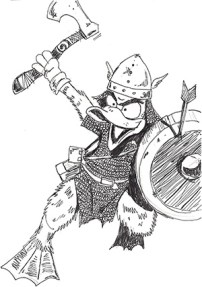
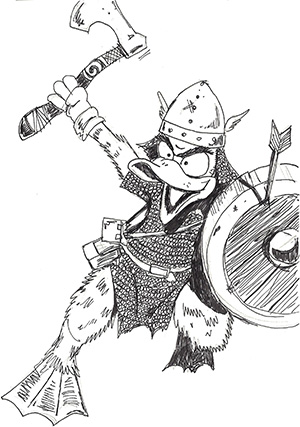
This was the third – an update of the classic Apple Lane scenario by Greg Stafford for 1st level 13G characters. I set it a month after the original adventure, when the PCs have to clear up after the last adventurers, and tried to make it a lighthearted pastiche of the elements of the first adventure. I trust Greg would see the funny side – I mean, he did invent Ducks, after all, so he can’t blame me for putting one in a tuxedo, surely? The adventure is also here as a .pdf if you want to print it out.

Gringle’s Pawnshop

A 13th Age in Glorantha Adventure for 1st-level PCs

Introduction

As your band of heroes wanders out in search of adventure, you seek out the Runelord Gringle, proprietor of his Pawnshop in Apple Lane. But upon arrival at the hamlet, you find it overrun by trollkin, with Gringle and his faithful Duckservant Quackjohn trapped in the Pawnshop. After rescuing them, they tell you of their problem – Apple Lane has fallen into ruin since the temple of Uleria was ransacked by a tribe of baboons. The priestesses have been kidnapped and taken into the hills – the players must rescue them!

Dramatis Personae

Gringle is a white-bearded man obsessed with his stock and the hoarding of magic items. A Runelord of Issaries, he enjoys nothing more than the hustle and bustle of trade, but this has all but dried up since the baboons ransacked the town. His collectors nature has, in fact, proven to be his undoing. A tribe of baboons returned last month to claim their stolen necklace of Toothsharp from the shop, easily dispatching the rookie adventurers Gringle had employed to guard it. So easy was the recovery that they also saw fit to set fire to the Tin Inn and kidnap the three priestesses of Uleria while they were at it, leading to his present predicament. Gringle is a pleasant fellow who speaks kindly to adventurers – but he dislikes getting his hands dirty, hence his propensity for hiring adventurers to do his dirty work.

Quackjohn is Gringle’s longsuffering duckservant. He speaks rarely, and when it is it is often to remind Gringle in weary tones of something obvious he has forgotten. He is usually clad in a worn and battered tuxedo. He has pulled Gringle’s neck out of more than a few scrapes, and grows weary of his time serving his eccentric master.

The three kidnapped priestesses are the true power keeping Apple Lane going. They have manged to ensure that the regular visitors to the pawnshop spent their money freely with the local businesses, and kept the bickering farmhands in line. It is no surprise that without them Apple Lane has fallen to ruin.

  • Avareen Bosom is a hard-nosed and fearsome woman, and the true leader of the town – a stern yet kindly woman in late middle age.
  • Pretty Aileena is indeed pretty, but also the shrewdest of the three. Gringle in particular has learned several times not to trifle with her quick wit.
  • Bingoood is the youngest, barely out of her teens but already possessed of powerful magic and a temper to match

Khochaz the baboon cannot believe his luck. A minor tribal leader, he has managed to not only reclaim his prized Toothsharp necklace but also capture three human females who he hopes he can ransom to the strange shopkeeper from the village. He’s good at leadership and keeping his crew in line, but less good on details like keeping close eyes on the hostages or making sure his baboons guard the camp properly.

Biglaugh Bigclub is the mercenary Khochaz employed to help him loot the pawnshop. He has stayed with the Baboons (along with Pinfeather, a duck thief) in order to try and double-cross them, and steal both the humans and the Toothclaw pendant. Both him and Pinfeather are neither bright nor brave, however, and are prevaricating over the best moment to escape with the prize – maybe when some heroes attack the Baboon camp?

Scene One – Apple Lane

As the heroes approach Apple Lane, they find it very different to what they expected. The Tin Inn lies in ruins, and the Temple of Uleria has been trashed. Print out and place one of the many available maps of Apple Lane into the middle of the table (there’s a good one in the RQG GM’s pack) and draw the destruction on with a sharpie. As they explore the town, they hear skittering and screeching – before a group of Trollkin ambush them!

There is one Dark Troll Warrior, Shuffle, and 9 Starving Trollkin Wretches. If the Dark Troll is killed, make a Save for the remaining Wretches – they will attempt to flee. If you have fewer or more than 5 players, add or subtract 3 trollkin per player. Their statistics are in 13G p295.

Scene Two – Meeting Gringle

As the scene clears and the trolls and/or trollkin flee, a white-bearded man emerges from his ruined Pawnshop, followed by an elderly duck in a tuxedo. He introduces himself as Gringle, and states that he was just about to deal with the trolls himself using his “powerful Issaries rune magic.” Quackjohn rolls his eyes and coughs politely.

He explains the situation – Apple Lane is in a sorry state, and he is forced to admit it is since the priestesses were captured. He had acquired a necklace of Toothsharp through perfectly legal means, but the tribe of baboons who claimed it decided to raid his shop. Thinking it prudent to employ some protection, he employed a group of adventurers, who failed so poorly at defending his shop that the baboons (and their allies, who were led by a centaur) then set about looting the town and carried off the priestesses.

If questioned about where he was with his powerful magic while this was going on, he was involved in an important Issaries ritual in the basement of his shop, which also required Quackjohn’s attendance. When he emerged in the morning he was dismayed to find that the adventurers had fled, leaving him with a disunited village, many of whom started to flee to neighbouring towns since their protectors had so abandoned them. The troll raids started shortly afterwards.

He implores them to rescue the priestesses – he knows that the baboons tribe will be in the hills to the southeast, towards Highwyrm.

Scene Three – The Journey

As the heroes set off on their journey, and they have the directions from the adventurers who sold Gringle the Toothsharp necklace. Play this scene as a 13th Age montage – each player in turn narrates an event on the journey. Begin by narrating their first obstacle as they set off – the bridge across the river to the foothills has been cut by the trollkin as they ransacked the village, and they now stand at one bank of a mighty rushing river. Pass to a player who narrates how the party manage to overcome the obstacle – add a twist yourself if you wish to, to remind them that they are entering the wilderness and that chaos is afoot – and they then narrate the next obstacle. Proceed until every player has taken a turn – further examples of this are in the 13th Age GM Screen pack.

In your twists as GM, play up how dangerous the terrain is and add in any additional monsters just to add to the peril – they are venturing into dangerous mountains. The hills should gradually turn into mountains as they approach, until they come across the Baboon’s camp, nestled in a rocky valley and well defended.

Scene Four – Baboon Camp

The Baboons have taken up their camp in an old abandoned Dragonewt temple. The Baboon camp is as well-defended as it can be by a tribe of semi-sapient monkeys. Bigclub has attempted to organise some sort of watch system, but he knows he might need to sneak out one night so hasn’t bothered too much when the Baboons keep wandering off and losing interest.

As the players approach, they can see the chaotic attempts at guarding, and there are many opportunities to formulate a plan; judicious use of runes may work here. The baboons guard in pairs before they inevitably begin to wind one another up and fall about fighting or arguing, before Khoshaz jumps on them with his big stick to whip them into line.

If you like, sketch a map of the area and allow the players to think about their approach; any reasonable plan should be able to give them the advantage of surprise, or of not having to fight all the Baboons at once, particularly if the players make judicious use of runes.

If they vacillate, have matters come to a head for them. As they watch, a patrol of Baboons spots them, and a round later, they see Bigclub and Pinfeather attempting to carry the priestesses off.

There are a total of 10 Baboon Troopers from 13G p244, plus the NPCs detailed below.

This is a double-strength fight, so could be dangerous for the PCs if they don’t have their wits about them. There are a few ways to manage this

  • If the players are finding it too easy, more Baboons rush to their fellow’s aid – add an extra three Baboon Tribesmen
  • If they look to be finding it hard, allow Avareen breaks out of his bonds and runs across to them. A glow of love suffuses the battlefield, and all involved can heal using a recovery; this may also cause Bigclub and/or Pinfeather to be occupied for the next round chasing after her and re-capturing her


Khochaz, Baboon Leader

2nd level leader

Initiative: +8

Long spear: +8 vs AC – 5 damage

Natural 16+: Other baboons gain a +2 damage bonus against the target until the end of the battle

R: Sling +8 vs AC (one nearby or far away enemy) – 5 damage

Surviving: When an attack hits Khochaz and he’s staggered, roll a normal save. If it succeeds, it hits the other baboon instead.

AC 18                     PD 17                     MD 14                   HP 40

Bigclub, Centaur Raider

3rd level troop

Initiative: +9

Charging Lance: +9 vs AC – 12 damage, and the target pops free from the centaur

Hit ‘em hard: The crit range expands by 2 (18-20) and instead deals 16 damage on a hit if Bigclub first moves before attacking a new enemy

Natural 18+: The target is also dazed (-4 to attack) until the start of its next turn

Big Club: +8 vs AC – 10 damage

Natural even hit: Bigclub can Kick as a free action

Kick: +7 vs PD (1d2 enemies engaged with Bigclub) – target takes 4 damage and      pops free from Bigclub

Harnessed speed: +4 AC bonus vs opportunity attacks

AC 19                     PD 16                     MD 13                   HP 48

Pinfeather, duck thief

3rd level archer

Initiative: +9

Daggers: +9 vs AC (two attacks) – 6 damage

R: Shortbow +11 vs AC – 8 damage

Natural even hit or miss: Pinfeather can make a second shortbow attack as a free action

Quick shot: When Pinfeather is unengaged and an enemy moves to engage it, roll a normal save. If successful, Pinfeather can make a Shortbow attack as a free action just before he is engaged

AC 15                     PD 14                     MD 11                   HP 46


Scene Five – Victorious Return

The heores can now escort the three priestesses back to Apple Lane. Once their equipment is recovered, they cast a ritual that returns them to their temple; and as they harness the power of the Toothclaw necklace to do so, it crumbles into dust while the walls of the temple are rebuilt.

The find Gringle in good spirit as they return – he had found a few charms in his store, and has set about rebuilding the Tin Inn – riding into town is Bulster Brewer, the landlord, who says that now the baboons have been defeated he plans to reopen. He reckons there are still a few barrels in the cellar that should be good, and opens them while the players, Gringle, Quackjohn, Avareen, Aileena, and Bingoood drink to celebrate Apple Lane’s return to prosperity!


The Training Mission – Blades in the Dark One-Shots Part 2

Welcome to the second part of my thoughts on running Blades in the Dark as a one-shot game.

In Part One, I talked about using a structured Training Mission, similar to the introductory levels in video games, to introduce the game in the first half of a one-shot. Here, I’ll talk about the changes to Downtime and the transition to the second mission.

Payoff, Heat and Entanglements

Once the first mission is finished, give the PCs their payoff – be generous, and make sure that you describe what it looks like, since the Coin descriptor is arbitrary for new players to Blades – a couple of heaving chests of coins and a bracelet you can hawk to Mordis in the Night Market is much more rewarding than just “4 Coin”.

The next time I run Blades, I’m going to have a bowl in the middle of the table for Heat with counters for the expected amount of Heat for the mission, and add to it as complications and devil’s bargains occur – but I’ve found that for the first mission Heat can be quite tricky to engage with. Still, roll for Entanglements from the Heat generated, and be prepared to be brutal in interpreting it; it’s quite possible in the first mission that PCs still have plenty of Stress left, so giving them some heavy Entanglements gives them something obvious to do during Downtime.

Downtime

Between the missions I run a simplified “Training Downtime” that just gives the players a taste of the mechanic. The reasons for this are twofold – firstly, in an ongoing campaign downtime can bloat to a very enjoyable, but time-consuming, player-led exploration of the factions and setting of Duskwall. Secondly, the players haven’t had chance to make much trouble yet, so they are unlikely to have many schemes of their own to accomplish. As with any one-shot, we want to avoid players wandering around aimlessly, so this shortened version allows the players to achieve their goals and have some agency while still keeping it moving; I aim for 30-40 minutes for Downtime, and then take a break and introduce the next mission. My modified one-shot Downtime rules are below.

In Downtime, you can pursue one action from the list below. This is a change from RAW Blades where each PC gets two actions, but don’t worry, you’ll be generous with some of the actions. A couple of them have changed as well – since starting a Long-Term Project in a one-shot is a bit dissatisfying.

  • Indulge Vice: As the regular Blades rules. If anyone overindulges, either add an additional entanglement (if there are players left to take their action, since this gives them a chance to overcome their crewmate’s actions) or add Heat to the next score.
  • Work on a Project: This replaces the Acquire Asset and Long Term Project actions from the regular Blades rules. Ask the player what they want to achieve, checking it fits with the fiction, and start a countdown clock (in almost all cases, I’d make it a 4-segment one, to give them a good chance of achieving it in this downtime). Progress is as the regular rules on the roll of a Trait (1-3: one, 4/5: two, 6: three, Crit: five). Other players can also work on already started projects, rolling an appropriate trait and adding sectors as above. This allows the players to work together to achieve projects during Downtime and have them take effect during the one-shot.
  • Recover: If anyone needs Healing, they can choose this option as per the regular Blades rules
  • Reduce Heat: It’s unlikely that players in a one-shot will be careful enough to want to keep their Heat down, but they can do using the regular Blades rules.

You’ll notice that there’s no Train option. This is because there are a few options for experience in one-shot Blades games that I have yet to explore and will explain below.

The Next Mission

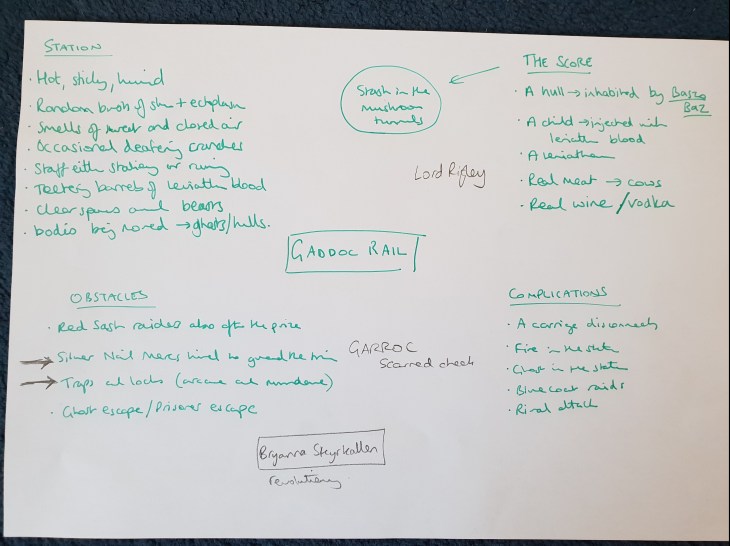
notes for Gaddoc Rail

My notes for Gaddoc Rail – pencil were added during play

After Downtime is done, take a comfort break and introduce the next mission – this is a regular mission, but be sure to reincorporate any established facts about the setting – use NPCs already established and factions already introduced.

In terms of prepping for this mission, I like to keep it as loose as possible – I write four lists:

  • A list of descriptors of the main location of the mission. For Gaddoc Rail, this is the station itself, but it could be the base they are infiltrating, the party they have to explore, and so on.
  • A list of options for what the score could actually be / any opponenets. For Gaddoc Rail, since what you are stealing is not defined, this was examples of what it could actually be.
  • Obstacles – all the possible obstacles I can think of to oppose the PCs during the score
  • Some possible Complications. In the past I’ve found this the hardest part to prep, but I’ve got a lot better by not dismissing obvious suggestions – sometimes the obvious thing is the best

With these four lists, I have plenty of options to draw from when the players look at me expectantly. It also makes it much easier to pace the game in a one-shot, since I can use as many or as few as I want to make the score enjoyable but keep to time. I’ve used a similar approach in lots of PBTA games, and talked about it in a post here, and it’s a really useful one-shot technique.

Gaddoc Rail map

Gaddoc Rail station map, mid-score – spot the “Explosion” Complication

XP and Training

I’ve not had chance to explore/hack the XP system in Blades for one-shot play, usually because I always forget about it – and there’s quite a lot for players to get their heads around anyway, but if I do, these are the options I’d explore

  • Just ignore it. There is no experience or advancement. This, the default, is what I’ve generally used
  • Use it as in the Blades rules. It’s very unlikely that you’ll get any advancement in the session, but that keeps it simple, and prepares the players for the full system. It also makes it easy to transition to the regular Blades. If I used this, I’d give everyone a bonus “Train” action in Downtime, giving the 1 XP to an attribute of their choice
  • Hack it for advancement. Start everyone with 2 XP marks on each XP track, and double all XP awards – 2 XP for each Desperate roll, and 2 XP for Training in downtime. It’s up to you if you give the bonus Train action, but if I’m going to the trouble of this, I might well. With this, a few of the players will advance during the one-shot

In summary, while Blades is a fantastic campaign game, it’s also a lot of fun in a one-shot setting; as I stated in the first post, I’ve managed 3 scores in a 5 hour session using these guidelines and it certainly felt like the players engaged with both the rules and the setting – they achieved quite a lot in-game in those three scores. For further reading, check out the Forged in the Dark games which are emerging using the same rules set. There’s far too many of them to try them all, but I can certainly recommend Scum & Villainy for Star Wars-style “ashtrays in space” space opera.

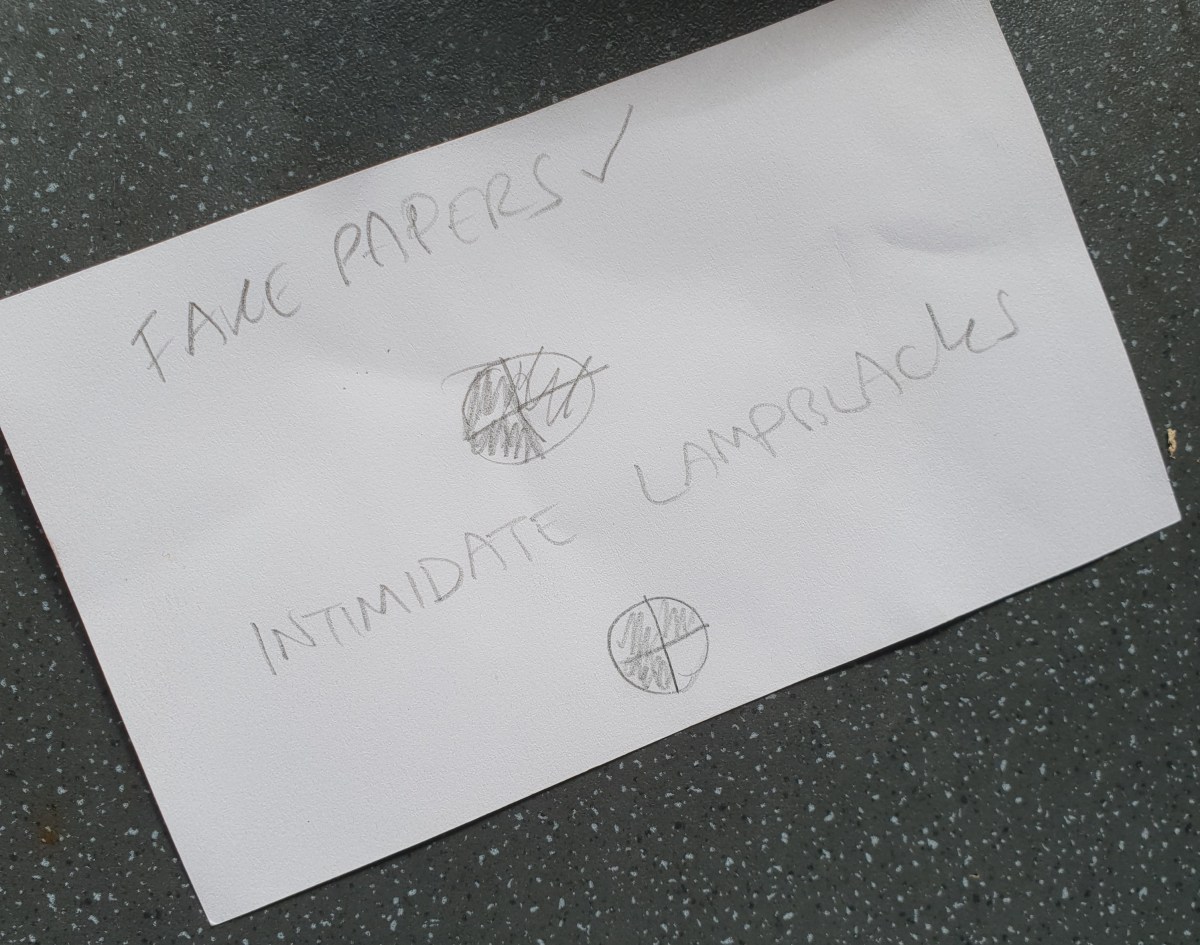
"Fake Papers" and "Intimidate Lampblacks" countdown clocks

The Training Mission – Blades in the Dark One-Shots Part 1

I’ve been working out how to run Blades in the Dark as a one-shot for a while. The first couple of games I’ve played/run managed to get through character and crew generation, and one score, in the 3-4 hour session, and while that was a great introduction to the game, there were a few things I wasn’t sure about with that

  • character generation is fun and exciting, but crew generation is often not; players negotiate awkwardly with each other and the sometimes over-think choices
  • the setting needs to be explained quickly and concisely
  • factional interactions (in crew generation and after the score) take too long to explain and monitor
  • the pattern of score – downtime – score is a key rhythm of longer-term play; it seems a shame to neglect downtime entirely in the one-shot

With this in mind, I set about working out how to give a satisfying one-shot experience. I used to run a lot of Mouse Guard, which has a similar turn structure, and I used to make sure that I did a GM’s Turn (where they completed the first half of the mission – often this started in media res and there was little chance to prepare or negotiate approaches), a Player’s Turn (where they tried to recover from conditions, and planned for the next mission – which they had a fair idea about from plot threads in the first section) and another GM’s Turn – a more player-led mission where they might have to assemble allies or negotiate approaches, with multiple means of resolution.

With that in mind, my Blades one-shot structure now looks like this

  • Players pick playbooks from a restricted list
  • GM introduces Crew sheet and abilities (already picked, but without a name / hideout)
  • Players play “Training Score” – Race to Gaddoc
  • Downtime activities – simplified and quick
  • Players play a full score – either the starting score or one of Sean Nittner’s scores – I’ve used Gaddoc Rail a couple of times

Does it work? Well, by beginning with a simple score, the players get a chance to learn the ropes of the system and what approaches they can use, which makes the second score much more straightforward – they risk stress, use flashbacks, and really invest to make sure it works. I ran it at Go Play Leeds recently and we managed another score after Gaddoc Rail – which was short and sweet thanks to some really good rolls, but it still gave a sense of progression to the game beyond the “one score and out” approach I’d used previously.

For the playbooks, I reduce the choice to just Cutter, Hound, Leech, Lurk, and Slide – the other two are a bit ‘weird’ and can be a stretch to get the players involved if they aren’t going to stretch it themselves.

The crew are Shadows – probably the easiest crew sheet to get in with – I put the crew sheet down, tell them after the first mission they’ll have a name for themselves, and tick the first Special Ability – Everybody Steals – so they all get an extra dot in Finesse, Prowl, or Tinker.

For the training score – Race to Gaddoc – I have some pre-prepared scenes based on what playbooks have actually been selected. I don’t have to use all of them, but enough to make sure everyone has enough spotlight time – they are pitched at one of the playbooks in particular, but there’s no need for that person to necesarily resolve the issue. The scenes are below (a .pdf with all of the details in one place will be linked in Part 2 when I post it next week).

Race to Gaddoc – A Training Score

  • Explain the starting situation – as a gang of ne’er-do-wells out to make a name for themselves, they have been asked by Lyssa, new leader of the Crows, to transport a rare case of Iruvian Brandy across the city to the Railjacks Guild at Gaddoc Rail. The problem is, she obtained this Brandy by stealing it from the Red Sashes, and the Bluecoats are looking for it as well, so this won’t be an easy task
  • Explain that this is a Transport task, and ask them for their Route across the ciry – they can choose to go by the alleyways and side-streets, or by the rivers and waterways, or they can try and disguise themselves as respectable merchants
  • Don’t allow too much planning, but they need to pick their Load based on the approach chosen
  • They make their engagement roll: 1d for luck, and if they have added anything to the approach which is useful, they get +1d for a better plan. They can also add in their friends or contacts if that’s relevant for +1d (only one friend can be involved)
  • Randomly select who rolls the engagement roll – unless somebody wants the responsibility
  • On a 6, it’s all going swimmingly until the acts below happen – their rolls will generally by Controlled to start with
  • On a 4-5, there are complications – rolls will start at Risky
  • On 1-3, it’s all going wrong – rolls begin with Desperate
  • Select encounters based on the Playbooks chosen as below

 Cutter

  • As they turn a corner in an alley, there are two heavies from the Lampblacks there – they wanted this job, and don’t see why they shouldn’t have got it rather than these upstarts.
    • Controlled: they’ve got their backs to you and are talking about the problem,
    • Risky: you see them sizing you up, threatening you – maybe they can be reasoned with, or at least surprised?
    • Desperate: there’s a knife at your throat before you know it and a threat in your ear. They’ve been tracking you since you left the Crow’s old watch tower hideout
  • Results of failure are likely to be Harm! Either way, they should escape to continue the mission. Also, use the level of success to determine the position for the next roll – if it’s successful, the next roll is likely to be Controlled or Risky, if it’s a failure, it might well be Desperate, and use the fiction to snowball into this

Hound

  • As you round a corner towards your goal, you can see the Red Sashes are tracking the route to the station – there are sharpshooters on the rooftops around the alleys or waterways, and you can see their Iruvian bows glittering in the breeze
    • Controlled: They are patrolling, but haven’t noticed you yet – they should be easy pickings
    • Risky: As above, but you can see they’re watching one another as well, tracking the alley/road/canal you’re coming down – and it’s too late to turn round, and carry alarm whistles – you’ll have to take them out quickly
    • Desperate: One’s looking straight at you, whistle in his mouth and bow at his shoulder about to shoot
  • Results of failure could be Harm, or to start a Red Sash Alert! Clock (4 sections) that can be filled in by future rolls. If it fills, they’ll have the full force of the Red Sashes waiting for them at the Railjack Yard and have to fight their way through

Leech

  • You’ve found the perfect short-cut – just around this building and you’ll have it, you can walk right through the main square without ducking round. But you’ve got an array of construction apparatus blocking your path – maybe it’s time for a little engineering to get through it?
    • Controlled: As above – there’s a web of rickety scaffolding around you, that need disassembling quietly and safely so you can proceed
    • Risky: The scaffolding is rickety and groans as you touch it – and there are construction workers just around the corner moving around – you’ll have to work quickly
    • Desperate: With a sickening crunch your cart is pinned beneath the web of a scaffolding link. There’s a commotion above and you can see hard-hatted engineers making their way towards you to investigate
  • You could start a Bluecoats clock as a result of failure as they are alerted to you, or fill in another clock

Lurk

  • The area of Nightmarket around the Railjack’s yard is crawling with Bluecoats, Red Sashes, and everyone else from Duskwall. You’re going to have to sneak past them to get in – maybe use the rooftops, or the sewers. This is a good opportunity for a Group Prowl roll.
    • Controlled: They are milling around, but they’re not looking for anything in particular – could be you could sneak past in plain sight
    • Risky: They know a shipment is coming in from the Crows and what it is – the case has been reported missing, and there are sniffer dogs around who have the nose for brandy
    • Desperate: They are looking for exactly the group that the Crew represent. It’s rooftops or sewers, or there’ll be trouble.

Slide

  • The Railjack‘s yard is surrounded by customs officials – they’ve had a big shipment of blood in and there’s no way at all that the players can come in for business, or otherwise
    • Controlled: It should be a simple matter of showing your papers though?
    • Risky: There’s Bluecoats and/or Red Sashes moving around as well, talking to the customs men – depending on the state of the clocks
    • Desperate: Behind the man is a hastily-sketched likeness of your Cutter, for this or a previous crime
  • After this, they can deliver the Brandy and update the crew sheet – give them +1 with the Crows and the Railjacks, and -1 from the Red Sashes and the Bluecoats. Take a break!

In Part 2, I’ll talk about the changes to Downtime to make it quick and easy, and how to transition to the second score.

13th Age Pregens and Resources

After my last post, I had a few requests for examples of the pregens that I’d used. Although there are loads on the Pelgrane 13th Age page, it’s always worth having some more at appropriate levels, and I’ve got a couple of examples here.

For both sets of pregens I’ve not included spell lists – when I’m running I print out the relevant pages of the SRD for that level of spells for the character.

crown-commands-coverThe first set are 5th level – I used them for a one-shot of Gearwork Dungeon, a Battle Scene from The Crown Commands supplement. As that’s a Dwarf King-based adventure, this set are particularly focused towards dwarfs and their allies.
5th Level Pregens

The second set are 2nd level and for a series of one-shots I ran in Greyhawk, the classic setting of original D&D. I’ve included my not-very-thorough notes on PCs in Greyhawk – just replacing the Icons with some of my favourite Greyhawk deities.

2nd Level Greyhawk Pregens

13th Age in Greyhawk

Pregens are always useful, both to use in one-shots and also to get a feel for the system. I’m thinking of gathering all of mine in one place (not just for 13th Age – for all sorts of systems), and maybe getting contributions from others, to have a big repository of them that people can use for their own games – if that’s something you’d like to see, comment on here or on social media and I might get round to doing it!

13th Age One-Shots

13th Age coverI run a lot of 13th Age One-Shots; I like the balance of narrative player-led stuff and tactical combat. But it is a pretty crunchy system that can take some getting used to – especially if your point of reference is D&D – so here are my top tips for running it at conventions
By the way, if it’s 13th Age in Glorantha (13AG) you’re planning on running, you might want to check here for my advice on running Glorantha one-shots. 13AG is slightly crunchier even than regular 13th Age, so you might want to start by running a one-shot in the Dragon Empire before you encounter the brain-melting exceptions of Storm Bull Berserkers and Tricksters.

It all starts with the pregens

With any crunchy game, how you set up the PCs can make your job much easier. I tend to use this array for attributes, and pre-calculate the bonus+level for my players – and explain in my quick tour of the character sheet that the bonus+level is what you’ll be rolling.

I fill out One Unique Things, but give players license to change them at the start of the game. I know that there are lots of one-shot GMs who ask their players to pick them, but I’ve found that this can leave players confused by the wide range of options. So I pre-populate them, and tell them they can change them, and usually one or two players will.

For Backgrounds, I half-bake them; I give each PC 3 points of Background in a broad, narrative skill (like “Dragon Pass Wanderer,” or “Smartest Elf in the Room”) and let them assign the remaining points however they want, at the start or even during the game. Again, Backgrounds can be picked completely by the players at the table, but they often just aren’t that big a deal in 13th Age One-Shots, so it’s often not worth players worrying too much about them.

I add on any descriptions of powers on the character sheets, either paraphrasing them in as simple language as I can manage or cutting and pasting from the SRD. Most of my prep is spent getting these pregen sheets ready, but that’s no problem because 13th Age is very player-facing in its complexity; most of the tactical heft and rules exceptions are carried by the players.

…and carries on with the pregens

I tend to go low-level with my 13th Age games – level 1-3 is a good level for standard heroics, and even 1st level characters have plenty of tactical options. For higher levels (and I have run as high as level 5) I’ve combined a few optional rules for damage – I let players choose to either inflict average damage with their weapons or flip a coin for max/min damage with each hit. I make Crits work exactly the same – they can choose when they roll a crit whether to double average, or flip a coin to risk it. I add a “Damage Track” under any attacks on the sheets that looks like this:

Damage Track: Average 26, Coin Flip 48/13, Miss 5

It’s worth taking care at the start of the game when you hand out the pregens. Some classes are significantly more complex than others, and it’s a good idea to be open with your players about this. I never say that they need to have played the game before, but if they are playing a Bard or Sorcerer they’ll need to be up for engaging with some rules to make the most of their characters in ways they won’t have to if they are playing a Barbarian or Ranger. I also try to remind them the Fighter is towards the more complex end of the scale, because it can sometimes still be seen as the easy option – which in 13th Age it definitely isn’t.

Get your kit out

escalation die

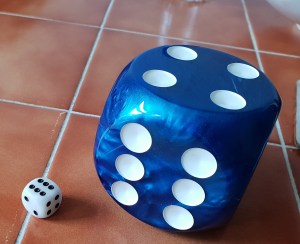
my escalation die – normal-sized d6 for scale

Central to 13th Age is the escalation die, a d6 that goes up every round and gives the PCs bonuses to attacks. It’s a great device for pacing battles, and it’s such a simple idea that it can be easy to forget to update it at the start of the round. My solution is to get a BIG d6. Mine is pictured here – it’s 7cm on a side and weighs about a pound, and it’s not easy to ignore. It wasn’t cheap, but you can get big foam dice cheaply, or just a whiteboard to write the bonus on – bear in mind that if you have a Trickster PC in 13th Age in Glorantha they sometimes get to roll the escalation die so you might want it to be an actual die.

I avoid maps for 13th Age – it’s loose range band system doesn’t use them, and they can actually discourage the kind of freeform swashbuckling action that works so well in the game. Non-gridded maps, like those that come with the Battle Scenes, can be useful, but even with these I’d be reluctant to let my players put figures on them – they are much more about a feel for the location rather than precise locations.

For Icon Relationships, I like to write them out onto cards and give them to my players after rolling – either plain index cards or these dry-wipe ones from All Rolled Up. Giving the relationship rolls on cards encourages the players to “spend” them during the one-shot, and that they won’t forget them. I usually give my players the option of spending at the start of the session for magic items or boosts (and prep a few ideas about what these might be) but also keep them for interventions in the game. I’m super loose in what they can get with them, trying generally to say “yes” to anything that sounds cool – this is a cinematic action game after all. (For Glorantha, the same applied to Runes, although they can’t spend them at the start of course).

Use a Montage

13th Age GMs screenThe montage technique is absolutely brilliant in a 13th Age one-shot, adding a sense of the epic and letting you fit much more ‘plot’ into your one-shot, so it makes it a satisfying game. There’s a brief summary of it from Pelgrane’s Wade Rockett here, but there are more details in the GM’s Kit – which is probably the most useful resource you can get if you plan on running 13th Age one-shots a lot, even more so than the Bestiary.
Even a basic dungeoneering adventure can be improved with a montage – and I’ve used it exactly for that, the party battling the initial guardians of a ruin and the montage-ing their way through the twisted tunnels and subsidiary monsters until they run up against the big bad at the end. In my module The Beard of Lhankor Mhy for 13AG the entire journey across Snake Pipe Hollow is run as a montage – and for me as a writer, it was a good workaround for covering an iconic part of Gloranthan adventuring lore without stepping on canon. In play, the Glorantha experts can go to town introducing whatever chaos monsters they like, and coming up with inventive runic ways around obstacles.

There’s Loads of Stuff

There really is. All the organised play adventures are excellent either to use or steal, and unusually for published adventures are actually easy to use in play. Oh, and they’re all free. There are lots of published adventures, including the Battle Scenes which contain short adventures based around the icons. All of these are very easy to steal or borrow set-pieces from, and literally a couple of these and a montage (and maybe a couple of interesting NPCs to interact with) and your one-shot is prepped). You might spend a while planning the pregens, but the rest of your prep should be fairly straightforward.

Enjoy! I think 13th Age is a great game for one-shots, and a game I keep coming back to again and again. Because the players come up with so much narrative, different games can give surprising developments which is always a nice feeling as a GM.

Gloranthan One-Shots – Ducks, Broo, and Basket-Weaving

I’m a relatively new convert to Glorantha, Greg Stafford’s legendary mythic fantasy setting, having come at it from 13th Age in Glorantha (and an extremely fun Heroquest campaign run by Newt Newport of D101 Games). It’s a big setting, and quite distinctive, and it carries with it challenges for the one-shot GM. To explore the history, the culture, the excitement, without the game turning into a mythology seminar, is a challenge.

Choose Your (Bronze) Weapons Wisely

Crontas-The-Duck-for-Web

Crontas the Duck, true spirit of Glorantha, by John Ossoway

There are now a wide range of systems available for your Glorantha game. If you want a high-falutin action game of mythic heroes, I’d suggest Heroquest Glorantha (HQ) or 13th Age in Glorantha (13AIG). The former is rules-light narrative – of the sort that can turn off a particular kind of trad gamer; the latter is D&D-esque rules-crunchy narrative. In either case, you can expect to put some players off with your system if you’re running at a convention – but you always run this risk. I have run 13AIG for at least one dyed-in-the-wool D&D-hater and they loved it, so you never know.

If you prefer proper trad, you want to turn to either RuneQuest Classic (RQC) (which is an old-school game in the truest sense, a reprint of an old edition from back when Hit Locations were the new shiny thing) or Runequest Glorantha (RQG) (the latest Chaosium release, which walks a tightrope – largely successfully, although I am working my way up to a review here – between old-school hit location simulationism and mythic rune-channelling excitement). RQG feels a lot like an old-school game redesigned to work in this day and age, and it’s no bad thing for that.

My own one-shot preferences veer toward 13AIG or HQ, but that’s because I like high-action, resilient heroes, and am not very good at running games where combat can end quickly with a lucky roll and a severed limb. Whatever you’re running, be sure to use the rules to inform the one-shot – 13AIG works best with set-piece battles like any other 13th Age game, whereas RQG and RQC work best where combat is possible but avoidable, and the players have ways to use clever play to mitigate the awful risks of adventuring through using their cunning.

Stick a Myth on It – the Backstory is the Story

I have a tried-and-tested method for Glorantha adventure / one-shot design. Design a normal fantasy one-shot, then write a myth from the old times of the Gods that relates to it. Add in references and throwbacks to that myth with a heavy hand, so that towards the climax of the adventure the PCs could almost be following that very myth, and proceed as usual.

Think of it in comparison to a ‘standard’ D&D adventure – you might explore an old ruin full of goblins, to discover the evil sorcerer who has gathered them around him. In your D&D adventure, you might have that the ruin was built by an ancient civilisation, and throw in weird frescoes on the walls of the ruins, living quarters, suggestions of the previous occupants.

In Glorantha, the previous occupants, and the history of the ruins, should be up front and personal in every room. It won’t be goblins, of course (broo?), and the sorcerer might well be possessed by the spirit of one of these ancient builders when they meet him. As they venture deeper into the ruins, they will almost come alive again for them, as if the civilisation lives again and they are exploring it anew.

Use the Cool Stuff

There’s a lot of  very cool ‘stuff’ in Glorantha. Disease-ridden chaos broo, Jack O’Bears with maddening gazes, gorps, those weird humanoid tapir things – even ducks! If you’re running a one-shot, try and add a few of these in to your game to make it feel more ‘Glorantha.’

And a note on the Lunars – the Roman/Persian-ish civilised invaders who are often the default human enemy. Try to make them simultaneously sympathetic (as fellow humans just like the PCs) and disturbingly alien (with their strange sorceries and cities). In all those other fantasy RPGs, the PCs are the lunars, fighting the strange barbarians with their shamans and weird rune rituals.

Source Some Resources

HIG7-Front-Cover-web

HiG 7 cover by Stewart Stansfield

When I first started getting into I joined a G+ forum about it, and the first query that hit me from it was a question about dentistry in Orlanthi culture. I kid you not. My innocent query about a good introduction to general Gloranthan culture was met with a recommendation to read a long-out-of-print supplement. Glorantha used to be, relatively speaking, inaccessible.

This is not the case now. Chaosium’s website has links to not only all the games above, but a wealth of supplements, some of which focus more on playable adventures and less on dentistry practices. Chaosium also have a great presence now on forums and social media – questions on their Facebook group often get answers from the game designers, for instance, so it’s easy to engage with them.

The single publication that made me ‘get’ Glorantha was Gloranthan Adventures 1, from D101 Games. It is a selection of short one-shot adventures for HQG, and an in-depth article on writing Gloranthan adventures, all of which serve to demystify the setting and put it in terms that a novice can understand. My other formula for prepping Gloranthan one-shots is just to run or adapt one of these adventures, if I’m honest.

And finally, you’ll forgive me for plugging the writing that inspired this post. Available for pre-order, and highly likely to be in print before the game it’s written for, my own adventure The Beard of Lhankor Mhy is published in Hearts in Glorantha 7, a fanzine from D101 Games. It’s a straight-up 13AIG adventure for 2nd-level heroes that tries to bridge the standard fantasy one-shot with the mythic, and it even comes with a set of pregenerated Orlanthi characters. So snap it up!

Tenra Bansho Zero One-Shots

TenraIt’s been a long time coming, but I finally got my head around running Tenra Bansho Zero, an RPG of hyper-Asian fantasy lovingly translated from the Japanese by Andy Kitkowski. It’s a beast. But an awesome, gonzo, emotionally charged beast, like a Kaiju with laser cannons being ridden into war by your long-lost son to avenge your disappearance. The path to bringing this to the table wasn’t painless, but it was worth it. I hope any prospective GMs are persuaded to give it a go with the advice below.

Pregens all the way

You need to pre-select (or let your players pre-select) their characters. I recommend using the sample characters in the book, unless you have a very specific archetype in mind for your plot; I made this one-sheet for my players to help them pick. Reassure your prospective players that they’ll get to evolve and customise their character in-game, so starting with templates isn’t as restrictive as in other games.

Don’t use the Onimyuji – it’s just too complex to have a shiki-summoning sorcerer in the party unless they already know the rules – in which case, why aren’t they running the game?

My players picked Samurai, Kijin, Shinobi, and Kugutsu – a good balance, and easy on the rules – I filled in character sheets with their abilities and printed off the Dark Arts section for the Shinobi to manage, as they can buy extra powers in-game and it handed over management of those rules to the player instead of me.

Incidentally, for NPCs I just used the sample characters too, adding 2 to each Attribute and the extra Vitality described (double it, add 2 per player in the game, or 5 per player if they are a solo boss, add a Dead box but no Wound boxes).

Get your stuff together

You will need piles of d6s. You will need piles of counters, or paper chits, for Aiki and Kiai. I was lucky and found a few in the sale at Dice Shop Online; otherwise improvise, but bear in mind it’s not an exaggeration to say you might need 100+ Kiai chits, and players may well find themselves rolling 30d6+. I put my Aiki and Kiai out on All Rolled Up dice trays in the centre of the table to remind the players that they should be awarding them.

There are some really useful rules summaries out there, and I found some other advice on the internet (this, from Deeper In The Game, was really useful); print them out and use them, and expect some hard-to-find rules – for me, it was how quickly Soul points recover (it’s one point per hour, FYI).

Keep your main plot simple

You only need a straightforward plot for Tenra. Use the examples available – Tragedy in the Kose Art District is good, as is Lotus Blossom’s Bridal Path – which I don’t seem to able to find online now. Honorable mention to Rinden Snarls, which I played to get me into running it – quite a few years ago now. I’ll be writing up the scenario I ran soon too, expect to see it on the download pages in a few days time.

I went with a basic Seven Samurai plot; a village was under threat from bandits to the East and a warlord from the West, and had called to neighbouring provinces for help. Each of the PCs was a representative from one province, brought together to help the village. I added a nearby Oni village, a treacherous villager, and a forest demon who had corrupted the lands nearby and subjugated the Ayakashi river spirit who guarded the village.

Think symbolism and theme; I had cherry blossoms running as the theme of the village, and they reappeared at the end of each act – either falling or blooming in the trees. Corny, but it worked.

Prep Zero Act

In the Zero Act, every player should get to showcase their PC, and it’s a good opportunity to roll on the Emotion Matrix, which is going to provide all the subplots you need. I picked the zero act from each of the sample characters that I found most melodramatic, and we rattled through them with an encounter with an important character, a roll on the Emotion Matrix, and a fade out once that conflict had been resolved (or left juicily hanging!)

I deliberately didn’t use the PCs being recruited as the zero act for any of them – this was entirely about establishing their characters as protagonists, not introducing the mission. My Destinys were much more about the characters than the mission itself.

The Rule of Reincorporation: Chekhov’s NPC

This is a specific case of a general one-shot rule, which will no doubt spawn its own blog post, but any NPCs that appear in the Zero Act need to reappear during the game, unless they are boring and/or dead (and even dead ones might reappear).

The warrior who defeats the samurai and leaves him for dead, inspiring him to undergo the painful samurai transformation? Of course they will be on the antagonists’ side in the final conflict. These call-backs are essential to make an epic story feel fully-resolved.

Scene One (and Two)

I’d recommend having the players meet gradually as your first scene. That way you can roll the Emotion Matrix each time a new PC arrives and have a pause for them to roleplay and internalise these relationships. Be aware this may create some (temporary or otherwise) PvP situations – and require some interpreting of the results.

As with most of my one-shots, I made scene two a ‘training combat’ – straightforward opposition that let the players get to grips with the rules and allowed a break in the scene pattern below.

Two Types of Scene

You will have scenes that are epic combat, where dice will hit the table. You will have scenes of roleplaying, where players will push their Fates. In the roleplay scenes, in my experience, dice rarely hit the table. All you need to do to get the pace right is have a good balance of these scenes. During the roleplay scenes, it’s fine to sit back and watch; if your players are chewing the scenery with each other (and the Emotion Matrix will no doubt push them to do this), let them do it.

With roleplay scenes where they were petitioning an NPC, I usually waited until a key moment in the conversation happened, cut it off, and asked for a Persuasion check (or other social skill). Be prepared for the players to make these rolls easily – they are rolling a lot of dice, and if it’s a roll they care about they have lots of Kiai to spend for bonus dice, skill, or successes.

Don’t Panic; Embrace the Gonzo

At the end of the day, Tenra is a game almost without balance, with hard mechanical systems to encourage the scenery-chewing social interactions. The Emotion Matrix is up front and centre for everyone, and it should provide all the drama you need as long as you provide enough antagonists and mooks to fight.

I’ll be publishing Four From Dragonscale, my own scenario, in a few days on here, and there is already Tragedy in the Kose Art District and Lotus Blossom’s Bridal Path available. Take one of these (they’re pretty much complete playkits, given that they include pregens and all you need to run) and use it, mine it, copy it, or make your own adventure. And good luck!

Have you got any further advice about running Tenra? Comment away! And watch out for Four From Dragonscale, appearing on this blog soon!

Review: Invasions: Target Earth

Invasions target earthI know, I know, I’m reviewing a supplement from over 25 years ago. I blame finding it on the All Rolled Up stall at Student Nationals last weekend. Invasions: Target Earth (I:TE) is a supplement for Champions, 4th edition, from 1990. It is available in .pdf here. It’s a cracking book, which I’m glad to have reclaimed a print copy of – particularly since it’s a very good supplement for any sort of invasion plot, whether superhero roleplaying is your bag or not.

The Fluff

I:TE presents a review of how to structure a plot involving invasions, giving a solid list of events that you can expect to happen in an invasion storyline, modified for whether it’s an open invasion (aliens rampaging through the streets) or a secret one (subversive shapechangers taking over Earth’s military). It has a useful breakdown of the likely command structure of invading forces, and several examples of both superhero and more mundane invasions.

It then gives a full-length example of an invasion, which is very… 1990s. Demonicus Rex and his army of Demons and Demon Lords (including ratlike Kobolds and flying Furies) have come from an alternate dimension to invade earth. The Demons look and feel an awful lot like Rocksteady and Bebop from the old Teenage Mutant Hero Turtles cartoon, and it gives a quirky Saturday morning cartoon feeling to what could have been pretty dark subject matter.

The Crunch

This being a Champions sourcebook, the majority of the crunch lies in stat blocks for the demon invaders, along with details for some weird Breeder aliens, anodyne “Space Invaders,” giant animals, and robots that could be used with multiple invasion foces. Honestly, unless you’re a the particular type of grognard who still actually runs Champions 4th edition, I can’t see this being very useful. Hero System doesn’t just feel like an algebra textbook, it also reads like it, so don’t expect to be able to make sense of phrases like “1 pip HKA (1/2d6 w/STR), bite” in the Breeder Hatchling description. You’re better off using the pictures to convert some stats.

Don’t buy this for the crunch.

The One Shot

Buy it for the story structure! Seriously, this gives a very good structure for a short, or longer mini-campaign dealing with an invasion. The 10 steps it gives for plotting an invasion, together with numerous examples, are easy to adapt to whatever system you’re running with and give a nice structure to work on.

For a 3-4 hr one-shot, I’d simplify the sections to these 4 (which I’ve picked from the longer list):

  • Arrival
  • Invaders win Battles
  • The Defenders get Organised
  • Final Battle

This gives a good, if tightly railroaded, structure to use as a basis. As with one-shots everywhere, though, the key to making it not feel like a railroad is to make everything else flexible.

The idea of The Defenders get Organised is that you rally enough support or manufacture a special weapon that the invaders are vulnerable to, so I would have several options there. Likewise, the location and environment of the Final Battle and the vignettes you use for Invaders Win Battles can be flexible and informed by player choice.

With a few stat blocks (with or without phrases like “Transform 5 1/2 d6, Area (1250 hexes), any shape Non-selective target”) and settings, there’s your superhero alien invasion sorted. I’m very pleased that the plot sections of this supplement seem to hold up as well as they do, and it makes me wonder what other gems are lurking in the 1990s supplement time machine.

#1H1S Mk. 2 – More Thoughts on the 1 Hour 1 Shot

So, a few more thoughts on the 1 Hour 1 Shot idea. There have been a few developments about this, and I’ve had time to think through a few ideas to help move this forward. The original post is here. I won’t duplicate that post, but the idea was that you should be able to have a satisfying RPG experience in an hour or less. Here’s a few more thoughts on how to make that happen.

The first thing was to try and gather everything in one place – so I’ve started a page here to collect together resources and 1 hour adventures.

stopwatchSimon Burley, one of my gaming buddies, has been on a crusade to get more people into tabletop RPGs, and has toured tangentially-related conventions doing 1-hour demo slots, mostly using his own systems. He’s blogged about the process here and most of what he says it completely transferable to all but the most quirky systems. So, non-RPG conventions are a good start, if you can recruit the players.
I’m convinced that there are huge numbers of nearly-RPGers, either involved in adjacent hobbies like boardgames, video games, or wider geek culture, or viewing RPG sessions online. I think most of these folks would spare us an hour to get a taster of the hobby, and that can only be a good thing?

I also often find myself wanting to try a new system out to get a grasp of it before running it myself. This happened recently – it’s been a shamefully long time before I could get into a game of Blades in the Dark, and now I wish I’d tried it sooner as I’m sure it’s a game I’m going to run again and again. It would have been great if I could have found an hour to get a grasp of the system and setting from a GM who’d already done the heavy lifting of learning the system and setting.

The question of when to run #1H1S games is tricky, because a lot of our scheduled times are designed to fit around our idea of the ‘regular length’ session. If we want to introduce new gamers to the hobby, we need to be able to provide structures to change this. A few ideas

  • A face-to-face Games on Demand system at the bigger conventions – even non-RPG ones. This already happens at UK Games Expo and some of the US conventions (although it isn’t really sustainable at the smaller cons over here) and it would provide a great chance to showcase new games.
  • Online Games on Demand – I’m not really up to speed with the online gaming community and getting hold of games – all of the ones I’ve played have been word of mouth rather than publicly invited. But it might be worth setting up a slot where a GM is ready to spend an hour showcasing a game, either for gamers unfamiliar with the system or just people who want a short burst of RPG action.
  • A speed dating system at smaller conventions. Say instead of signing up for one 3-hour session at a convention where 5 players have 1 GM, you sign up to 3 1-hour sessions with 15 players and 3 GMs. Every hour the bell rings, and you move on to the next game. The GMs can either run the same game 3 times, or mix it up and run different games. Would there be interest in this? We’ll never know until we try!

I’m sure there will be more ideas and thoughts to follow on this, but in the meantime keep a lookout for more #1H1S resources and comment below if you have more ideas about how to run these.

Where I’m At – Seven Hills, Liminal, Go Play Leeds and other stuff

Burn After Running is nearly a year old! I thought I’d share what I’ve been up to recently, and what is coming in the immediate future.

Seven Hills

At the end of March I attended Seven Hills, a games convention in Sheffield. Paul Mitchener has organised it for the past 5 years, and announced prior to the convention that he’s stepping back from this – and I’m pleased to announce that I’ll be taking over from him! I’ve got a team of people who actually know what they’re doing behind me, of course, and Paul has left a very successful format that I don’t intend to mess with, but it’s exciting and daunting in equal measure. We’ve tried to revitalise the “themed” format of the convention by making an executive decision about next year’s theme – so Seven Hills 2019 will be Historical.

I ran two games at Seven Hills 2018, and both went well, from what I can tell. Unusually for me, I didn’t follow the name of this blog, and ran games that I’d previously run – which made my prep significantly easier. I ran the Emerald of the Ice Queen for 7th Sea 2nd edition, which I’ve blogged about here, and it went sufficiently smoothly for me to start writing up my notes to share on here. 7th Sea really is a loosey-goosey system, which holds together more from shared enthusiasm and keeping the plot moving, and my players were very helpful in making sure this happened. I’m going to be running much more 7th Sea, and I’m happy that I managed to get a ‘starter set’ adventure written that was a lot of fun. I’m going to write up the adventure into a playable form and stick in on here in due course – the pregens are already available to download here.

Crontas-The-Duck-for-Web

Crontas the Duck – as featured in The Beard of Lhankhor Mhy, in 13th Age in Glorantha (art by John Ossoway, one of my players the first time round)

I also ran 13th Age Glorantha, which was a blast, and similarly an ‘introduction to the system’ sort of game. I’m tidying this up to send off to be published in Newt Newport’s Hearts in Glorantha fanzine, so watch out for that, but I’m pleased that I managed to combine explaining the system with blagging my limited knowledge of the basket-weaving mythic nonsense that is Glorantha.

I got to play as well of course, although I had to leave early so dropped out of a chance to play Mutant Year Zero Mechatron, which I hear went really well. I’ve been meaning to run Blades in the Dark for ages, and so jumped at the chance to play it with Pete Atkinson at the helm, and it confirmed my suspicions that it is a game right up my street. I didn’t expect the setting to ooze through quite as much as it did – but we couldn’t help but feel the steampunk desperation vibe as our created-at-the-table crew staged an ill-fated raid on a rival gangs coffers. I got to play the Face of the group and I got to spam my character’s disguise skills.

And I got to play Earthdawn, the styled “greatest RPG ever made,” with Gaz from the Smart Party in the GM’s chair. It was a lot of fun, although also a great reminder of what 90s games were like, as we all remembered what Perception checks – and not making them – meant. Earthdawn has a slightly funky – and almost certainly uneven – dice ranking system, meaning that any bonuses or penalties result in you rolling a completely different set of dice for every ability, but it didn’t seem to slow us down too much, even if I did pick a Nethermancer (wizard) with 4 pages of character sheet. The plot was an interesting investigation into betrayal and familial guilt that surprised me in its complexity, and we had much more roleplaying than rolling dice – probably for the best given the shonky system.

Other gaming

I’ve started playing some online D&D (5e) over Roll20 – one session in, and it’s great. I have loads of tactical options every round, and this is even playing a cleric! By picking the War domain I’ve managed to be a fairly capable front-line fighter, although I don’t think I can dole out as much healing as the rest of the party was hoping for. I’m still iffy about the square-countiness of the grid, but I’m getting there with it.

Go Play Leeds has had a minor hiatus while we source a new venue, but we have a great one lined up which will be revealed in good time. The start of this year has seen a big rise in people coming who are returning to RPGing or have never played before, and so many new faces makes me feel positive about the hobby.

It’s not tabletop RPGing, but I’ve just started getting my head down in Assassin’s Creed Origins; I’ve just got to Alexandria and hit the open-world segment proper of the game. Can’t help but get a hankering to run some Hunters of Alexandria now!

Liminal

And I’ve just sent off my first piece of writing for the Liminal RPG, which I’m involved in with a team of great UK RPG designers (and me). The team is already overflowing with ideas for our British Urban Fantasy setting, and as we bounce folk tales off each other and build on one another’s ideas it feels like we’ll have a really great RPG at the end of it.

I’m involved in editing, writing some Case Files (adventures), and a sourcebook on Vampires. What started as a kickstarter for a new RPG has turned into an entire game line, with books on Mages, Fae, Werewolves, and specific location books for London and Newcastle as well as  big gazetteer of the setting, and it should keep us all busy for a while!