Sting of the Scorpion Men – a 13th Age Glorantha One-Shot

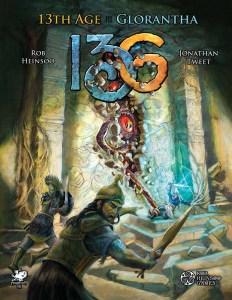
13th Age GloranthaI’ve run this one-shot, for 4th level PCs, twice now, at UK Games Expo and at BurritoCon, and it’s been a lot of fun both times. I’m not going to claim it’s the most original plot structure going, but the combination of two of Glorantha’s iconic (but less-known than Broo) Chaos beasts, Gorps and Scorpion Men, make it a lot of fun.

One note – these aren’t the same stats for Gagix Two-Barb as are included from p422 of the 13G book – she’s not got 1000 hp. If this bothers your Gloranthan versimilitude, maybe this is a Chaos body-double for Gagix, or rule that she’s weakened by the Stone Chair Man’s enchantments.

Pregenerated characters are here, if you want. The Praxian Bison Rider uses the optional Mounted Combat rules from 13th Age Monthly that you can find here. All of them have 3 of their Background points spent, with the others to be allocated as they please.

Want a 1st level 13G one-shot? My re-imagining of Gringle’s Pawnshop is here.

Sting of the Scorpion Men

A 4th level 13G adventure

Introduction

An unprovoked attack on an isolated village tells you that the poisoned Earth around Larnste’s Footprint is rising up. You will have to travel through the Fossil Woods, and evade the Chaos beasts therein, to steal Gagix Two-Barb’s sting!

The PCs begin as established adventurers – they may be Rune Lords of their cult by 4th level, and are travelling through the wilderness near the village of Stone Chair after a successful adventure. Once their, an attack by corrupted Earthbeasts leads them to investigate the Stone Chair Man, a guardian spirit, who sends them in Larnste’s Footprint to steal the sting.

If you are inserting this into an ongoing campaign, maybe the characters have been asked to travel to Stone Chair because Venkor and/or Sarooth have forseen that the enchantments that protect the village are fading, or they have dreamed of strange chaos-touched Earthbeasts attacking villagers in the area.

Characters

Sarooth the Wise is the Elder of Stone Chair. He half-expects trouble when welcoming Rune Lords to his village. Every time they come, Chaos seems to follow, and he is weary of the disturbance even as he knows he will need their help.

Venkor the Fair is Sarooth’s daughter, an Ernaldan Earth Priestess who sees to the medical needs of Stone Chair. She hates the village and that she has to stay in it, since the wards that protect it make the population healthy and well, and dreams of a more interesting assignment in Backford or Whitewall.

The Stone Chair Man is a Guardian Spirit of the Woods around Stone Chair – their influence allows the village to continue to prosper. He lives within a huge ancient stone chair in the depths of the Fossil Woods, where his Earth Beasts normally protect him. Since it was overwhelmed by chaos, he his Earth Beasts will not follow his commands, and his altar is overrun with Gorps. He appears as a ten foot tall, stick-thin man made out of stone, and his altar is a large stone chair.

Gagix Two-Barb is a vicious scorpion woman with two stingers at the end of her tail. Ensorcelled by the Stone Chair Man in this adventure, she is less of a threat than on p426 of the core book, but she is still a formidable enemy.

Scene 1 – Earth Shark Attack

The Village of Stone Chair is between Backford and Larnste’s Footprint, and is nestled precariously around the hills above Backford. A tight set of steps leads up to a small square, where preparations are underway for the heroes’ arrival.

  • The trickle of a brook and the smell of cows roasting – “More Cows!” if there is a Troll in the party – and the chatter of villagers
  • They notice Venkor the Fair looking glum, sitting outside the circle, despite Sarooth trying to introduce them
  • They ascend stairs to the flat area of Stone Chair, and can see a winding path leading into the Fossil Forest – “This way lies doom!”

The village square is laid out, a feast is upon them, and everyone is dancing and relaxing, when an earth shark attacks! They notice the earth around Venkor raises up to surround her, and she is carried away on a wave of earth.

An Earth Shark has stats as a bulette from regular 13th Age (stats available on the SRD), a L 5th-lvl wrecker. For 3 players, it is alone. Add one earthbeast (13G p301) per additional player as well.

No. of PCs Opposition
3 1 Earth Shark
4 1 Earth Shark, 1 Earthbeast
5 1 Earth Shark, 2 Earthbeasts
6 1 Earth Shark, 3 Earthbeasts


The Earth Shark and Earthbeasts burst out of the very ground beneath them, and damage the foundations of the village – describe the rumbling ground beneath their feet as they fight.

When they recover, Sarooth is beside himself. Not only is village under threat, but Venkor, his daughter, has been carried away. He pleads with the PCs to travel to the Stone Chair Man to see what can be done – he is sure that something must be up with the protective wards that keep the village safe.

Scene 2 – Journey to the Stone Chair Man

They need to travel through the Fossil Woods to speak to the Stone Chair Man, an ancient shaman.

  • The path is well-trodden at first, but gets more loose and overgrown
  • Soon wood and trees begin to show signs of stone, and soon it is like walking down the corridor of a cathedral of stone – the noises quieten, and they can hear nothing but an eerie silence – and the occasional odd squelch
  • Soon a brash, acid scent – not unlike fresh vomit – hits their senses – and an appropriate Background check will reveal that this is a sign of Gorps in the area.
  • The Stone Chair man is in a vast Stone Chair in the centre of a circular clearing – but they can see a huge mass of ooze atop it, tentacles going into and out of the ground as they watch.

They must defeat a Gorp to rescue the Stone Chair Man – for 3-4 players, this is a single Earth-Killer Gorp (13G p265) ; for more PCs, add additional Gorps (13G p264). Use the toxic terrain special feature – when a non-Chaos creature rolls a 1 or 2 they take damage equal to their level.

No. of PCs Opposition
3 1 Earth-Killer Gorp
4 1 Earth-Killer Gorp, plus on the 2nd round an additional 2 Gorp spawn and attack
5 1 Earth-Killer Gorp plus 2 Gorp (from each Arm)
6 1 Earth-Killer Gorp plus 2 Gorp (from each Arm)


Scene 3 – Speaking to the Stone Chair Man

Once the Gorp are defeated and the Stone Chair Man awakens, he tells them of a curse on the Fossil Woods, that the natural order of things has broken down and the Foulblood Forest has infested them. He tells them that the source of the infection is deep within Larnste’s footprint, and the Scorpionmen leader Gagix must be behind this. He tells them that the only way he can lift the curse is by hitting Gagix where it hurts – and asks that they bring him the sting from the end of one of her scorpion tails. With this in his possession, he can cure the poison that is infecting the Fossil Woods and the village. He can help them, too – he can use his magics to send the scorpion men into a deep sleep, which should allow the PCs to creep up on them.

He pleads with them to go, and if they agree, they feel a shifting in their perceptions as they enter the Hero Lands. They can see Larnste’s huge foot in the clouds above – and he bids them set off straight away!

Scene 4 – Into Foulblood Forest

This is a montage scene (explained here, or in the 13th Age GM’s kit), accompanied by the spirit of the Stone Chair man. They emerge eventually into the Scorpion Man ruins, and can find Gagix and her inner circle of guards at the top of a ziggurat in the centre of the scorpion men city. Stealing the sting will be easy – but it will wake up her and her guards, if not the entire city!

The initial scene (for the GM to narrate) is that the Fossil Woods end abruptly, at the edge of Larnste’s footprint – with a sheer cliff leading into fogged grasslands below. You think you can just make off the towers of the Scorpion Man towns in the distance, but there are no ways down the cliff as far as you can see – what little goat tracks you can see disappear into the distance.

As the final scene, have the players sneak into the city, which is crawling with scorpion men. Resolve the final obstacle by seeing the Stone Chair Man’s face above them, and Larnste’s foot falling, sending all the inhabitants into a deep sleep. They can ascend the steps to the palace and find Gagix softly sleeping.

Scene 5 – Steal the Sting

Within the Scorpion Man Palace:

  • There is a thick aroma of spices and strange meats, and smoke and dust are everywhere. Pools of poison dot the bare sandstone grouns.
  • There is a light snoring all around. Gagix is fast asleep, on either side of her rest her champions.
  • Tied up in cane cages around the scorpionmen are a group of villagers, including Venkar. If the fight is going badly for the PCs, allow Venkar to help – maybe she casts some healing magic on an injured PC, or she summons an Earthbeast to distract one of the Scorpionmen.
  • Assuming the PCs attempt to either kill her or cut off her stinger, she will still awaken, along with her immediate bodyguards. Who else will fight them depends on the opposition table
No. of PCs Opposition
3 Gagix and a ScorpionMan Bruiser
4 Gagix, a Bruiser, and a Warrior
5 Gagix, a Bruiser, and a Shaman
6 Gagix, a Bruiser, a Warrior and a Shaman


Gagix is a Scorpion Man Bruiser for the purposes of this fight – except that her ranged attack is the Shaman power. All scorpion men have the nastier specials

The Bruiser is Mesh, and old, aged Scorpionman whith countless scars across his bare torso. The Warrior is Flex, a youth not older than his teens who wears bright red armour. The shaman is a female Scorpionman, who carries a strange glowing staff.

Scene 6 – Return

They can effect their escape and return to Stone Chair with the help of the Stone Chair Man – as the rest of the city awakens and tries to avenge their leader. They return as heroes, the village saved.
D&D One-Shots, Part 4: More Tips

I’ve spent the best part of the summer running D&D5e for (relative) newcomers to the hobby. I’m at the point where I’m probably going to take a breather and look to my shelves for some other games to prep one-shots of now, but I’ve learned a few more things that are worth sharing since the first post that started it all. So, here goes:

Maps Are Good, Even Without Minis

A map – even one sketched with a Sharpie on plain paper – is really useful if you’ve got a set-piece combat scene. I’ve talked before about how I’m not a huge fan of minis and grids – and in this context it makes the game a little bit more complex – but a map is really useful. Next time I run, I’ll try and find some evocative art as well – even just pictures of a monster or scene – to help players get into the moment.

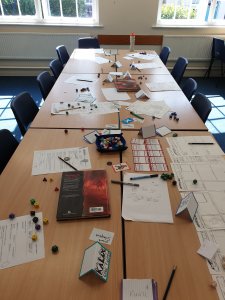
This is what a table for 12 D&D players looks like

Ambitious Stuff Works!

Over the summer, I ran a D&D Activity Group with another GM on a residential week. We had 12 players in two groups of 6, playing for 1hr 15min a day for the week. We thought up linked plots for our groups – one was escorting a pair of children who would turn out to be werewolves, one was hunting a beast from the town who turned out to be an escaped werewolf. We had four sessions as separate groups, and managed to drag them together so the final two sessions could be a huge 12-player group as they joined forces to face the source of both of their problems.

We had a real range of experiences in the game – a couple of experienced players (more on them later), some who had played a few times before, and some completely new to the hobby. Now, I’m not going to run for 12 players again very soon – but the session where they linked up and shared their stories was -amazing-. It’s the kind of ambitious cross-campaign shenanigans that I’m usually wary of, but thanks to my amazing co-GM we managed to pull it off. So don’t shy away from doing the epic. It works.

Bring Dice, In Sets

For my games, I’ve brought a big pile of dice and got my players to pick out their own d20 and any other dice they might need. This is not the best way, I learned from my co-GM in the werewolf game. The best way is to have a set of dice for each player. They have their own dice, can move them around and put them on their character sheet, and have ownership of them for the game. A player’s relationship with their dice is a key part of the game, and by having their own they get to try this.

Use Your Expertise

If you’re lucky enough to have a few players with some experience in your group, use them! Conventional wisdom might say to encourage them to play the more complex classes – the wizard or the sorcerer – but I’d say that it works better having the player next to them playing those, and them helping them out. They need to have a players handbook – they can look up spells, if you don’t have spell cards, and even conditions – I’m a big fan of saying, eg “OK, you’re weakened – Scott, what does that mean in-game?” and letting them manage it.

Use The Good Stuff Out There

I’ve mentioned Spell Cards, but having the Monster Cards lets you avoid juggling a monster manual and you can show them the art on the back. I have run Goblin Gully a few times (with my adapted notes here), but I also found Troll Trouble by Gary Whicker to be an excellent first level adventure – a good mixture of dungeoneering, role-play, and interesting action scenes. It’s a long time since I’ve run it, but The Goblins and The Pie Shop is a fun little one-shot too that I posted up on here. Come to think of it, it still sees a lot of traffic, so I’m planning to put some more 1st-level one-shots on here as I write them. But for now, I need a break from D&D – you can have too much of a good thing after all.

D&D One-Shots, Part 3: Goblin Gully

In my last post, I talked about running a one-shot for six complete newcomers using an extended/modified version of Dyson Logos’ Goblin Gully one-sheet dungeon. I added some stuff to it, mainly to give a bit of an introduction to the core mechanics (with a straightforward battle against some bandits) and a chance for a bit of out-of-dungeon roleplaying (by interacting in the town before venturing to the dungeon).

It worked really well as a 1st-level introductory game. The dungeon is just complex and multi-layered enough to give a chance for tactical decisions, and the final encounter really emphasises that sometimes you don’t have to defeat the enemy, just capture them. My notes that I used, in addition to the original dungeon, are below. And check Dyson’s stuff out! There are loads of really good maps, geomorphs, and adventures on his website.

Synopsis

The PCs are young, thrusting adventurers out to earn their fortune. They have recently taken their first, exciting, job – escorting the merchant Donia and her husband Reaghan through the High Forest to the village of Stone Stand.

They are attacked by bandits, and Reaghan is wounded before they are able to chase them off, and they learn that there is much increased bandit activity – linked to the goblins near the Kalil Slave Pit. At the town, Donia and the innkeeper Jarrod engage them to investigate the Slave Pit and drive off the goblins.

Cast

Donia is an able and capable merchant, middle-aged with a steely stare and an eye for business.

Reaghan, her husband, is a feckless idiot, an ex-adventurer who doesn’t see why the PCs should have been hired since he can easily deal with a few bandits.

Jarrod, the innkeeper of the Wyvern’s Rest, is a stout and hearty barkeep who  just wants the best for Stone Stair.

Scene One – Ambush!

As the players round a corner in the depths of the High Forest, less than a day’s travel away, their cart sticks in the mud – closer inspection (DC 10 perception) shows that a groove has been hollowed out in the road deliberately to trap them. As they inspect, Spencer and his Bandits approach – Reaghan immediately challenges them, and is seriously wounded by an arrow for his troubles.

There is one Bandit for every PC, plus Spencer, the leader. They attempt to flee if the battle starts to clearly go against them, which it probably will.

Spencer: As a normal Bandit but hp 18.

Searching the bandits they find two potions of healing (regain 2d4+2 hp) and a map showing the details of the Kalil Slave Pit, with scrawled notes on it – Keep Adventurers Away from Stone Stand, and from the Pit – Maglubiyet will reward you (10 gp/adventure head – double if alive!).

Reaghan can be stabilized with a Wisdom (Medicine) DC 10 check, or any healing that restores even 1hp. If there isn’t a cleric or paladin in the party, consider them finding an extra potion of healing – maybe on Spencer. Once he is stabilized they can continue to the village.

Tracking the bandits

If they are keen to track them, they can make a Wisdom (Survival) DC 10 check to show that they have a basic camp about half a day’s march away. There they may be able to ambush the remaining bandits, or question them about the goblins

Questioning the bandits

Spencer and his men are opportunists – they dug the hole in the hope of a cart coming along because they’ve tracked the PCs for the past day. The goblin bounty has made ambushing carts much more lucrative as there are often adventurers amongst them. They will plead with the PCs to let them go, or failing that to at least take them back to town – Wisdom (Insight) DC 10 will reveal that what they are really scared of is being sent to the goblins.

Scene Two – Stone Stair

Stone Stair is a picturesque village in the middle of the wilderness, nestled on either side of stone steps up a hillside, making it very defensible but also reliant on imports for food. The one tavern, the Wyvern’s Rest, is run by Jarrod, a retired adventurer. As they are settled and rested, they will learn that Stone Stair has been beset by bandits – none have dared attack the village itself yet, but many supply carts have gone missing, and there are rumours of goblins abroud in the hills to the north as well.

Jarrod and Dorian will offer the PCs 200 gp to clear out and/or investigate the old Kalil Slave Pits – a mysterious wanderer, Kras, will tell them that he has seen the bridge has been restored to it.

Gathering Information

They can question any of the NPCs around town about the Slave Pits – on a successful DC 10 check of an appropriate skill they receive a True rumour from the Goblin Gully sheet, on a failed on they receive a False one – but will know it is questionable.

Scene Three – Goblin Gully

The PCs can make their way to the Kalil Slave Pits and explore Goblin Gully as per the one-sheet. Additional notes for each location are below.

By investigation, the goblins believe the black pudding to be an avatar of Maglubiyet, and have been throwing sacrifices in. They have been running short, so last week two goblins were pushed in, and their claw marks are visible on the walls as they tried to escape.

  1. Entrance – two Goblins up a tree. They attack with their shortbows.
  2. Antechamber
  3. Grand Hall – four Goblins guard here (or one per PC)  (Passive Perception 9 if sneak)
  4. Bridge Room – two Goblins will attempt to support combat in 3 – but not leave their posts.
  5. Bridge – to cross quickly is a DC 10 Dex save or they will be left hanging off a thread, a further save or they fall for 1d6 damage
  6. Gully Floor – the bodies carry a Scroll of Bless
  7. Empty Room – goblin in 8 to surprise
  8. Contains Graz’tur, a goblin boss, and three Goblins (XP 350)
  9. Secret Chamber. The door is trapped, and secret (DC 10 to find, DC 15 to disarm – or DC 15 Dex save or 1d10 damage from a dropped rock)
  10. Secret Storage. There is a +1 Longsword here, but if it is disturbed then the Animated Armor at the back of the room attacks with its ornate two-handed sword – this sword detects as magical.
  11. Four goblins, can be ambushed easily
  12. The Pit. Contains a black pudding. Required DC 15 Wisdom save to flee and shut the door. The door to the Pit is barred by heavy wooden bars, and the sword in 10 can be used to seal the portal permanently.

So, there are my notes for Goblin Gully (posted with Dyson’s permission, I should add). What are your favourite short dungeons to introduce D&D to newcomers?

Next post, I’ll talk about prepping one-shot games for D&D.

D&D One-Shots, Part 2: Absolute Beginners

Here I talked about why we should be running D&D one-shots; I shared some pregens here (there will be more of them later); and I talked about the start of sessions here. In this post I’m going to offer some tips from experience for running for a table that are entirely new to tabletop RPGs. Some of this advice will be D&D focused, but a lot of it goes for any system where you have a lot of players who are new to the hobby.

20190812_1721532071750066900064083.jpg

Best advice for running D&D for new players

Bring All The Stuff, Make Friends

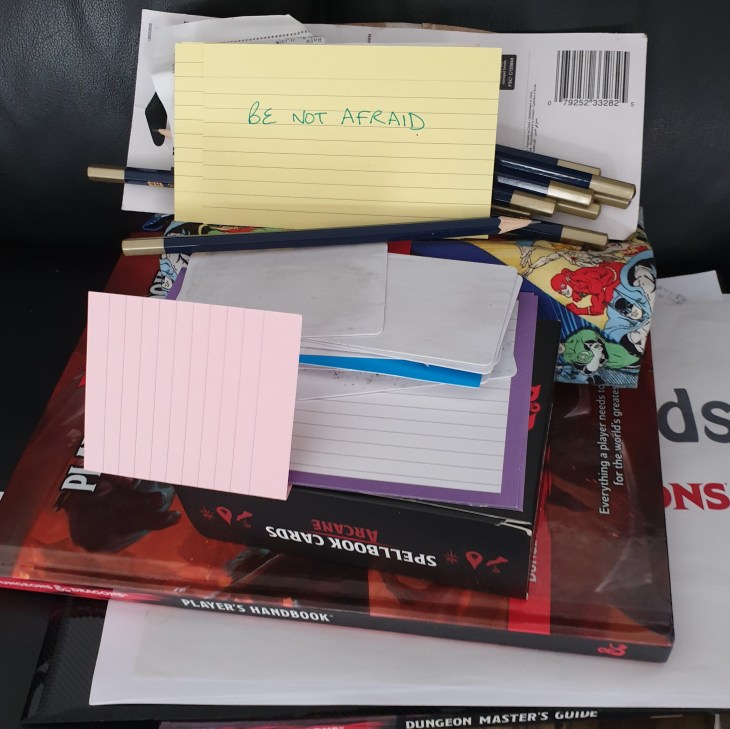
You will need dice for everyone. You will need pencils for everyone. You will need an index card for each player to make a name tent (with their character and ‘real’ name on, if the group doesn’t know one another). Do introductions. Be nice to people. Be aware that if this is a new group, weird social dynamics can emerge, and you share some responsibility for making sure that people don’t dominate or shy away.

1st Level is Fine

With more experienced players, or in a convention slot, I’d probably want to start at least at 2nd level, to give players a range of options. With new players, I take advantage of D&D’s training levels and stick to level 1. Why?

  • there’s an obvious action each round so they don’t have to worry about ‘doing the right thing’
  • the mental arithmetic is easier with fewer hit points and options
  • there are less ‘rules exceptions’ – rules that change other rules, that are really confusing if you’ve not used the actual rules before

Keep it As Simple As You Can

The pregen sheets I used (in the same format as the 2nd level characters here) are here. From the feedback of my six new players, they were easily complex enough – in fact they couldn’t believe that the actual character sheets were more complicated than this, until I showed them the one in the back of the Player’s Handbook.

I had spell cards for the sorcerer in the game, and I’d recommend having them ready, and introducing that PC as the most challenging. In my game I nudged the sorcerer towards the one player who had his own set of dice – that seemed to indicate he’d be down for a bit more processing, even though he hadn’t played before.

Teach Core Concepts First

After a quick tour of the character sheets, I’d recommend teaching the core concept of D&D. The core concept, in case you are wondering, isn’t “roll 1d20 and add a bonus,” the core concept is this:

Say what your character does, and we’ll work out what happens from there.

The reference point I used was videogame RPGs, as that was one point of reference they were all familiar with. Saying it’s like you have dialogue options, except you can say whatever you want, and I’ll say what the NPC says, helped, as did referring to combat as being turn-based like Final Fantasy.

Model What To Do

So, as I talked about here and here, I like to do a bit of an introduction for a one-shot to bind the PCs together. This felt a bit like throwing them in at the deep end, so I just asked for a brief description of what their character looked like and acted.

I modelled this first myself by describing the merchants who had hired them – the confident, worldly wife and her feckless moustached husband who didn’t understand why they needed to hire adventurers for support as he could deal with any bandits himself. They then went round and, following my lead, described their PCs in a similar amount of detail. I did some interjecting, like “I’m thinking you’re a pretty wide-eyed and innocent…” and giving positive feedback while they did this.

This was absolutely crucial to the action that followed. When their cart was inevitably attacked by some bandits, one of the fighter’s first actions was of course to check on the female merchant in the cart that she was OK – while the sneaky sorcerer hid under the cart and hoped he wasn’t noticed until it was obvious he had been.

Get the Action / Roleplay Balance Right

I think this varies for each game, but for D&D I was certain I was going to use a proper dungeon – so I started with Dyson Logos’ excellent Goblin Gully, and added an inciting event (the aforementioned bandit attack, and then some investigation in town) before they ventured to the dungeon. Prioritising the roleplay and being your character meant that, even in combat, everyone was describing their awesome (or not so awesome) moves. I’ll be sharing my notes on how exactly I did this, and my D&D5 conversion for it, in a later post.

Minis: You Do You

I didn’t use minis, because they aren’t me. I never really use them – even when I played in a mini-campaign of Pathfinder, we managed to muddle through (I’m not a fan of the term “Theatre of the Mind,” either, as it just sounds pretentious).

But if you’re a GM who uses minis, by all means crack them out – props are good, and they provide a good focus for the play. I would definitely have had less swashbuckling derring-do from my PCs with a map, but that’s just my tastes I think.

Enjoy it!

Running D&D for six complete newcomers is one of my most exhilarating experiences at the table this year. I can’t recommend it enough – not just for bringing new people into the hobby, but for the enjoyment yourself of seeing them grow in confidence through the game. And, despite what I’m saying in a lot of these D&D posts, after a few games of D&D it might be time to talk to them about other games – and see if they want to give, say, Star Wars a try.

Have you run games for complete beginners? How did it go? In future posts I’ll expand on how I opened out Goblin Gully, and give my own approach to balancing encounters and timings for D&D5.

D&D5e One-Shots, Part 1: Getting Started

Previously, I told everyone they should be running D&D5e one-shots. Here, I shared some of my techniques for pregens, as well as some actual pregens. In the next few posts, I’m going to actually talk about what techniques and tricks I use to make D&D5e one-shots sing, starting with the start of the session. For this post, I’m assuming that you’re running for players who have played D&D or another tabletop RPG before – my next post will be about players who are completely brand new.

Pregens / Characters

D&D5e is unusual in that, thanks to Adventurer’s League, often players will expect to be able to bring their own characters to the table. Also, if they have D&D Beyond, they can probably whip up a character in 10 minutes to your spec. I try to embrace this as much as I can – if I advertise a game, I’ll be clear that although I’ll bring pregens, if they’ve got (standard array) characters at the right level, I’m happy to have them instead. They do have to meet that spec though – no “I randomly rolled these stats,” or “My sorcerer is 4th level instead of 2nd, is that still ok?” – again, with the app it’s really easy to make those adjustments, so they should be at least initially balanced to the other PCs.

I usually turn up with a selection of my own pregens, a few extras from the excellent FastCharacter website, and let them pick. Running D&D, of course, that you might well have players who really know the system – so if they want to adapt or change stuff from a pregen, they can usually just go ahead and do it.

Forming a Party

This does mean that you can often have a fairly disparate band of PCs at the start of the session. I’m blogged here about using charged questions to help bring groups together, but I’ve recently started using Backstory Cards, and these have worked really well to not only tie a group together but also tie them to the setting.

With Backstory Cards, you have a few lists of individuals, groups, and locations, and then ask questions of the players to establish some shared history. With a set of cards, they can be drawn at random by the players, but I just pick some interesting questions from the cards and my lists, and manage it so that everyone gets some screen time.

Example questions might include:

  • Pools, you and Fuuwde did something in Hightower that at least one of you regrets, or is ashamed of. What lengths will you go to hide it?
  • Van Erp, your allegiances aren’t clear when it comes to the Dock Rats thieves’ guild. How did Jansora find out? What don’t they know?

As you can see the questions are pretty multi-levelled – I’m not too bothered if we don’t get right to the bottom of the question – just spitballing a heist in Hightower that went wrong will be enough to bond the players together. I use a mixture of groups, individuals and places from the one-shot itself, and peripheral to it – so, although the city watch might not specifically be mentioned in the scenario, they are around, and having some history with them means they can be on stage during scenes as much as the players (and I) want.

I do this straight after an introduction – so the start of the session looks like this:

  • players go round the table and introduce their PC’s name, race, class, and anything obvious they have set in their mind about them
  • we do the backstory cards – making sure that each PC gets some screen time. I’ll use this to drip-feed anything important about the setting, too, as they do this – sometimes I’ll amend my prep notes as well if something particularly juicy comes out
  • players introduce their PCs properly. I get them to do this like an opening montage in a cheesy TV series, like Robin of Sherwood or Quantum Leap – we see each PC in the middle of an action scene from a previous (or future) adventure, doing something that defines them in some way

This all of course takes a bit of time, but it’s well spent. At the end of this process (which I normally budget about 30 minutes for, longer if players faff around with their characters) you should have an adventuring party, rather than a collection of individuals. I’ve lost count of how many one-shots (and D&D is over-represented here) where half an hour in I still didn’t know the character names of my fellow PCs.

So that’s my approach for the start of the session. In my next post, I’ll talk about running D&D one-shots for players that are completely brand new to Tabletop RPGs, which simplifies some of these ideas a bit.

Why Aren’t You Running D&D One Shots?

Periodically, a discussion starts online like this –

“I have a friend / colleague / partner / child who wants to try D&D. What should I run for them that’s a good introduction to the hobby?”

…and the discussion then proceeds with lots of helpful advice about what system to use, people suggesting their favourites – D100 because the probabilities are easy, Fate because the narrative aspects are easy to grab, Fighting Fantasy because they’ll know the system from the books, that sort of thing.

And they’re all wrong.

If somebody wants to play D&D, you should run D&D for them. It’s not complex, and is (finally – in its current edition) a really intuitive, straightforward, balanced system. As a wider hobby, those of us who run non-D&D games need to get over ourselves that D&D can’t be as good as our favourite game just because it’s popular, and maybe consider that actually that popularity might be in fact because it’s really quite good.

For the first time in the history of the hobby, it’s staggeringly easy to ‘get into’ D&D – Critical Role and similar AP series have made people realise how much fun it can be, and it gets generally sympathetic media coverage. So, we should just accept that D&D is a good entry point to the hobby – yes, of course, there are other games, but D&D is one of those games.

But everybody else runs D&D!

Unless your local area has a flourishing, and welcoming, D&D Adventurers League, I’d counter this that there aren’t all that many people running D&D One-Shots. There are lots of D&D Campaigns going on, but even a quick review of Adventurer’s League shows that the vast majority of adventures featured are designed to be slotted into an ongoing campaign. As previously discussed, the one-shot format (and ideally the short-one-shot format) is an easier way for newcomers to access the hobby.

But I don’t like D&D!

Don’t you? How much D&D5e have you played, or run? I know people who aren’t keen on the fantasy genre, which is fair enough, but a lot of people who claim to not like D&D tend to hold this view from previous editions. I mean, certainly, don’t run the game if you don’t like it, but be open about that, and tell your potential hobbyist that your reluctance to run D&D is because of your own tastes, and not that…

But D&D Is Rubbish! It’s not as good / realistic / fun as Runequest / Fate / Dungeon World!

Look, D&D doesn’t do all genres well. But it does do D&D Fantasy very well – as you might expect. It emulates its own genre perfectly, if you like. Sure, see previous answer, but if you have somebody who is keen to engage with the hobby, telling them that the one thing they are interested in isn’t as good as another game with lower exposure isn’t going to draw them into the hobby. Run D&D first. Then you can tell them about Runequest, if they’re into ducks.

D&D Is Too Complicated!

character sheet comparison

It’s not. One of the great design aspects in D&D5e is that the first two levels are training levels for each of the classes. First level D&D is really easy to play, 2nd level adds in one or two more options, and it’s not until 3rd that PCs really start to get some complexity and depth. Even then, it’s a nice balance where system mastery is much less important than in many other games, so it’s much more forgiving for the new player to pick up.

I do think that a lot of D&D Character Sheets look too complicated – I’ve been working on my own designs that look like the picture here (I copied them off (I think) someone from Critical Role who posted a photo of their sheets for a one-shot) – and will be posting more on this site over the next few weeks.

So Run Some D&D

So, if I can implore you, rather than complain about everyone wanting to play D&D and how they aren’t interested in your favourite system, just run some D&D. In my next post, I’ll cover some ways to make it work – because of the exposure and expected play styles, D&D one shots are a little bit different to other games.

And don’t look down your noses at D&D – it’s not becoming for the hobby for us to throw our game vs. game wars at newcomers, and as well D&D5e is really really good. I’m spending some time over the summer making sure I always have some D&D ready to run – in part because I have a few friends who are interested, and I want their first D&D experience – and their first TTRPG experience – to be awesome.

Spotlight Maintenance and the Three-Skill Trick: A One-Shot Prep Technique

After several cons in the last few weeks, I’ve come to realise how important spotlight sharing is in One-Shot games. In some games, a structured turn helps to make this happen naturally, especially in combat; in D&D, for instance, everyone has a role to play in combat, so generally a fight has the spotlight shared reasonably equally. But in games that are less combat-centric, such as investigative games, it can be easy to neglect some characters and favour others. And even in D&D, outside of combat it can be easy to make the game focus more on some PCs and not others.

So, in thinking about this, I present…

The Three-Skill Trick

You do this at some point in your prep after you have your pregens ready. You might only have the bare bones of your plot – in which case this might take you in unexpected directions – or you might have the game basically prepped – in which case this will add detail and options that will check that everyone has plenty to do.

Start by looking at your pregens and working out what they are really good at – this will include their “Apex skill,” whatever they are best at, but also anything that they have a Talent/Stunt/whatever your system calls them that can boost it. Sometimes talents can have specific instances – for instance in FFG Star Wars Talents sometimes just remove penalty dice – so consider if those instances can occur in the game.

Then list three places in the scenario for each pregen where these skills can shine. Make sure these are skill uses that hinge on success – passing them adds significant value and plot leverage to the game.

Why three? Well, not all of them may come up, no matter how obvious you think they might be. By having three, you’re guaranteeing as close as you can that it’ll come up at least once. This is easier to illustrate with an example, so let’s look at a classic/boring adventure structure, and let’s stick to D&D, the “Bandits on the Road” adventure.

Imagine this is as far as our prep goes for this 1st level D&D adventure: the PCs are hired to escort a caravan through the dangerous woods; part way through they are ambushed by bandits, who run off with a vital item. The PCs are offered double their fee to track the bandits and recover the item, from which they can then return to civilisation.

Just to stick to the cliche, let’s assume a bog-standard D&D party of Fighter, Magic-User, Thief, and Cleric, and let’s make them good at standard 1st Edition AD&D things – the Cleric can heal and speak to people, the Fighter can, er, Bend Bars and Lift Gates, and hit things with his sword; you get the idea.

Let’s look at each PC in turn and look at what we can add to give them a proper spotlight.

Fighter

  • during the ambush, the caravan is forced into a rut and loses a wheel – it needs lifting up and repairing
  • during the ambush, one of the bandits is carrying a shield bearing the heraldic crest of the Duke’s bastard son – foreshadowing that…
  • the bandits have a champion, the Duke’s disgraced bastard son, who seeks to duel the fighter in single combat

Thief

  • The camp is nestled up a cliffside – by climbing the (fairly easy) cliffs it can be scouted and alarms cut off
  • The bandits around the camp (or even during the ambush) carry obvious keys that can be pickpocketed from them
  • The camp has tripwire traps all around the approach to the forest

Cleric

  • At the start of the ambush, the merchant’s wife is shot and dangerously wounded – she needs healing
  • During the night – during which the PCs must travel to get to the bandit camp – restless spirits and ghosts stalk the forest
  • There are druids in the forest who are none too happy about the caravans coming through, but a friendly approach leads to their help against the bandits, who they are equally displeased with

Magic-User

  • the stolen item is an arcane box that can be magically tracked
  • during the camp ambush, there are lots of braziers and pots of oil (that can easily be mage hand-ed to cause distraction)
  • from the ambush, they find a map to the bandit camp – but it is in code

Obviously, this isn’t quite game-ready, but I’d argue it’s a significant improvement on the standard adventure already. All it needs is a re-arranging into order and a few stats and names, and it’s a pretty serviceable one-shot. Watch this space and I might even do that – after all, I did try and chisel a decent one-shot out of another classic/corny adventure plot, “The Orc And The Pie.”

What are your tricks for managing spotlight in one-shots? Have you tried a similar technique? And watch out for Part 2, where I’ll apply it to a more complex base adventure.

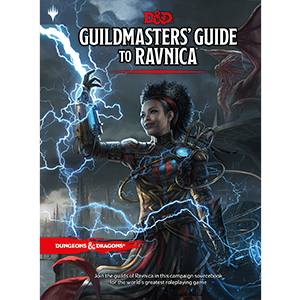
Review: Guildmaster’s Guide to Ravnica (D&D5)

Let me begin with a disclaimer. I do not play, follow, or even really understand Magic: The Gathering. I understand that Ravnica is a setting in Magic, where some of their cards are set (?),  and that Wizards of the Coast own both properties, so it makes logical sense to bring a D&D supplement covering it as a game world. I had written this off as a game supplement I did not have to get into – that it would be much more useful to players in the intersect of the Venn diagram of RPG/Card gamers. And I’m not a massive fan of high-magic kitchen-sink setttings, so Ravnica probably wasn’t for me. (M:TG has got to be high-magic, yeah? It’s in the name).

GGRThen I browsed the book, and saw it had steampunk mad scientist goblins and anthro elephant men and centaurs and mushroom druids, and shrugged my shoulders and bought it. I’m glad I did. It’s a funky and original setting that shakes up some D&D expectations, and it’s also ideal for one-shot play.
The Fluff

Ravnica is a world-sized city; an entirely urban game world. What areas of ‘wilderness’ there are are rubble pits, ruined parts of the city, or ancient catacombs. It’s steampunky; there’s underground trains, bio-engineered human hybrids, and a scientific approach to magic from many of the guilds that bicker and fuel much of the conflict in the setting. There are ten guilds, each ostensibly running a part of the city’s functions, but also at each other’s throats. A tenuous Guildpact keeps them from open warfare, but it is currently manifested as an actual person, who keeps wandering off onto other plains, so it’s policed unreliably.

The guilds themselves are at the centre of play in Ravnica, and they range from the fairly vanilla (the Azorius Senate are the city watch, the Boros Legion are the army/mercenaries) to the interesting (the Cult of Radkos, led by an actual demon, provide performance and entertainment like bloodthirsty court jesters), to the brilliantly gonzo (the Simic Combine use bioengineering to augment evolution, the Orzhov Syndicate are a combination church/bank/thieves-guild led by a cabal of ghosts).

There’s a chapter covering in just the right amount of detail (for me at least) the Tenth District of the city, with lots of stuff for players to do and trouble for them to get into, and each guild gets a set of random mission tables, an iconic location mapped out, and a bunch of monsters and NPCs. The NPCs are great – the Izzet League, mad scientists and experimenters, have several NPCs who are basically flamethrower-wielding guards. D&D5 could use more NPC stat blocks, and this chapter is full of interesting ones, and they are easily adaptable to other settings.

The Crunch

You get six new races – Centaurs, Goblins, Loxodon (elephant-men), Minotaurs, Simic Hybrids (bioengineered humanoids), and Vedalkin (blue-skinned semi-aquatic humans). There’s an extra Cleric Domain (“Order,” yawn) and the Circle of Spores for druids, as well as detailed guidance for which classes and races would fit for each guild. Each guild also comes with a default Background option that links the PC into the Guild they serve.

There’s lots and lots of random tables. D&D5 has really embraced these and I think it’s a good thing. Where previous D&D settings sometimes left me feeling stifled at the weight of background needed to navigate it consistently (Forgotten Realms in particular), distilling implied setting into random tables is a much clearer way to set your imagination running. If you’re not convinced, you can listen the The Smart Party here use the DMG to create a random adventure, and see what I mean.

The One Shot

While there’s some discussion of how PCs from different guilds could work together, I can see lots of great one-shot play emerging with the PCs working for just one guild. The structure of the guild interactions, and the resources provided for each of them, mean it’s easy to think up some exciting scenarios – pick a Guild for the PCs, pick the Guild they are up against and a villain’s nefarious plan, and then throw in another Guild with perpendicular interests to get in the way and complicate matters.

There’s enough variety within each guild to make a sufficiently distinct group of PCs, and the mission-based structure works really well for a tight opening to your one-shot and an obvious climax. Conversely, the urban environment and the option to move around the city quickly make it easy to have multiple resolution options in the middle of your one-shot (the swell, which I talk about here). It even comes with a sample adventure, which is good (but not Great – I’d have preferred a more exciting enemy than a Goblin gang-lord, and you could fairly easily set most of the adventure in Waterdeep or Sharn), but it gives a good framework as an introduction to the setting. Of course, it’s written more as an intro to the setting than a one-shot, and so provides leads at the end for the PCs to follow up, but having an adventure as a matter of course in a setting book is a good thing generally.

In general, I’m really pleased with Ravnica as an addition to the D&D stable, and I think it’ll make for some excellent one-shot play. Now, how’s about Spelljammer and Dark Sun?

Gringle’s Pawnshop – a 13th Age Glorantha One-Shot adventure

Like all of our community, I was very saddened to hear of Greg Stafford’s sad passing. As just the week before I’d been running a ‘tribute one-shot’ to one of his classic adventures, it felt only right tidy it up a bit to share it here. Greg was the creator of Glorantha, which I’ve talked about here, and also (by all accounts – I never got to meet him myself) a thoroughly nice bloke – so many of the tributes to him have talked as much about how friendly and welcoming he was as well as his innovations in game design and worldbuilding.

Last weekend, at Furnace convention in Sheffield, UK, I ran three games of 13th Age Glorantha. I had planned to run two, but a few GMs had to pull out so I offered up another game in one of the slots. The first was Beard of Lhankor Mhy, for 2nd level PCs and published in Hearts in Glorantha 7 from D101 Games (along with the pregens). The second was a 3rd level one-shot, Into The Wasps’ Nest, where the PCs had to petition both the trolls of Troll Wood and the Wasp Riders of Wasp Nest to aid the Sartarite tribes.

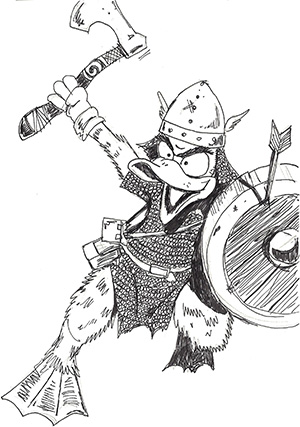
This was the third – an update of the classic Apple Lane scenario by Greg Stafford for 1st level 13G characters. I set it a month after the original adventure, when the PCs have to clear up after the last adventurers, and tried to make it a lighthearted pastiche of the elements of the first adventure. I trust Greg would see the funny side – I mean, he did invent Ducks, after all, so he can’t blame me for putting one in a tuxedo, surely? The adventure is also here as a .pdf if you want to print it out.

Gringle’s Pawnshop

A 13th Age in Glorantha Adventure for 1st-level PCs

Introduction

As your band of heroes wanders out in search of adventure, you seek out the Runelord Gringle, proprietor of his Pawnshop in Apple Lane. But upon arrival at the hamlet, you find it overrun by trollkin, with Gringle and his faithful Duckservant Quackjohn trapped in the Pawnshop. After rescuing them, they tell you of their problem – Apple Lane has fallen into ruin since the temple of Uleria was ransacked by a tribe of baboons. The priestesses have been kidnapped and taken into the hills – the players must rescue them!

Dramatis Personae

Gringle is a white-bearded man obsessed with his stock and the hoarding of magic items. A Runelord of Issaries, he enjoys nothing more than the hustle and bustle of trade, but this has all but dried up since the baboons ransacked the town. His collectors nature has, in fact, proven to be his undoing. A tribe of baboons returned last month to claim their stolen necklace of Toothsharp from the shop, easily dispatching the rookie adventurers Gringle had employed to guard it. So easy was the recovery that they also saw fit to set fire to the Tin Inn and kidnap the three priestesses of Uleria while they were at it, leading to his present predicament. Gringle is a pleasant fellow who speaks kindly to adventurers – but he dislikes getting his hands dirty, hence his propensity for hiring adventurers to do his dirty work.

Quackjohn is Gringle’s longsuffering duckservant. He speaks rarely, and when it is it is often to remind Gringle in weary tones of something obvious he has forgotten. He is usually clad in a worn and battered tuxedo. He has pulled Gringle’s neck out of more than a few scrapes, and grows weary of his time serving his eccentric master.

The three kidnapped priestesses are the true power keeping Apple Lane going. They have manged to ensure that the regular visitors to the pawnshop spent their money freely with the local businesses, and kept the bickering farmhands in line. It is no surprise that without them Apple Lane has fallen to ruin.

  • Avareen Bosom is a hard-nosed and fearsome woman, and the true leader of the town – a stern yet kindly woman in late middle age.
  • Pretty Aileena is indeed pretty, but also the shrewdest of the three. Gringle in particular has learned several times not to trifle with her quick wit.
  • Bingoood is the youngest, barely out of her teens but already possessed of powerful magic and a temper to match

Khochaz the baboon cannot believe his luck. A minor tribal leader, he has managed to not only reclaim his prized Toothsharp necklace but also capture three human females who he hopes he can ransom to the strange shopkeeper from the village. He’s good at leadership and keeping his crew in line, but less good on details like keeping close eyes on the hostages or making sure his baboons guard the camp properly.

Biglaugh Bigclub is the mercenary Khochaz employed to help him loot the pawnshop. He has stayed with the Baboons (along with Pinfeather, a duck thief) in order to try and double-cross them, and steal both the humans and the Toothclaw pendant. Both him and Pinfeather are neither bright nor brave, however, and are prevaricating over the best moment to escape with the prize – maybe when some heroes attack the Baboon camp?

Scene One – Apple Lane

As the heroes approach Apple Lane, they find it very different to what they expected. The Tin Inn lies in ruins, and the Temple of Uleria has been trashed. Print out and place one of the many available maps of Apple Lane into the middle of the table (there’s a good one in the RQG GM’s pack) and draw the destruction on with a sharpie. As they explore the town, they hear skittering and screeching – before a group of Trollkin ambush them!

There is one Dark Troll Warrior, Shuffle, and 9 Starving Trollkin Wretches. If the Dark Troll is killed, make a Save for the remaining Wretches – they will attempt to flee. If you have fewer or more than 5 players, add or subtract 3 trollkin per player. Their statistics are in 13G p295.

Scene Two – Meeting Gringle

As the scene clears and the trolls and/or trollkin flee, a white-bearded man emerges from his ruined Pawnshop, followed by an elderly duck in a tuxedo. He introduces himself as Gringle, and states that he was just about to deal with the trolls himself using his “powerful Issaries rune magic.” Quackjohn rolls his eyes and coughs politely.

He explains the situation – Apple Lane is in a sorry state, and he is forced to admit it is since the priestesses were captured. He had acquired a necklace of Toothsharp through perfectly legal means, but the tribe of baboons who claimed it decided to raid his shop. Thinking it prudent to employ some protection, he employed a group of adventurers, who failed so poorly at defending his shop that the baboons (and their allies, who were led by a centaur) then set about looting the town and carried off the priestesses.

If questioned about where he was with his powerful magic while this was going on, he was involved in an important Issaries ritual in the basement of his shop, which also required Quackjohn’s attendance. When he emerged in the morning he was dismayed to find that the adventurers had fled, leaving him with a disunited village, many of whom started to flee to neighbouring towns since their protectors had so abandoned them. The troll raids started shortly afterwards.

He implores them to rescue the priestesses – he knows that the baboons tribe will be in the hills to the southeast, towards Highwyrm.

Scene Three – The Journey

As the heroes set off on their journey, and they have the directions from the adventurers who sold Gringle the Toothsharp necklace. Play this scene as a 13th Age montage – each player in turn narrates an event on the journey. Begin by narrating their first obstacle as they set off – the bridge across the river to the foothills has been cut by the trollkin as they ransacked the village, and they now stand at one bank of a mighty rushing river. Pass to a player who narrates how the party manage to overcome the obstacle – add a twist yourself if you wish to, to remind them that they are entering the wilderness and that chaos is afoot – and they then narrate the next obstacle. Proceed until every player has taken a turn – further examples of this are in the 13th Age GM Screen pack.

In your twists as GM, play up how dangerous the terrain is and add in any additional monsters just to add to the peril – they are venturing into dangerous mountains. The hills should gradually turn into mountains as they approach, until they come across the Baboon’s camp, nestled in a rocky valley and well defended.

Scene Four – Baboon Camp

The Baboons have taken up their camp in an old abandoned Dragonewt temple. The Baboon camp is as well-defended as it can be by a tribe of semi-sapient monkeys. Bigclub has attempted to organise some sort of watch system, but he knows he might need to sneak out one night so hasn’t bothered too much when the Baboons keep wandering off and losing interest.

As the players approach, they can see the chaotic attempts at guarding, and there are many opportunities to formulate a plan; judicious use of runes may work here. The baboons guard in pairs before they inevitably begin to wind one another up and fall about fighting or arguing, before Khoshaz jumps on them with his big stick to whip them into line.

If you like, sketch a map of the area and allow the players to think about their approach; any reasonable plan should be able to give them the advantage of surprise, or of not having to fight all the Baboons at once, particularly if the players make judicious use of runes.

If they vacillate, have matters come to a head for them. As they watch, a patrol of Baboons spots them, and a round later, they see Bigclub and Pinfeather attempting to carry the priestesses off.

There are a total of 10 Baboon Troopers from 13G p244, plus the NPCs detailed below.

This is a double-strength fight, so could be dangerous for the PCs if they don’t have their wits about them. There are a few ways to manage this

  • If the players are finding it too easy, more Baboons rush to their fellow’s aid – add an extra three Baboon Tribesmen
  • If they look to be finding it hard, allow Avareen breaks out of his bonds and runs across to them. A glow of love suffuses the battlefield, and all involved can heal using a recovery; this may also cause Bigclub and/or Pinfeather to be occupied for the next round chasing after her and re-capturing her


Khochaz, Baboon Leader

2nd level leader

Initiative: +8

Long spear: +8 vs AC – 5 damage

Natural 16+: Other baboons gain a +2 damage bonus against the target until the end of the battle

R: Sling +8 vs AC (one nearby or far away enemy) – 5 damage

Surviving: When an attack hits Khochaz and he’s staggered, roll a normal save. If it succeeds, it hits the other baboon instead.

AC 18                     PD 17                     MD 14                   HP 40

Bigclub, Centaur Raider

3rd level troop

Initiative: +9

Charging Lance: +9 vs AC – 12 damage, and the target pops free from the centaur

Hit ‘em hard: The crit range expands by 2 (18-20) and instead deals 16 damage on a hit if Bigclub first moves before attacking a new enemy

Natural 18+: The target is also dazed (-4 to attack) until the start of its next turn

Big Club: +8 vs AC – 10 damage

Natural even hit: Bigclub can Kick as a free action

Kick: +7 vs PD (1d2 enemies engaged with Bigclub) – target takes 4 damage and      pops free from Bigclub

Harnessed speed: +4 AC bonus vs opportunity attacks

AC 19                     PD 16                     MD 13                   HP 48

Pinfeather, duck thief

3rd level archer

Initiative: +9

Daggers: +9 vs AC (two attacks) – 6 damage

R: Shortbow +11 vs AC – 8 damage

Natural even hit or miss: Pinfeather can make a second shortbow attack as a free action

Quick shot: When Pinfeather is unengaged and an enemy moves to engage it, roll a normal save. If successful, Pinfeather can make a Shortbow attack as a free action just before he is engaged

AC 15                     PD 14                     MD 11                   HP 46


Scene Five – Victorious Return

The heores can now escort the three priestesses back to Apple Lane. Once their equipment is recovered, they cast a ritual that returns them to their temple; and as they harness the power of the Toothclaw necklace to do so, it crumbles into dust while the walls of the temple are rebuilt.

The find Gringle in good spirit as they return – he had found a few charms in his store, and has set about rebuilding the Tin Inn – riding into town is Bulster Brewer, the landlord, who says that now the baboons have been defeated he plans to reopen. He reckons there are still a few barrels in the cellar that should be good, and opens them while the players, Gringle, Quackjohn, Avareen, Aileena, and Bingoood drink to celebrate Apple Lane’s return to prosperity!


Where I’m At – Seven Hills, Liminal, Go Play Leeds and other stuff

Burn After Running is nearly a year old! I thought I’d share what I’ve been up to recently, and what is coming in the immediate future.

Seven Hills

At the end of March I attended Seven Hills, a games convention in Sheffield. Paul Mitchener has organised it for the past 5 years, and announced prior to the convention that he’s stepping back from this – and I’m pleased to announce that I’ll be taking over from him! I’ve got a team of people who actually know what they’re doing behind me, of course, and Paul has left a very successful format that I don’t intend to mess with, but it’s exciting and daunting in equal measure. We’ve tried to revitalise the “themed” format of the convention by making an executive decision about next year’s theme – so Seven Hills 2019 will be Historical.

I ran two games at Seven Hills 2018, and both went well, from what I can tell. Unusually for me, I didn’t follow the name of this blog, and ran games that I’d previously run – which made my prep significantly easier. I ran the Emerald of the Ice Queen for 7th Sea 2nd edition, which I’ve blogged about here, and it went sufficiently smoothly for me to start writing up my notes to share on here. 7th Sea really is a loosey-goosey system, which holds together more from shared enthusiasm and keeping the plot moving, and my players were very helpful in making sure this happened. I’m going to be running much more 7th Sea, and I’m happy that I managed to get a ‘starter set’ adventure written that was a lot of fun. I’m going to write up the adventure into a playable form and stick in on here in due course – the pregens are already available to download here.

Crontas-The-Duck-for-Web

Crontas the Duck – as featured in The Beard of Lhankhor Mhy, in 13th Age in Glorantha (art by John Ossoway, one of my players the first time round)

I also ran 13th Age Glorantha, which was a blast, and similarly an ‘introduction to the system’ sort of game. I’m tidying this up to send off to be published in Newt Newport’s Hearts in Glorantha fanzine, so watch out for that, but I’m pleased that I managed to combine explaining the system with blagging my limited knowledge of the basket-weaving mythic nonsense that is Glorantha.

I got to play as well of course, although I had to leave early so dropped out of a chance to play Mutant Year Zero Mechatron, which I hear went really well. I’ve been meaning to run Blades in the Dark for ages, and so jumped at the chance to play it with Pete Atkinson at the helm, and it confirmed my suspicions that it is a game right up my street. I didn’t expect the setting to ooze through quite as much as it did – but we couldn’t help but feel the steampunk desperation vibe as our created-at-the-table crew staged an ill-fated raid on a rival gangs coffers. I got to play the Face of the group and I got to spam my character’s disguise skills.

And I got to play Earthdawn, the styled “greatest RPG ever made,” with Gaz from the Smart Party in the GM’s chair. It was a lot of fun, although also a great reminder of what 90s games were like, as we all remembered what Perception checks – and not making them – meant. Earthdawn has a slightly funky – and almost certainly uneven – dice ranking system, meaning that any bonuses or penalties result in you rolling a completely different set of dice for every ability, but it didn’t seem to slow us down too much, even if I did pick a Nethermancer (wizard) with 4 pages of character sheet. The plot was an interesting investigation into betrayal and familial guilt that surprised me in its complexity, and we had much more roleplaying than rolling dice – probably for the best given the shonky system.

Other gaming

I’ve started playing some online D&D (5e) over Roll20 – one session in, and it’s great. I have loads of tactical options every round, and this is even playing a cleric! By picking the War domain I’ve managed to be a fairly capable front-line fighter, although I don’t think I can dole out as much healing as the rest of the party was hoping for. I’m still iffy about the square-countiness of the grid, but I’m getting there with it.

Go Play Leeds has had a minor hiatus while we source a new venue, but we have a great one lined up which will be revealed in good time. The start of this year has seen a big rise in people coming who are returning to RPGing or have never played before, and so many new faces makes me feel positive about the hobby.

It’s not tabletop RPGing, but I’ve just started getting my head down in Assassin’s Creed Origins; I’ve just got to Alexandria and hit the open-world segment proper of the game. Can’t help but get a hankering to run some Hunters of Alexandria now!

Liminal

And I’ve just sent off my first piece of writing for the Liminal RPG, which I’m involved in with a team of great UK RPG designers (and me). The team is already overflowing with ideas for our British Urban Fantasy setting, and as we bounce folk tales off each other and build on one another’s ideas it feels like we’ll have a really great RPG at the end of it.

I’m involved in editing, writing some Case Files (adventures), and a sourcebook on Vampires. What started as a kickstarter for a new RPG has turned into an entire game line, with books on Mages, Fae, Werewolves, and specific location books for London and Newcastle as well as  big gazetteer of the setting, and it should keep us all busy for a while!