Wyrm’s Teeth: 13th Age Glorantha – A Retrospective on a Short Campaign

I’ve just spent a sunny afternoon prepping the final session of a short 13th Age Glorantha campaign, and it’s been great to get through a short season entirely home-written. I’ll have run 6 sessions by the time the finale is over, and we’ve taken 3 PCs from 1st level to the cusp of 4th level – we might come back to them at 4th level for a sequel, when we can rotate it back into the schedule.

While you’re reading this, I should tell you about my Patreon. Patrons get access to content 7 days before they hit this site, the chance to request articles or content, and the chance to play in one-shot games, for a very reasonable backer level of £2 per month. If you like what you read, want to support the blog, and have the funds for it, please consider supporting here. Telling people about the blog, and sharing links/retweeting is much appreciated also – thanks!

And it’s been great. I thought I’d review and share some of the prep techniques that worked for me. In fact, I’m going to look at adapting it and getting it up on the Jonstown Compendium, Chaosium’s fan-made storefront. In advance of this, Patrons are going to get sent my unedited, raw prep notes – they can let me know if they think this is a good idea.
Run What You Know

I’ve never actually run an ongoing 13th Age game before, although I’m fairly sure I’ve run more 13th Age Glorantha at conventions than anyone else over the past few years. I’ve a real love for the crunchy narrative combat / freewheeling player agency interlude bit of 13th Age, and this was a great chance to see it fly with players that were involved with it. 

So, if it isn’t too obvious, pick a game you like and ideally one you know the rules to pretty well. This gave me a good feel for making combat balanced and exciting (pretty important in a game like this) and how to handle the narrative techniques like montages.

Have A Campaign Plan

By “Campaign Plan,” I literally mean just a bullet point for each session. I didn’t follow it exactly, but it helped make prep easier as I wasn’t starting from an empty page each time – I’ll be doing this again with every season going forwards.

In fact, this was what it looked like:

  • S1 – Defeat cattle raiders, learn of encroaching chaos L1
  • S2 – Investigate chaos, learn of lunar magics upsetting balance L1
  • S3 – Secrets in the Cackling Caves – dungeoning L2
  • S4 – Consult with corrupted Silver Wolf tribe
  • S5 – Travel to Jonstown to find who could have learned of this – citycrawl beset by lunar spies L2
  • S6 – Fight the lunar spies in the Compendium / somewhere else exciting L3

We ended up going to six sessions, partly because session 1 was a sort of combined session 1 / session zero with character generation folded into it – so the first session took a couple of sessions really. Jonstown, too, ended up a bit different, because I thought it’d be a good idea to have the city burned down and besieged by Lunars. Session 6 is also completely different – they’ve dealt with a Lunar ghost and now have to find how to finally lift the curse on the lands.
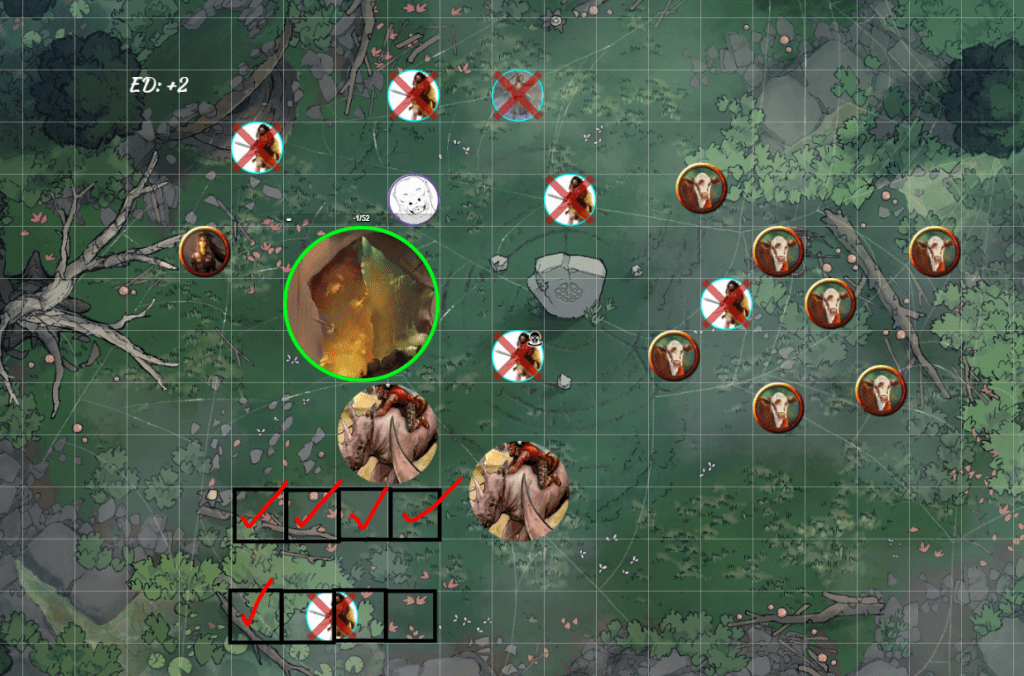
Starting the campaign with a cattle raid, classic Glorantha. The presence of two rhino riders is a result of Roll20 teething problems.

Then Prep A Session At A Time

After that sketch was done, I stuck to only going one session ahead at a time. Why? Well, this allowed me to reincorporate player ideas. 13th Age has montages, hazards, and other opportunities for players to add elements to the story, and this let me re-use them in following sessions. I’ve written before about how effective reincorporation is, and this let me respond to it without having to feel like I was improvising too much.

This led to an entire session changing – I’d thought of the Cackling Caves as being a Broo encampment, but this became a corrupted Brown Elf shrine when elves were introduced in a montage the session before. I did a fair bit of checking in with the players for what they wanted more of through Stars & Wishes, too – which meant I had plenty of material to work with each session. Adding parameters, like with anything creative, usually makes things easier rather than harder, and this is a campaign I’ve genuinely enjoyed prepping.

Use Random Generators

Speaking of the Brown Elf Shrine, I actually used a random dungeon generator (well, sort of) for it – and similarly for the Silver Wolf tribe. In fact, I used the same generators each time – the tools in Kevin Crawford’s excellent Worlds Without Number. There are many more available, and although I’d recommend these, use whatever you want to spike inspiration within the parameters set.

Make Up Monsters

While 13th Age Glorantha has a great bestiary in the game, it’s also been fun to lean into 13th Age’s recommended way to freeform monsters. Most of the time I’ve either reskinned existing monsters, but I’ve also used the standard stats in 13th Age core – flavour counts for more than statistics in a game like 13th Age, and so picking up a few of these has been great.

So, a run down of how I’ve prepped a full campaign for a (relatively) trad game. I’ve learned a lot from these processes, and a lot of them I’ll use again. Are there any go-to prep techniques that you use for campaign planning? Let me know in the comments.
Lonely Fun, Or What To Do When You’re Not At Expo

We’ve all been there – a convention you couldn’t make, or just didn’t fancy, and the FOMO that sometimes hits when you see the pictures of the happy gamers on your social media. Even worse, sometimes you see the swag they’ve bought! For a number of (happy) reasons, I wasn’t at UK Games Expo last weekend, and although it’s not a con I hold in much affection (it’s just too big – and it’s not really about the games), I did get a few wistful feelings about it.

So I did what every self-respecting gamer does – some game stuff, and then I felt better about it. Feel like you’re missing out on game stuff, either through cancelled sessions, a missed convention, or a spare evening you could have been gaming? This sort of stuff used to be called “lonely fun,” which I think sounds a bit too sexy, but here’s a few things to do to cope with not being at a convention.

While you’re reading this, I should tell you about my Patreon. Patrons get access to content 7 days before they hit this site, the chance to request articles or content, and the chance to play in one-shot games, for a very reasonable backer level of £2 per month. If you like what you read, want to support the blog, and have the funds for it, please consider supporting here. Telling people about the blog, and sharing links/retweeting is much appreciated also – thanks!

Get That Back Pocket Game Prepped

I’m a great exponent of everyone having a few back pocket games ready for when a game night gets cancelled, or when you’ve got to fill in a convention slot. For this you’ll need pregens, a few scenes, and a sketch of the start and end. If you’ve nothing but a game idea, start with pregens – if you can get a solid set made, you’ve already done the hardest part of prep. If you aren’t quite up to that, try an easier set-up – a DCC one-shot with the character generators at Purple Sorcerer, or read through a quickstart and make some notes. Myself, I was getting the new Candela Obscura prepped to run a YouTube game of it – watch out for it soon!

Do Some World Prep

If you’re not ready to prep a whole one-shot, why not get some prep done in a game setting. The original lonely fun (to a certain definition of fun) is, I guess, rolling up Traveller worlds, but there are so many random generators out there it’s a great opportunity to get a setting sketched out – and maybe then an adventure will come from that!

Notable resources that are well worth digging out to do this include Stars Without Number (or indeed any of Kevin Crawford / Sine Nomine’s stuff – most are available in free or deluxe versions), Tome of Adventure Design, or any number of old-school procedurally generated stuff (1e DMG, anyone).

Alternatively, why not dive into a rich, detailed setting? I often don’t have enough time for this, but Glorantha, the Forgotten Realms, or even Dune offer lots of options to dig into a setting. A proper setting sourcebook should spark a bunch of adventure ideas, which you might or might not come back to – who knows?

Play a Solo Game

I’ve got more detailed posts coming about solo gaming, but in case you’re curious, you could check out Ironswon or Starforged for a way to play solo that embeds the game into this approach. Alternatively, try the Mythic GM Emulator with your system of choice (you might still need pregens, mind). There’s been a real explosion of solo games recently – and some will give you a really close approximation of a traditional game. I found this interview from the Grognard Files with Jon Cohen, the host of Tale of the Manticore really useful to picture how a solo game of a more trad game might look.

Watch Some Actual Play

Okay, I’ve said what I’ve said about Actual Play, but there are some good ones. I’m planning to be contributing to the good ones soon with Unconventional GMs, but in the meantime try Jason Cordova’s youtube channel for some great demos of PBTA games, or the One Shot Podcast.

Or, as I did, you can spend yet more time trying to learn some basic photoshop and video editing to get yourself onto the AP scene. Still a way to go there.

So, four options for your lonely fun. What does your coping-with-con-absence prep look like? Comment below or catch me on other social media.

Bad Player Habits – And How To Avoid Them (Part 1)

Recently on twitter I posted about one of my gaming bugbears (not the furry kind) – players avoiding risk when the rest of the group is embracing it. This generated a lot of responses about similar play that can come up in one-shots, and make it harder as a GM to produce an enjoyable session for everyone. So, looking at some of these behaviours, I decided to think about what we, as GMs and fellow players, can do to discourage – or avoid – them. I’m going to look at my top three Bad Player Habits (BPH) – Risk Avoidance, Revisiting, and Un-Roleplaying. In this post, we’ll look at Risk Avoidance – one of the most common, and most problematic – particularly in one-shots.

While you’re reading this, I should tell you about my Patreon. Patrons get access to content 7 days before they hit this site, the chance to request articles or content, and the chance to play in one-shot games, for a very reasonable backer level of £2 per month. If you like what you read, want to support the blog, and have the funds for it, please consider supporting here. Telling people about the blog, and sharing links/retweeting is much appreciated also – thanks!

First, though, so you know I’m not a monster:

But maybe the players don’t know any better!

This was a response I got from several commenters – that I was unfairly victimising poor players who just preferred to play in a different way to me. To this, I say two things – firstly, in one-shots you really need to be explicit about expectations, and in almost all of the games I play at conventions, people are. And in any case, “This game is deadly and survival is more important than pace. So play carefully and check every room for traps,” is weak-sauce GMing – don’t do that.. 

Every time I’ve played and these have come up, of the n players at the table, n – 1 of them have had a very clear understanding of the game premise and the kinds of behaviours encouraged – it’s been clearly explained and understood by everyone except the player performing these things.

But what about new players? – I can categorically say that these are not behaviours that I see in gamers who are new to the hobby, but exclusively by old hands who really should know better. In all cases they’ve been oblivious to the annoyance that this has caused to the rest of the table, even when other players have directly challenged them about it.

Risk Avoidance

This is my top BPH. To be fair, I can see how it develops, sort of, if you’re used to an adversarial GM style where you need to check every door for traps and search every room in case you miss something. Careful play is fine – in some one-shot games that I run, it’s encouraged to an extent – in Warhammer Fantasy Roleplay, you want the players to see combat as dangerous and to avoid, say, fights with the city watch. But it’s when one player is doing this and the rest of the group are playing normally that it’s irritating.

“I’ll stay in the van while you explore the warehouse”

“I’ll stay in the control room and monitor the cameras”

“I’m not very good at combat, so I run away when the monsters attack”

All of this is poor because you’re caught as a GM between including them in the game – when they’ve opted out of the action – and letting them have the satisfaction of avoiding the danger that they clearly crave. They’re also leaving the rest of the group at higher risk from any danger that emerges – which is the real problem with this. When that player runs away, they make it harder for the other players who now have to fight with one fewer combatant. Add to this that very often these same players will back-seat drive the play from their position of safety, despite very clearly not being there.

So how to avoid this?

Well, first of all – and this goes for all of these – be explicit. Both at the start of the game, and during, make the level of risk-taking clear. If you’re running Mork Borg, it might just be to say:

“Look, this is a deadly game and the dice are going to fall where they may – some PCs might die, and that’s just fine – I’ve got a bunch of extra pregens and we’ll bring them in immediately. It’ll be more fun if we all just embrace this, rather than avoiding doing anything.”

Sometimes, you’ll find the whole group gets distracted by a perceived danger – sometimes what they perceive is even actually dangerous, but they can’t get past it and wind up in circular discussions about it. Here, it helps to have a friendly NPC who can drop in some clues as to the most fruitful route – having a local guide to point out that, while the deserts of Ja’darr are very dangerous, he’s pretty sure that heroes of the PC’s stature will be able to cope with them.

The other way is to demonstrate competence early. Begin with an action scene (often, although not always, a fight) where the PCs can win. An easy early scene lets the players learn the rules if they need to without too much peril, and also demonstrates that they can triumph in similar scenes.

Another prep technique is to have multiple options at each stage – if they are really hung up over the Deserts of Ja’darr, maybe there’s another way to cross them to the temple – they could try and hitch a ride on a passing roc to get them there. These alternative options are still dangerous, of course, but letting the players choose the one with less perceived risk satisfies some of the careful players’ needs.

So, there’s some techniques to counter risk avoidance and encourage all players to be on the same page about their approach to play – next time we’ll look at the other two.

Target Rich Environments – Making Set Pieces Pop

Often, TTRPG one-shots or sessions coalesce around big set-piece scenes, where players need to achieve multiple goals and spend significant amounts of time – a party where they need to find the murderer, a train they need to rob, a castle they need to conquer or defend, an abandoned village they need to exorcise of ghosts. 

While you’re reading this, I should tell you about my Patreon. Patrons get access to content 7 days before they hit this site, the chance to request articles or content, and the chance to play in one-shot games, for a very reasonable backer level of £2 per month. If you like what you read, want to support the blog, and have the funds for it, please consider supporting here. Telling people about the blog, and sharing links/retweeting is much appreciated also – thanks!

These are often difficult to prep – you can over-think or over-simplify them, and either can be frustrating to run. Likewise, you can often end up railroading players if you try and prep thoroughly for one of these scenes, as you sketch out the various sub-scenes that could feature. I’ve got a technique that can help with that – design such scenes as a Target Rich Environment.

Be Clear About Goals

What are the PCs trying to do in this zone? They might need to accumulate clues (in which case write out a list of clues independent of sources as well as tying up likely ways they can get them), or they might just need to find somebody or something hidden. Think about where it is and why it is hard to find.

Big Open Spaces, Multiple NPCs

Give yourself an overview of the space the scene will take place in – even if it’s just with a map, it’ll give you an idea of how it can fit for the players. There should be multiple ‘zones’ within the scene, so that PCs can split up effectively (so at your party, you might have the bar, the dance floor, mingling with the guests, and backrooms with the staff) – and have a good number of NPCs lightly sketched who they can interact with. 

Lots of Targets

Give the players lots of options of stuff to do, and lots of plot-related hooks that can be pursued multiple ways. To paraphrase from The Alexandrian’s Three-Clue-Rule, work out at least three ways each vital piece of information or goal could be achieved, and sketch out what that might look like in-game: is it a social challenge, a skill check, or some sort of longer skill challenge?

Narrow Down The Start

As the PCs arrive in the environment, you want to spur them into action straight away – so give them at least two options that you explicitly present to them (do you mingle with the socialites at the bar and try and work out what the gossip is, or go straight to the dancefloor to try and ingratiate yourself with the princess and her party, or something else?) Giving concrete options helps prevent decision paralysis and keeps the pace up – and gives you the best of both worlds for sandbox/linear play.

Descriptions and Moments

Now that you’ve got a rough structure for the scene, add some pithy descriptive touches for each of the areas. I like to do this as bullet points, as they’re easy to scan and incorporate into descriptions without too much hassle. Moments – things that can be witnesses that serve as background flavour – also help to make the scene sing. Credit to Trophy as the first game I saw them in, although other Gauntlet publications like The Between also make use of them.

In summary, give your set pieces a little more thought  – and prep – than usual, and you can make truly memorable scenes for your one-shot or ongoing TTRPG game. Have you had any memorable target-rich environments in your games? Are there any good examples in published adventures? Let me know in the comments.

Playing The Apocalypse – being a better player in PBTA games

Last weekend, I was at Revelation – possibly the world’s only PBTA face to face con. It’s in Sheffield, UK, and I’d recommend it to anyone who wants to get a big dose of PBTA or PBTA-adjacent gaming (games of FITD and similar drifts are allowed). It got me thinking on best practices for playing these games, which often take a bit of a shift in mindset to get right. There’s tons of GM/MC advice around, but I think these games – particularly the factiony / PvP ones – need a shift in mindset from everyone at the table, and so here are my player top tips

While you’re reading this, I should tell you about my Patreon. Patrons get access to content 7 days before they hit this site, the chance to request articles or content, and the chance to play in one-shot games, for a very reasonable backer level of £2 per month. If you like what you read, want to support the blog, and have the funds for it, please consider supporting here. Telling people about the blog, and sharing links/retweeting is much appreciated also – thanks!

Talk Hard

If you’re having a ‘proper conversation’ with a PC, or NPC, try to push it towards a move. What are you really trying to get out of them, and how can you get it? It’s fine to remind the GM what you’re shooting at, or to negotiate with them for what you’re going for, but in PBTA the split between roleplaying/talking scenes and action/combat scenes in many cases doesn’t exist. 

Often the “Find Information” move is underused in PBTA games – the questions you get to ask often develop plot really well – so pitch towards them where you can. You should expect to be triggering moves when you’re, for instance, asking about the murder or trying to persuade the cops to leave you alone.

Think One Step – But Only One Step – Ahead

In some player-driven games like Urban Shadows or Apocalypse World itself, there’s often an expectation on players to drive plot. The GM might well turn to you and ask what your PC does next, or even ask you to set the scene. This can be daunting! To avoid this, think about what your character’s next step is, and be ready to try and achieve that. It might be fairly loose – if I’m starting out as a Vamp in Urban Shadows, my first plan might just be to get some allies – so I’ll be visiting some established NPC or PC and trying to negotiate a mutual deal.

A word of caution – PBTA games thrive on twisting plots and loyalties, so thinking more than one step ahead is unlikely to be a fruitful exercise. But having a broad plan of action, and your PC’s next step, will give you something to shoot at.

Be An XP Hunter!

Many PBTA games have advancement, or XP systems, deliberately built to drive good play. So keep one eye on how you can earn XP, and be prepared to do it. For instance, in SCUP, you get an XP for the first Honor move you do each session, so you’re incentivised to bring your Faction into play and spend Honor points – do it! 

Many games have moves that allow you to earn XP by complying with other players – it’s absolutely fine and encouraged to set up these situations so you can both earn XP. Advancement will just unlock more options, many of which will drive plot and offer more interesting things to do, so feel free to use this as a driver when you’re picking your next step to do.

Don’t Overthink It

Playing RPGs in your head is rubbish. Your big secret plan, or long-contemplated backstory, is worth nothing if it isn’t shared with the table. This is always true, but even more true in PBTA! If you want something, go ahead and get it – don’t worry about showing your hand, or sharing your secrets, at the table. PBTA overwhelmingly works better when players know one another’s secrets and can bring them into play as well – as an author or an audience as well as an actor – so wear your heart on your sleeve.

Do What The Game Says

Having a moves sheet in front of you helps to show you the kind of things you can do (but obviously don’t look to it for the answer of what to do – for that you need your next step plan). The game will likely have advice on the playbook, or in the text, about best practices for play – and Player Principles – these are an actual part of the game. If you’re not following the Player Principles, the game won’t work – like MC Moves and Agendas, they’re as much part of the game as rolling 2d6 and adding a bonus.

So, there’s my top tips for PBTA play. If you’ve got any that you think I’ve missed (or that you think I’m wrong about – I’m aware there’s a school of thought that says move sheets should be kept MC-only!) – let me know in the comments!

Play is King

I’ve started a new year resolution in 2023 – in 2022 I managed 86 game sessions through the year, and I’m determined to get it back over 100 (2021 was 106, and 2020 was 161 sessions – wonder why that was?) in 2023. So far, so good; I played 12 sessions in January, a month without any big conventions for me, and giving me a projected total of 140 sessions which would be a nice return to form (yes, I do have a spreadsheet).

While you’re reading this, I should tell you about my Patreon. Patrons get access to content 7 days before they hit this site, the chance to request articles or content, and the chance to play in one-shot games, for a very reasonable backer level of £2 per month. If you like what you read, want to support the blog, and have the funds for it, please consider supporting here. Telling people about the blog, and sharing links/retweeting is much appreciated also – thanks!

I’m determined in 2023 to play as much as I can, and while I’ve got a few advantages to doing this (I’m relatively short of family commitments and have both a group of fairly local conventions and one-shot days I’m a regular at, and a group of gaming buddies all in the same time zone) – there’s a few approaches that I think can help everyone get more games in.

Playing Games Is Better Than Reading Games

I guess first we should ask “Why?” There’s a big section of the hobby that consists of collecting and reading games and game paraphernalia, and this isn’t meant to be a slight on that. Well, maybe it is, just a little bit. But games are meant to be played, not read! I’ve lost track of the number of rules that didn’t really shine until the dice hit the table, or plots that were better in the playing than the reading. A few years ago, I decided to make all my reviews on here play-based, and I’ve stuck to that – every review or written piece here is based on a game session, and that’s how it should be.

Make Game Nights Resilient

There’s numerous memes about how hard it is to schedule TTRPG sessions, but there are a few things you can do to help reduce cancellations. Having one more player than you need is an excellent move – our Tuesday night group is 5 of us, which is probably one more than we’d ideally have for online play, but it means we can carry on playing even if one person drops out. This keeps the momentum and makes future cancellations less likely.

We also alternate GMs – if you can find a group to do this with, it really helps. Playing seasons of 4-10 sessions and then swapping over keeps everything fresh and, again, maintains momentum. If I was setting up a new D&D / traditional fantasy groups from scratch now I’d probably go for 5 players, with an explicit expectation we play with 3 or more – unless the canceller is the GM, you’re good to go.

Obviously, sometimes it doesn’t make sense to continue playing without all players – the first session of a new season, for example. When that happens, try to get a one-shot down, so that you’re still meeting up and playing – we did this recently with my “Star Trek” group (which I’m currently running Avatar Legends for – but we started playing Star Trek, hence the name) – a Trophy Dark one-shot which was a complete break from everything we’d been doing.

Go To Conventions / Meet-Ups

It won’t surprise you that I’m a huge fan of one-shot games, and I really believe if you only play in long campaigns you’re missing out. There’s lots of conventions and one-shot meetups advertised all over the place now, and going to a few of these to mix up the people you play with is a great opportunity to get more games in and broaden your experience of the hobby. If you can’t find one convenient for you, you can always post in your local Geek Retreat to see if anyone fancies a one-shot – I did this during the summer holidays a few years ago and ran more 1st level D&D for new players than I’ve ever done since!

Don’t ignore online conventions, too – or online gaming generally. Most of my sessions (about 70% of them, according to the spreadsheet) are online, and it’s a great way to maintain a regular group without having to leave your house.

Do Prep

Having a few ‘back pocket’ games is a great way to keep playing – those one-shots when your group can’t meet up rely on somebody having something ready. Luckily there’s lots of opportunities now to use starter sets and introductory adventures, so it doesn’t even have to be loads of prep – just read them and be ready to run.

If there’s a game you’re keen on getting to the table, ask yourself if a group came round tomorrow could you run it? Get the prep ready and you stand at least some chance of it happening. I’m at that stage now with both Ironclaw and Rhapsody of Blood, both games I’ve wanted to run for ages but never really got to the table – and without anything prepped for them, I’m unlikely to.

Solo Stuff

Don’t ignore some of the solo gaming options out there! I’m very much a newcomer to the solo RPG world, and I confess I still find it a completely different experience to group play, but there are some excellent games that work really well for solo play (Ironsworn and the new Rune are the ones I’m thinking of) and some great tools to play solo (I like DM Yourself for published adventures, and the Mythic GM Emulator is the old hand for it). I’m no expert, as I say, but a quick glance at youtube shows lots of people who are having great times doing this – and it’s a good way to master as system ready to prep a group game, too – so give it a look if you think you might fancy it.

So, can I keep up to my 140 expected games in 2023? I certainly hope so, and I’m trying to broaden out some of what I play too – there’s a few conventions coming up that I’m keen to try new games at, so I’ll keep you posted here with how they go.

Pull the Other Warhammer: Soulbound, the Age of Sigmar TTRPG

I’ve managed to get another new game to the table this week – Soulbound: Age of Sigmar, Cubicle 7’s RPG of the Games Workshop fantasy reboot. For a wargame-inspired game, it’s a surprisingly loose-limbed high fantasy game, and one session down I think it makes a great convention game. Here’s why…

While you’re reading this, I should tell you about my Patreon. Patrons get access to content 7 days before they hit this site, the chance to request articles or content, and the chance to play in one-shot games, for a very reasonable backer level of £2 per month. If you like what you read, want to support the blog, and have the funds for it, please consider supporting here. Telling people about the blog, and sharing links/retweeting is much appreciated also – thanks!

Superheroes with Swords

This is proper high fantasy. You’re powerful heroes, and because your group is soulbound, you get tokens you can use to cheat death which you keep as a group. Every PC has at least 1 Mettle, which you can spend to get an extra action in a round, or boost your attack significantly – and PCs are properly high powered while still being pretty simple to play and run.

You Don’t Need to Sweat The Lore

As you’d expect from a GW property, there is a significant amount of lore you could delve into. But there’s no need, really. Chaos was all risen, it’s been sort of beaten back a bit, you’re heroes trying to finish the job. There’s monsters, chaos, undead everywhere, and you just need to do the right thing and kill them. We’ve seen this approach work really well in 13th Age Glorantha, where setting it in a more ballsy era means you don’t have to worry about history so much.

It’s a Zonal, Freewheeling Combat System

No minis. I repeat, no minis. It has a loose zonal combat system which I guess you could use a map and counters for, if you had them already – but it’s straightforward enough for theatre of the mind to work just as well. Simple rules for dangerous terrain are easy to implement, and combat is fast and fun with both sides potentially hitting hard.

There’s great one-shots out there

As well as the Starter Set, there’s also a couple of free RPG adventures. I ran Trouble Brewing, which while not free, is an excellent convention adventure. It’s worth giving the published adventures a read for how they structure and build combat encounters, too – you can really hit the PCs hard, and the terrain rules add a lot of options.
So, will I run Soulbound at conventions again? Strong yes! I’m looking at a Tzeentch-themed thing for Seven Hills 2023: Change, which as it happens is open for registrations if you’re near to Sheffield – or even if you aren’t.

You Can Run Anything As A One-Shot

Last year, one of my one-shot highlights was playing in a game of Ars Magica, run by the @Asako_Soh at Grogmeet. Ars Magica, as many of you will know, is the TTRPG game that invented troupe play – you follow a covenant of magi through the seasons in quasi-Medieval Europe, alternating between wizards, companions, and grogs. It’s also famously one of the games that people say you can’t run a one-shot of.

While you’re reading this, I should tell you about my Patreon. Patrons get access to content 7 days before they hit this site, the chance to request articles or content, and the chance to play in one-shot games, for a very reasonable backer level of £2 per month. If you like what you read, want to support the blog, and have the funds for it, please consider supporting here. Telling people about the blog, and sharing links/retweeting is much appreciated also – thanks!

There are lots of games like this. “It runs better it an a campaign, I can’t see how it’d work,” people say. But how often do games like this actually get played? I want to see how a game plays before I invest multiple sessions in it, and I refuse to believe any game can’t be run as a one-shot.

Burning Wheel? Done it. Hillfolk? Done it. Apocalypse World? I’ve played in a few, and there’s a recommended method here by Vincent and Meg Baker for how to do it. You can run anything as a one-shot, and I’d recommend that you do – I’m convinced that no matter what the game is, it can be run as a one-shot at a convention or as a break from regular gaming.

However, there are a few things you can do if you want to run an un-one-shottable game as a one-shot. Here’s my top tips for it: –

Be Prepared to Limit The Scope

You’re likely to get one solid mission/story beat, with a twist, through. So now is not the time for your Pendragon-like exploration of multiple generatioms – just head to the monastery and find out what happened to the monks. Additional complexities can come up from the system anyway, and you don’t need to make it over-complicated – you generally just need three things, whether they are NPCs, monsters, or factions at play – keep it simple.

Do Roleplaying Scenes in Pairs of PCs

This particularly applies if you’re adapting a published adventure to one-shot it. Investigative scenes, as I’ve talked about earlier, are best done with the party split. Cut between the two groups and you’ll get more screen time and more productive investigation from everyone. With that in mind.

Start Late, Get Out Early

If you’re working with a baroque system/setting, you might be tempted to front-load information. Avoid this and instead hard frame scenes to put PCs in the action right away. Your Apocalypse World Hardhold is in danger? Have the gang show up with an NPCs head right at the start, don’t start with the usual “follow everyone around” stuff. You can always flashback if you need to – and keep these flashbacks narration-only to avoid engaging the rules where not needed.

If you’re running an investigative game, you might really want to start at the crime scene – but try to make any initial scene like this hold threat; maybe as you stand over the body you spot somebody watching who runs off, or perhaps there’s another group nearby who want to cause trouble – try to avoid scenes that are entirely stationary.

Use The 1-2-1 Structure for Multiple Passage of Play

If your game has multiple different structures (for instance Mouse Guard alternates between Player’s and GM’s Turns) – try doing GM’s – Player’s – GM’s to showcase both of these. Likewise, if you’re running The Between, start with a shortened Night Phase (maybe the final encounter with a previous enemy), then go through a Day Phase and another Night Phase. By structuring like this you’ll still get a satisfying conclusion and be able to end on an exciting scene, and keep some control over timings.

Take Care With Pregens

Even with PBTA games, I’d want to do some pregen work. Pre-pick playbooks, and you can even partially complete them without compromising player choice too much – you don’t want to have to teach chargen as well as the system.

For a more trad game of course, you’ll be doing full pregens – do yourself a favour and only make one or two of them remotely challenging to play. For our Ars Magica game, there were two Magi available – and players who had some idea of the system already picked them up, leaving the rest of us quite happy with our companions and grogs.

Cut to the Chase

When you’re running an involved game, it can be hard to get to that final scene if the players get bogged down in the middle parts of the game. If they do, though, just cut to the finale – you can remove encounters and obstacles from their way, or just hard frame into a satisfying conclusion. You’ll need to have some idea how long a big climax will take in the game you’re running – but that time before the end of the slot, be prepared to get the players together and cut to the finish. A satisfying ending is more important than finishing your middle scenes – your start and finish should be the best anyway.

And so, I reckon with these in mind, you can run any TTRPG as a one-shot. Should you? Well, yes – I think so – there’s lots of games out there and this is a great way to experience them. I’ll lay down the challenge now – any games you think can’t be run as a one-shot, I’ll run them over the course of 2023, if I haven’t already run or played them – I might even record them as proof it can be done. Who’s in?

Avatar Legends: A New Approach to Session Zero?

There’s a lot of buzz around Magpie Games’ PBTA Avatar Legends game – the usual stuff of people sharing their new kickstarter deliveries. It’s certainly a pretty game, but I managed to get session zero in with our regular Friday group the evening it arrived – and the session zero guidance is not only really interesting, but also easy to adapt to other games and systems.

While you’re reading this, I should tell you about my Patreon. Patrons get access to content 7 days before they hit this site, the chance to request articles or content, and the chance to play in one-shot games, for a very reasonable backer level of £2 per month. If you like what you read, want to support the blog, and have the funds for it, please consider supporting here. Telling people about the blog, and sharing links/retweeting is much appreciated also – thanks!

Avatar the what?

The game is an officially licensed RPG for the Avatar: The Last Airbender show, including Legend of Korra. If you’ve never heard of it before, they’re excellent shows, and although Avatar is aimed at kid, don’t let that put you off. It’s a fantasy-ish land where people from different lands can ‘bend’ elements to their advantage – so you have firebenders shooting gouts of flame, waterbenders skating around on sheets of ice, that sort of thing.

It’s heroic fantasy, and it suits PBTA well, as it’s as much about beliefs and principles as it is about cool fighting moves. In the game each playbook has a series of contrasting principles that can get shifted during the game (a lot like Mask’s stats) – so when The Icon’s Role principle goes up to +2, his Freedom drops to -2. Ever go more than +3/-3, and you suffer a crisis of confidence, probably leaving the scene, before it resets. There’s a funky combat system of stances and moves too, which I’ll write more about when I’ve seen it in action – it’s definitely second-gen PBTA with a bit of heft to the rules.

Session Zero

Before chargen, or even before players pick their playbooks, you make a few decisions. The first is to choose what Era you play in, and then what the campaign’s Scope is – is it set around a given area, or is it a picaresque game where you visit a new land every session. We went with the first era, Kyoshi, since there’s not much canon about it, and the players were keen for a narrow, but non-urban, scope – allowing recurring NPCs and locations to appear. So far, pretty standard session zero stuff.

You then pick your Group Focus – what you got together to do. Options range from “To Defeat [dangerous foe]” to “To Learn [idea, culture, training, history]” – we went with “To Protect…” and decided we wants to protect a village, since we’d thrown out some ideas about a bucolic, pastoral setting – a few of us in the groups have played fantasy city campaigns recently. Quickly, our group role becomes apparent, and we’ve got our village sketched out as well – Peony Blossom Falls, a village at a vital commercial crossroads that’s always the target of bandits.

I wasn’t too sure about this step initially – it felt like we were deciding from a blank slate – but the players had good ideas and some stuff just made sense immediately – we were unlikely to be picking “To deliver…” or “To rescue…” with a limited scope, and player ideas got built on by each other. One player realised it was very much like picking your Crew playbook in Blades in the Dark – it lets you decide what sort of stuff you’ll be doing – and gives the GM a big steer on what each session might look like.

The Inciting Incident

This is the bit that I’ve not seen before. As a group, you pick from a few options to decide the adventure that drove your PCs to adventure together. There are a few options for each of Act I, II, and III, which for me provided just enough of a framework to work it out. 

I added more structure and left it entirely to the players too – the first player picked the phrase (In our case for Act I “We did something fun, but drew the ire of [powerful figure] in the process”), the next player identified a specific from that (what the fun thing was), the next player who the powerful figure was, then on to Act II.

What did we end up with? Well, our heroes partied too hard in the waterfalls of Peony Blossom Village, drawing the ire of Fenfang the Magistrate before the Peony Blossom Festival. During the festival they stole a secret scroll of bending from Meng Shou, a wandering Fire Nation hero – without realising how valuable it was – but were rescued by Fenfang when he offered them a deal – defend the village for a year and a day, and their penance is served.

As a GM, this is brilliant. I’ve got just enough to see how the campaign will start – we talked about bandit gangs troubling the village, but they haven’t even appeared yet. What has appeared are two sort-of-antagonists who could be allies or enemies – Fenfang and Meng Shou – who are both tricky to deal with either socially or in combat. The first session almost writes itself from this prep!

Why It works

No hierarchy or player / GM split – I like that there aren’t really defined rolls for players and GMs in the procedures. You’re all just a group deciding what you’re going to do. I’d imagine that GM probably still has veto, but we didn’t really need it. It’s easy for the GM to set some parameters at the start (I’d picked the era, for instance) and then have players work within those boundaries.

No dice, not too fiddly – the process of the Inciting Incident doesn’t just plan your previous adventure, and give some idea of where the characters fit together – it also helps to plan the actual first session. With the consequences of their actions to work from, we can get into some drama immediately – which is often an issue with PBTA where you either jump into face-stabby blood opera or slow-burn around NPCs until somebody blinks.

Eras break the setting into manageable pieces – eras are a great idea to make a rich, fully detailed setting work at the table. There’s 63 pages of setting detail in the World of Avatar chapter – but I only really need to grasp about 12 of them, for the era we’re in. Each Era doesn’t just describe what’s happening and where nations are in their histories, but also what the key themes and stories you can tell in that era are – meaning you can grasp very quickly which one takes your fancy.

In summary, I’m really pleased with this approach, and I think it’s easily ported to any system or setting to add detail to a session zero and set your campaign in motion. I’ll be considering it with other games in the future. What approaches have you seen for session zeroes? Let me know in the comments.

Running Feng Shui One-Shots

I’ve recently managed to get Feng Shui 2 to the table at a few conventions – Summer Kraken and Grogmeet to name two – and it’s reminded me what an excellent one-shot game it is. It’s a game of high-gonzo Hong Kong action movies, and it leans heavily into the genre allowing players to have a great time pissing about with tropes and scenes.

It’s also a relatively complex beast for what it is, and there’s some nuance to how to approach it – so here are five tips for prepping and running one-shots. If you don’t want to prep it, feel free to snag one of the demo games from Atlas Games website, or Ape Attack! from this blog.

While you’re reading this, I should tell you about my Patreon. Patrons get access to content 7 days before they hit this site, the chance to request articles or content, and the chance to play in one-shot games, for a very reasonable backer level of £2 per month. If you like what you read, want to support the blog, and have the funds for it, please consider supporting here. Telling people about the blog, and sharing links/retweeting is much appreciated also – thanks!

Make Fortune Dice Explode

Rules as written, spending a Fortune point gives you a non-exploding extra dice. I’ve tried it both ways, and for a one-shot it really works better if these explode – the chance of your negative dice exploding and the Fortune being wasted leads to some player disappointment. It does increase player effectiveness a bit, but encouraging Fortune point use is all good, and it leads to some big results.

Pick a Small Selection of Archetypes

There’s no character generation in Feng Shui, which saves the pregen stage of one-shot prep, but it’s worth trimming down the archetypes you offer your players – you don’t need more than a couple more than the players you have, and it’ll help you to be familiar with any of the special rules they have. After the players have picked, make them decide on their names and melodramatic hooks there and then – and then go into a montage opening of a previous film. 

Ones to be careful with are the Big Bruiser (who hits hard and can take a beating, but often acts last in the initiative system) and the Killer (whose mook-killing power means they might be acting frequently as long as the player targets mooks). Also note that the Sorcerer (which is an excellent choice as it has some healing ability) has a default power that lets them use any Sorcery schtick in the book, which you might want to change depending on the player. I’ve always avoided the Driver as I’m not the biggest fan of the Chase rules, but feel free if you want to use them.

Pick a Just One Juncture

There’s 4 main settings in the core rulebook, and a bunch of pop-up junctures… you don’t have to use more than one. Most of my one-shots cover two, and one of them is modern-day – either starting in a normal setting and travelling back in time to a juncture to solve problems, or starting in the past and ending up in the present day. Just one juncture is fine, and getting there via a Netherworld trip is fine if you must, but there’s enough in each of them to make them solid one-shot settings.

In Play, Model Descriptive Action

Feng Shui 2 isn’t a game where “I try to hit him” will work. You need the players to describe awesome hijinx and fight scenes, so you need to lead from the front with this and encourage them to do the same. Feel free to go as big as you can – destroy scenery, break the fourth wall, have your villains monologue.

Another trick that works for me is to describe the action as if it’s a terrible movie – having the mooks in the second fight be played by the same extras as in the first, or the same three extras play all 30 street thugs in the big mook fight. Describe the music starting up, the framing of shots, the shonky camerawork. All this works well in other pulpy high-action games too, of course – it’s just it especially works in Feng Shui.

Do Initiative Verbally

Look, I know that Atlas Games produces a shot counter you can put trackers on to show when people next go – I just find having that in the middle of the table a bit cluttered. At the start of the first fight, briefly cover Feng Shui’s distinctive initiative system, and tell players that their attacks will take 3 shots – and then just count down yourself and have them shout out when it’s their go.

While I wouldn’t use the shot counter, I would recommend using the pre-rolled attack pages for mooks, and also pre-rolling initiatives for each sequence (you can see what I mean by this in Ape Attack). To be honest, I’ve started pre-rolling initiative for all of my one-shots where I can – it’s certainly one thing I can do ahead of time in games.

Make Fights (A Little Bit) Easier

The Feng Shui advice for prepping sessions is golden one-shot plotting advice, but I’d caution that their battle balance is designed for quite meaty fights with players who know what they’re doing. You won’t get through 3 full-strength fights in a one-shot game, particularly as the first one will be slower as the players get used to their abilities. I usually go with fights with just two or three featured foes and a bunch of mooks, or all mooks, until the end boss fight, and even that doesn’t have to have quite as many featured foes as the system suggests. 

If you want a boss or featured foe to be ‘sticky’ and not vulnerable in the first sequence, give them the Ablative Lackey schtick where they can sacrifice a mook to avoid damage (and make sure you’ve got a ready supply of mooks, especially if the Killer is in play).

And, one of the ‘connective tissue’ links between fights can, and should, be a 13th Age style montage – I’m fond of this for trips through the Netherworld, far future desert treks, or sinister caves in Ancient china.

So, I hope this inspires you to run more Feng Shui 2 one-shots, at conventions or just as a break from regular gaming – it’s a great system that deserves to get more play.