One-Hour One-Shots: Starfinder: Into the Unknown

SF into the unknown picI’ve blogged before here about trying to prep and deliver an effective one-hour introductory game (and attempted to use the #1H1S abbreviation!), so I was pleasantly surprised to find out about the Starfinder Quests packaged together as Into the Unknown (ITU). The link takes you to Paizo’s website, but it’s a free download, and it’s worth a look even if you’re not keen on Starfinder (although you shouldn’t be so quick to dismiss it) – as we’ll talk about here (If you want to see another example of a #1H1S, written by yours truly, head to D101 games and download (also free) Bite of The Crocodile God, my 1-hour game for Hunters of Alexandria).

The product consists of five linked adventures (“Quests”) designed to take an hour of game time for five 1st-level characters (and of course there are pregens available separately – along with some useful guidance about what starship roles they will be most effective at in the ship combats.

The adventures are simple and straightforward – three are ground combats with a mixture of exploration/investigation, and two are starship battles. I can see why Starfinder wants to show off its space combat, but I’d imagine these are the weakest to run on their own – they do just consist of a battle against another starship with a bit of plot context (and it doesn’t sell me on Starfinder – although the system is I’m sure fun – that these will take an hour on their own!)

If I was to run a few of them in sequence, the first three, in which the PCs follow a trail of clues (and a starship battle) to discover a missing starship, is a great 3-hour set, and if you were to run one on its own as a one-hour game, the first one would work well – there’s a good opportunity for roleplay as well as an interesting but relatively simple (as in complexity, not challenge) combat. It’s a good, tight design, and I’ll be stealing the structure to plot out similar traditional games for #1H1S.

Stick to One Set-Piece – but Seed with Roleplaying

With any kind of crunchy system (and see this post for more generic advice), in an hour you will only tackle one rules-heavy scene. That probably means if you’re planning one #1H1S, it’ll be a combat, so try and make it challenging and interesting and build stuff around it. For instance, in ITU’s first quest Station, there’s a neat investigation with an NPC leading to the confrontation, and probably an interrogation afterwards – so the combat is set in a context that justifies it.

Highlight the Best Crunch of the Game

As above, this is likely to be combat, but if you’re allowing yourself the luxury of a set of #1H1S games to piece together, you might like to expand. For instance, if I was planning something with Modiphius’ Star Trek Adventures (and I really should, given the popularity of the franchise), I’d probably want to include some sort of Extended Task scientific challenge for one of the segments – my scenes probably have a starship combat, a science-y extended task, and a ground combat – and maybe another extended task which is a negotiation or similar.

Either way, think about the rules you are showcasing as you prep. I’m sure that the Starship combat is deliberately showcased in ITU, which is why 2 whole Quests consist of an extended space battle. In other games, you might want to show how great social conflict can be (Burning Wheel springs to mind) – so include it if you can.

Episode it up and embrace the railroad

There’s a lot of guff spoken about railroading, especially when it comes to one-shot play, and even more if you’ve only got an hour to play with. Yes, in an extended campaign, forcing your players’ hands either explicitly or on the sly is certainly not good practice, but it’s necessary – advantageous even – in a one-shot to guide the players towards the good bits.

Also, try and make each #1H1S a complete and distinct chapter. This isn’t always easy, and it’s a stretch for some of ITU’s sections (I’ll come back again to the starship combat sections – yes, starship combat is a neat system in Starfinder, but I can’t see why you wouldn’t just play X-Wing for an hour if that was your jam).

Go forth and #1H1S

I must admit, since posting about them last year, I was a bit stymied about the #1H1S project – but finding ITU has got me seriously thinking about them now. Watch this space for further developments – and probably ready-to-play modules – and feel free to comment or contact me to suggest or request systems. As I said, Star Trek Adventures feels like a good fit for it. And let me know if you’re doing anything with them yourselves!
Hillfolk One-Shots

Hillfolk_Cover_reduced1Hillfolk is an amazing RPG. I’ve normally got a bit of a problem with what can be seen as “stone soup” RPGs, where the mechanics are limited to almost nothing, but there are two exceptions I make. One is Fiasco, where the complete absence of a resolution mechanic forces players into a hard director stance – you’ve got to embrace the feel of the films you are emulating and push your protagonists into difficult situations. And the other is Hillfolk. Hillfolk is a quieter, more contemplative kind of game; every time I’ve run it we’ve hit pathos, character development, and difficult decisions. And it does that because you don’t have to think about hit points.


It’s also a game that, unusually, benefits from a larger player group than I’d normally pick (I think the sweet spot is 5-6), and is explicitly designed for campaign play. But, like every game designed for campaign play (see my series on Powered by the Apocalypse games), with a few tweaks and procedures you can get a satisfying one-shot experience from it.

Skip Character Generation

Character generation in Hillfolk is awesome. It’s a whole session of setting up your series, where you’ll develop themes, dramatic poles, and potential story arcs. It takes a full 3-4 hour session. It does not benefit from being shortened. Instead, I’d recommend skipping it and setting up a tight initial situation yourself. There’s loads of information in the Series Pitches supplied with the game to develop your own with a little research, or there are some great ones already done. If you’re looking to run your first Hillfolk one-shot, I can’t recommend enough picking up Jon Cole’s character packs from the Pelgrane website (here, towards the end of Forms). There’s also a set of playbooks for The Secret of Warlock Mountain on the same site. And tons of advice and support; seriously worth a read.

Start with the Ensemble

Begin with a scene where (much like my advice for Urban Shadows) all the protagonists are present, and a looming threat emerges. This helps to coalesce the players towards working in one direction, even if PvP develops naturally. The classic Hillfolk set-up is that a nearby village has burned down your grain store, or the ailing Chief seeks a successor, but you can pick your own for the Series Pitch of your design. For my Hollywoodland game, I start with a party with all the protagonists present and have a police chief (either Charles Sebastian, or, if he’s a PC, a rival cop) shut it down and state that with the mayoral run coming up they’ll be coming down hard on the drugs and booze excesses of the movie industry. Depending on their reaction, one or two of them could get arrested, and you’re good to go. My own Hollywoodland start-up is a bit less flexible than the two examples linked, but that’s in part because the players are portraying real(ish) historical figures.

Listen, Prompt, Be a Fan

Because scene calling happens in rotation, your players will need to be ready to call the next scene. Give them the time and space to do this, and try not to prompt them too hard – I try to repeat the classic improv mantra that the most obvious thing to do is usually the best thing, and that they needn’t try to be original or flashy – the awesome will come naturally. If other players aren’t convinced of this, model it – be a fan of everyone’s scenes, and if you have players who haven’t played before you’ll see them blossom before you as they grow into the system, even if they’ve never played before.

Sample Set-Up

Here’s my own set-up for a Hollywoodland one-shot. Hollywoodland is a series pitch by Jason Morningstar set in the incipient movie industry of 1914.

I hope it’s useful to you, either to run yourself (and let me know how it goes!) or as a model for how to develop a one-shot set of characters for Hillfolk. I’ve tried to include as much detail as I can while still leaving the overall plot and scenes up to the players – there are scene notes and ideas for what to do to further their interests, and enough imbalanced relationships to hopefully lead to some slow-burn confrontations.

Bear in mind that the set-up can go to some difficult places, particularly if the film Birth of a Nation ends up being a backdrop, so I’d strongly recommend using an X-Card with this game (and almost any game with shared narrative authority that has any chance of similar things happening).

Afterword

I’ve got a few one-shot advice posts up now – for Dungeon WorldThe ‘Hood, Fate, Urban Shadows – as well as a piece on general “crunchy system” prep. I’ve got one-shot advice posts for 7th Sea (2nd edition) and 13th Age in the pipeline already, and I’m running Tenra Bansho Zero next month and will certainly blog about that, but I’m open to requests – what systems (even those that everybody says never work in a one-shot) would you like to hear about? Just tweet me or put it in the comments section.

Manchester, 1997 – An Urban Shadows City

As promised here, below is the city guide I used for my Manchester, 1997 game of Urban Shadows at Revelation. The inspiration was to use a not-quite-familiar city that could evoke a sense of nostalgia while still allowing some distance and oddness. I’ll confess that I did pretty minimal research for it other than my own experience – I lived in Manchester from 1999 when I went there to University, I’ve seen the excellent Steve Coogan vehicle 24 Hour Party People plenty of times, and a few wikipedia pages supplied the rest.

So, the dating is almost certainly off, and although the 1996 bombing really did have no direct fatalities, this should be credited to a substantial and quick response from emergency services rather than a gang of undead protectors. Similarly, Tony Wilson was never, to mine or anyone’s knowledge, a Chaos Magician seeking to harness the ley lines beneath the city. The best NPCs are of course those that the players themselves bring to the game, of course, but I couldn’t bring myself to include the demon-tainted Hazel Blears MP in the write-up.

The write up is below, or here in handy .pdf form. I’d say that it’s probably read-to-run if you pick some Playbooks and follow the procedures in my previous post.

The City

Manchester in 1997 is a city on the cusp of tomorrow; the music scene has exploded and is the envy of the North, if not London quite yet. The Hacienda nightclub and Factory records sound like they could last forever, and the punks and hipsters walk around like they own the place now. The city centre feels vibrant, edgy, as if the longed-for prosperity of the days when the Industrial Revolution built this city are just around the corner.

The city centre is also a maze of building sites and new developments; last year’s IRA bombing has left vast parts of the city straining to rebuild, and the shining bricks are a sign of the prosperity to come. Things really can only get better, in the words of Tony Blair’s successful election campaign.

Just outside the city lie some of the most dangerous parts of Britain. Moss Side, Rusholme, and Salford hold back-to-back terraces that have changed little since the Communist Manifesto was written in them by a shocked Marx and Engels. Trams run to Altrincham and Bury, linking both sides of the city but leaving vast areas at the mercy of crumbling buses.

South of the city, in Altrincham, Sale, and Didsbury, the wealthy middle classes – stayers-on from University or well-heeled Cheshire inheritors – carry on as they always have. These socialites and old money dealers have little truck with the regeneration of the city, unless there’s money in it for them.

To the North in Bury and Oldham the straining past of industry still stalks the streets – the dark satanic mills around here haven’t been made into flats or offices, and an older, deeper Manchester hides.

The largest population of students outside of London flood the streets of Fallowfield and Withington on the south side of the city, while the city’s four universities – Manchester, UMIST, Manchester Metropolitan, and Salford – tussle over long-held rivalries.

City Moves

  • Open a new development, bar, or shop
  • Reveal a deep industrial past
  • Shock the public with an unexpected display of violence
  • Discuss secrets on public transportation
  • Hold a powerful meeting in an aging bar or nightclub

Images and Hooks

A drunk staggers around Piccadilly, muttering something incomprehensible in an unknown language. Students flood the streets for a protest or festival. Groups of youths in tracksuits start trouble in a shop. A couple argue in the street. A cold pint of lager. A bag of drugs. A nice cup of tea.

Faction Mapping

Night

The City Ghosts

Astonishingly, in a bomb attack causing £700 million of damage last year, there were no fatalities. None that were mortal, at least. The media credited the fast response of the emergency services, but in truth, below Piccadilly in the old water routes and storage containers of the city’s industrial path, the people that built Manchester still guard it.

The City Ghosts started as men and women who died during the city’s building, but as an open association of Spectres they were augmented in both wars. They have one goal – for Manchester to endure – and watch over them from their pits around Cornbrook. The cities’ tram lines – even those yet to be built – mostly use old railway lines, and these routes let the city ghosts traverse the whole of greater Manchester.

Their ‘interference’ in last year’s bombing has ruffled a few feathers, most notably of the City’s Fae, many of whom have sympathies with the mortal bombers, but nobody dares move against them yet as a group so obsessed with their own self-endurance.

Sample Night NPC: Dead Fred, a rogue City Ghost who acts as a go-between between the city’s mysterious spectral protectors and the other factions of the city.

Power

The Seers of Affleck

A loose organisation of wizards, oracles, and hedge-mages, based from a sprawling tower of shops and cafes in the city’s Northern Quarter, the Seers of Affleck dream as they always have. They dream of a rebuilt Manchester, of Britain’s first city, of London and Leeds and Birmingham fading to insignificance as the hermetic patterns grow.

Manchester sits on a confluence of energy, they would tell you, making it like no other city on earth. They whisper in the ears of musicians and artists, architects and drug dealers and nudge them in the direction of their planned futures.

Students from the city’s universities follow them, particularly the city’s University of Manchester, who even designed their Mathematics Tower according to their own mystical geometries. Rumours abound about the latest influx of undergraduates, about how the Seers may have found their next great archmagi.

Sample Power NPC: Tony Wilson, CEO of Factory Records, a dangerous chaos mage channeling the life energy and forces of music to his own ends with scant regard for the safety of the city.

Mortality

The Bridgewater Club

In the city centre, there are well-heeled gentleman’s clubs still, where new money up-and-comers can drink and read the Express and forget about the dirty city streets around them. The Bridgewater Club is not one of those. It maintains private rooms in several bars around the city, but its main base is in Sale, south of Manchester and nestled in Cheshire money.

The wealth of these socialites is tied up in ‘protecting’ the city from supernatural threats – and liberating those threats of any valuable assets to ensure the survival of the Club. Part monster hunting club, part relic collectors, part tomb robbers, their activities are tolerated by the other factions as long as they only target individuals and do not openly move against the factions.

The Bridgewater, for itself, recognises the benefit in the balance of power for the city – and for their continued existence – and recognise that the Vampires of London and the Scottish Wolves are unlikely to offer them as much freedom as they have here in Manchester. So they plan their heists, track the movements of the supernatural around the city, looking for any hints of instability, to strike and take just enough. Of course, individual members do not always share the organisations careful approach to supernatural politics.

Sample Mortality NPC: Jack Firness, established Bridgewater Club Veteran and collector of supernatural ephemera. Jack may be a bit long in the tooth now but he isn’t above dusting down the old crossbow and going to kill some vampires.

Wild

The Oldham Tinkers

They aren’t all from Oldham, of course. They aren’t all from anywhere in this world, or the next. But any city with such a high influx of Irish settlers is bound to have a high fae presence, and the Celtic spirits have formed an alliance with the spirits of the hills and bogs of Lancashire North of the City to ensure that the city’s growth doesn’t compromise the earth.

All these huge buildings being rebuilt now are sometimes covering up important Glamour sites, and the Tinkers are frustrated that the City Ghosts seem to be doing nothing to prevent this. The life that’s recently come to the city with the new music and nightclubs is a welcome source of energy, but it’s drug-fuelled and tainted – something about the rise of the city just isn’t right, and the Tinkers will do anything to slow it – or even perhaps to destroy it.

Sample Wild NPC: Feargal O’Shaugnessy, leader of the Monkey Town Boys, a group of Redcaps and violent fae operating out of Heywood, Lancashire. Feargal and his boys have recently been posted in Manchester to keep tabs on the current situation in the city.

Like what you see? Want a peculiarly British take on urban fantasy with a straightforward simple system and a great team of some of the best UK RPG game designers and writers, and me? The Liminal kickstarter is funding! Back it and make me write a supplement on vampires and more Case Files!

Urban Shadows One-Shots

Urban Shadows (US) is Magpie Games’ Powered by the Apocalypse (PBTA) game of urban fantasy; if political manoeuvrings with wizards, vampires, and demons is your jam, it’s a great game. It’s a great game whatever, actually, which is why I’ve developed a few tips  for one-shot play that should help you if you want to bring it to a one-shot table.

I’m going to present this in two stages – what you do before it hits the table, and what you do at the start of play. Note that the book does have some great advice for one-shots in it already, but I’ve extended some of the advice to hit my particular sweet spot between player-driven and GM-prepped narrative. If you’d like more details on running PBTA one-shots generally, there’s a post here, as well as specific advice for Dungeon World.

Before Play

Pre-select Playbooks

You can make things easier for yourself by restricting the playbook selection for your players. This has two advantages – one, you avoid any chance of selection paralysis at the table, and two, you can focus your prep towards the playbooks selected. One from each faction is ideal – and I’d go with The Aware, The Vamp, The Tainted, and The Wizard for my choices – the Hunter has potential for some nasty PvP that some of your players may find uncomfortable, and The Fae has to keep track of promises as well as Debt which can be fiddly. If you have players pre-signed or know who’s going to play, you can let them pick, of course – but this helps to focus your thoughts on where they will be relevant. If you haven’t got anyone playing the Vamp, for instance, you don’t need to think about complex vampire politics.

Pick a City

Either use one of the cities already developed in Dark Streets, the setting sourcebook for US, or come up with one yourself. All you need for this is a defined group for each of the factions – for instance, when I wrote up Manchester 1997 for the Revelation convention I had the City Ghosts as my Night faction – a group of industrial-age spectres that keep the city surviving, and The Bridgewater Club as a group of hunters and graverobbers who sought to maintain the status quo – and represented the Mortality faction. If you’re able to, you could share your city write-up with your players in advance of the session. It’s also useful to develop broad brush strokes of one NPC for each faction. You need to be careful about introducing too many NPCs in your one-shot, but it helps to have some to start with so the players can generate them. Resist the temptation to have more than one NPC for each faction! Your players will generally invent more of them, and you can always create more on the fly for them if you need to.

Think of a Bang to Start With

Before play starts, think about an unavoidable event that can be happening that will bring the PCs together. Maybe something that threatens the whole city, or something that you know the PCs will hold dear – a reason for them to stick together. In play, the start of session move will give them more stuff to do as well, so your incident might be a backdrop or might be the key action of the session, but it should be unavoidable and with clear consequences.

Good ideas are an important area or location in the city being under threat, a massive monster being released or summoned, or a deadly NPC arriving and tipping the status quo. Even if it ends up being a backdrop, it should be something that sets multiple events in motion – it’s OK to have a deadly vampire killer on the loose, but make sure that his murders trigger an all-out Vamp-Werewolf gang war in the city, and have the wizards summoning blood demons to take out the most dangerous Vamp threats to them.

As well as an inciting incident, have a few ideas about how this event will climax towards the end of the session – the battle / binding of the demon, the restoring of the status quo, the NPC being chased off. Clearly it’s a good idea to have this as loose as you can make it, but it should be a clear endgame where the threat gets resolved one way or another.

Start of Play

Do Character Generation by the book

Get the players to fill in their Playbooks as per the rules on them. Follow the book advice on one-shots (one extra advance, 3 points of Corruption, one Corruption advance). Get them to go around and briefly introduce their characters after you give a brief overview of the city and the four factions you created. For each NPC, write their name and faction onto an index card and throw them in the middle of the table.

Do Debt – and make it a massive deal

Get the players to take turns in deciding Debt, and make a big deal of it. The book does advise this, but it helps to explicitly refer to Debt a key currency in the game – this is a game of factional manipulation and politics, so who owes whom is really important. I like to stress that 2 Debt is a big deal – you owe them big time, and they can call in a suitably big favour for this – anyone who owes 2 Debt to someone has a ticking time bomb of something being called in. In play, remember to remind them when they ask for something that Debt is the way to leverage it – and that they can always refuse to help with the appropriate Debt Moves.

Start of Session Moves

It’s easy to think that the start of session move doesn’t work for one-shots, but it really sings, especially if somebody rolls a Miss. I avoid giving any hints of my inital scene before they have done the session move, so that the PCs already have a lot on their plate before their unavoidable event happens.

Don’t pull punches! If they roll a Miss, it’s entirely appropriate to start them in a terrible situation. PBTA games are really resilient at letting PCs go from tragedy to glory, and back again, in just a few Moves, so don’t feel bad about starting with your Wizard captured by a recalcitrant demon he was trying to summon. When they mark their Faction, explain how the Advancement system works and that they are just 3 interactions away from advancing – they should be actively hunting down other factions to get their ticks. In the course of the Session Move, the players might suggest additional NPCs. Write them on an index card with their faction and put them in the middle of the table.

Check your NPCs

Before you launch your starting scene, take a look at the NPCs on the table and see if you can ditch any of them. If there’s one without any debt who doesn’t seem to be of interest to the group, suggest to the players that they might not feature in the game. They might have future plans for them – which is fine – but otherwise try to trim your NPC list down as much as you can. If this means ditching all four of your starting NPCs, so be it! The players inevitably come up with much more interesting characters.

Play!

Often PBTA games suggest you take a break now and collate your notes, look at how factions interact, and check you are ready to play. My own experience is that after the start of session moves I’m often fizzing with ideas, and the players are ready to go, so it’s better to start with the inciting incident now and have a break straight after it.

One piece of pay advice I’m terrible at following myself – make your hard moves soon! In a one-shot, once that first miss gets rolled in a risky situation, it’s fine to hit the player with unavoidable consequences; the “warn someone of impending danger” move is often slow. I prefer, in a one-shot, to “put someone in danger.”

So that’s a quick write-up of how I do Urban Shadows one-shots. It’s a cracking game and a great urban fantasy experience to bring to conventions. I’ll be posting up my Manchester 1997 setting shortly, so watch out for that – and putting up more one-shot advice soon enough.

Oh, and if urban fantasy is your bag, you should check out the kickstarter for the Liminal RPG. I’m involved in editing and producing some Case Files (adventures) for the system, and possibly more content depending on how far the stretch goals go. It’s already funded, so any extra Backers just mean more stuff gets written and produced for everyone!

Dungeon World One-Shots

Edit: If you’re interested in an actual real-life one-shot set-up, my Forest of Doom setup is available here.


I’m mid-way between running a Dungeon World (DW) one-shot, and prepping one at the moment, so I’m thinking a lot about how to make DW hot for one-shot play. John Aegard has some excellent advice here, and I’ve blogged more generally about prepping Powered by the Apocalypse (PBTA) games before, but here’s a few other tips that I’ve developed that are DW-specific. For me, running DW at conventions means I need a bit more meat on the bones of that the PCs will actually do, while still letting them freewheel and develop the narrative situation themselves.

Let them choose

Unlike in other PBTA games, there’s no need to pre-book players in Classes. In other games, the choices they make here have significant impact on the focus of the game and how it plays out – if your Apocalypse World group includes a Hardholder, for instance, you’re going to need to put their settlement front and centre of the action and aggressively threaten and develop it.

In Dungeon World, regardless of the choices made, the players are going to be an adventuring team – so there’s no need to do this. In fact, at the start of play I try to be really explicit that the balance of classes really isn’t important in this game, just to make sure they don’t feel like they need (for instance) a Fighter to tank and a Cleric to heal people. So encourage players to have a free rein in picking their Classes and Races. I tend to restrict mine to the classes in the DW book, just because there’s more than enough there, but if one of the players has a burning desire to play a 3rd-party Class, I’d probably let them.

Pitch your Sitch

For convention games, you usually need to advertise your game in advance, and for that you need to write an exciting teaser trailer for your upcoming game. Get this set in advance and not only can you give your PCs a problem they can’t ignore, but you can also tie them into this story right at the start with link questions.

The game I’m prepping at the moment is riffing off the classic Fighting Fantasy gamebook Forest of Doom by Ian Livingstone, and so to promote my game (and set my situation), I’ve just used the text on the back of the book:

A war is raging and your help is needed to vanquish the evil trolls. To save the dwarfs, you must find the Grand Wizard Yaztromo and track down the pieces of a legendary war hammer lost in the depths of Darkwood Forest, where gruesome monsters lurk.

Now, once this situation is prepared, I write a list of link questions to ask the PCs – at least one per player, but you might want a few more. They ask the PCs about their relationship with this crisis – and allow them to define twists, NPCs, or aspects of the situation within a comfortable framework.

For Forest of Doom, my link questions look like this:

  • You served in the dwarf army before, defending Stonebridge from the trolls. Why did you leave?
  • You’ve wandered Darkwood Forest before. What dangerous beast did you encounter?
  • What have you done to earn the Grand Wizard Yaztromo’s ire?
  • Gillibran, the dwarf leader in Stonebridge, leads a demoralized and divided army. What happened to bring the dwarf military so low?
  • And so on…

I try to make these questions about what has gone before, rather than what is happening now, so that players don’t feel like they might step on narrative toes, and so that I can keep my prep useful. In play, I go through them straight after Bonds.

Fronts, Dangers, and a Map

For a single 2-4 hour one-shot, you’re not going to want more than one Adventure Front. This is the backbone of the adventure, and the closest thing to a pre-determined plot you have. Likewise, your Dangers give structure to the encounters and opposition that the PCs face; without them they might feel they’re aimlessly wandering from monster to monster. For my current prep, that’s pretty much what playing the Forest of Doom gamebook feels like, so I’m especially keen to avoid that!

I’ve not run my Forest of Doom adventure yet, so I’ll publish my Fronts and Dangers separately at a later date to avoid any spoilers for my players, but suffice to say I tend to just follow the procedures on p185 of the DW book, including adding in stakes questions (which might sometimes already be answered by your link questions above).

A lot of the available adventure starters and modules for DW include several Custom Moves for each game. Personally, I try to avoid them – DW does not need new rules for a one-shot. The only time I put them in is when I don’t see an obvious fit with the Basic Moves for how to resolve something – very often one of those moves will fit. They give great flavour in an ongoing game as the party encounters new areas and foes – and ultimately with custom moves, new rules – but I really don’t think they’re necessary in a one-shot.

Forest of Doom map

The Ideal Level of Detail on your map – Darkwood Forest

I like to have a sketch map to put in the centre of the table during play. This doesn’t contain encounter locations or details, but it grounds the players in w

hat they’re doing and makes it feel a bit less like you’re pulling encounters and events out of thin air based on how they’re doing and the pacing needs of the game – which is pretty much what you’re going to be doing, except informed by the Fronts and Dangers. This map from the gamebook is exactly the level of detail I want for my game


Set Pieces

In play, I tend to follow the player’s leads, offer them choices as to which paths and routes to take, and respond accordingly. I do like to have 5-6 ‘set piece’ encounters lined up that I hope they’ll take – usually these will be where they find items or clues that move the adventure along. In Forest of Doom, where the quest is to find the lost two parts of a war hammer, obviously two of the encounters will result in finding the parts of the hammer – but unlike the book I’m going to seed clues in the rest of the encounters to show where the hammer might be, rather than rely on random wanderings through the forest.

These don’t have to combat encounters, and should have a number of options to resolve them. You can use linked questions (eg, “Tell me one thing all gnomes hate” when they first meet a gnome) to give narrative control.

You don’t have to use all of them, but they will provide a backdrop of things to use if you suffer the dreaded PBTA “Move Freeze” when an MC move doesn’t immediately occur to you. DW is already pretty forgiving in this – in no small way because it’s easier in the fiction and implied setting to have a sudden change of pace (orcs attack!) to bring up the energy levels at the table and even buy you some time to figure out what’s going on.

So those are my emerging tips for DW one-shots. I’ll conclude by saying that it’s my belief that Dungeon World really is the most forgiving PBTA game to start MCing, and encourage you to try it if you’re at all interested in these kinds of games. I spent several months trying to grok Apocalypse World and Monsterhearts before a game of Dungeon World made me chill the hell out and realise that they were easier to run than I was thinking. What are your top tips for Dungeon World one-shots? And look out for the full prep notes for Forest of Doom after the Revelation convention at the end of February.

Review: Xanathar’s Guide to Everything (D&D5e)

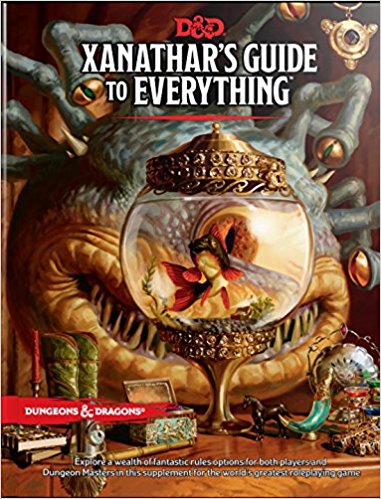
I’ve been saying for a while that playing, and running, more 5th edition D&D is definitely something I want to do this year; and in this post, I dissected the beauty of random tables and promised a review of the product that inspired them, Wizards’ latest D&D5e supplement Xanathar’s Guide to Everything. Well, here it is. Disclaimer first: I’m hardly the most knowledgeable person to talk about D&D5; if some of the new rules are imbalanced and hazy, I probably won’t have noticed them – other reviews are available, that will no doubt have a different focus to mine. I’m not going to be analysing the mechanical balance and options of each subclass presented, for instance – as usual in my reviews, I’ll be looking in broad brush strokes at what’s useful for one-shot games in the publication.

The Fluff – Roll 1d6 for your next three adventure hooks

While at first glance Xanathar’s contains little in the way of setting information, background or explicit ‘story,’ it is filled with is implicit, flexible background. Each character option and random table populates your game’s world with NPCs, factions, and hooks – and these are yours, not some silent D&D canon. This is a map-free book, but in using the optional rules just for your PCs you’ll find setting leaping out at you fully-formed.

What and how? Well, each background has additional tables, and there are a set randomly-rolled life events for each character. Each class has them; and they’re short and simple, easily picked though and just the relevant ones used. Wizards, for instance, now have three 1d6 tables that they can optionally use to determine what their spellbook looks like, what their mystical ambitions are, and what eccentricities they have developed through their studies of the art.

There’s also a set of random encounter tables by terrain and tier that give a good inclination of what different areas are like. It’s a long time since I’ve used any sort of random encounter table (and my procedure tended to be to roll up 2-3 in advance, make them tied to the world and interesting mechanically, and throw them at players if they came up, rather than rolling directly on them while in play) but they give a good sense for the setting and just what kinds of D&D creatures inhabit each kind of terrain.

Another nice bit of fluff is rules for Common Magic Items, which are cantrip-like magic items that provide small, but useful, functions – like the candle of the deep which never goes out, even underwater. Each one suggests multiple different uses – I can imagine a city beseiged by seasonal storms to have a roaring trade in candles for when the storms come, both from the wealthy seeking to keep their houses well-lit and those wanting to do business under cover of them.

The Crunch – there is a lot of this

Let’s start with the big stuff, the stuff that most readers will go to immediately – there are tons of character options, at between 2-4 new subclasses for each class. Some are familiar (I was pleased to see the Cavalier back, as well as the Kensai , Swashbuckler, and Hexblade) – and some are funkier suggestions (there’s a drunken master monk style, and a samurai). I’d really appreciate these when rolling up pregens for one-shots, as they provide a really clear distinct concept for players to latch onto. Because they’re subclasses, they don’t really add extra complexity to play, either, as they’re a one-off option that replaces other rules options in the class.

There’s lots of new spells, too – and extended trap design rules and systems for downtime. There’s tables and rules for buying, crafting, and selling magic items – not likely to see play in a one-shot, but fills in a handwavey part of play that’s been really poorly supported in previous editions. Back in youth of playing D&D, we’d always be heading back to town trying to fence yet another longsword +1 or potion of feather fall, and it always felt we were at the DM’s mercy as to how generous he was feeling.

There’s a new reading of the encounter design system, which appears much simpler and easier-to-use than the previous one in the DMG. My own experience from building encounters for one-shots right back from 3rd Edition would be to make every encounter harder than the rules say – you’re aiming for exciting, dangerous combat rather than the gradual resource-drain of regular dungeon exploration – and on the face of it this system makes it easier to twiddle those knobs to make that work.

Also there are extended rules for using tools – which I can see being really useful in a one-shot to make non-combat skill use a bit better supported in the game. Each set of tools is also linked to which skills are used with it – and if you’ve got any kind of mystery or investigation, these are good sources of inspiration for where clues might come from.

The One-Shot

Truth be told, most of the use this will see in a one-shot is embedded in the options above, but there are 3 excellent pages in an appendix at the back that are really useful. They detail how to setup and run a shared campaign, and although they clearly are geared towards running Adventurer League games, there’s some useful estimates such as how long combat encounters should take and how you can pace experience so everyone stays on the same page. I’m a big fan of linking one-shots into episodic campaigns, and this gives you most of the tools to do so, as well as sharing GM duties.

In an ideal world, for me this would have been 30 pages, not 3, and maybe explored using D&D for one-shots, different campaign formats (the 3-session minicampaign, sandbox play with a player pool like in West Marches, etc) – ook at structuring games and giving players ownership and genuine choice while also managing your prep (stuff like The Alexadrian’s Node-Based Design) – but hey, if it had all that stuff in, there’d be less for people to blog about, I guess.

To sum up, Xanathar’s brings an awful lot of extra ‘stuff’ to the game, but in a format that makes it pretty easy to drop in bits of it at a time to add to, rather than complicate, your game. I’ve still got a lot more thinking and exploring to do about running D&D5e as a one-shot (and I’ll be posting my thoughts here), but Xanathar’s increases the range of tools available to do so. What approaches or prep have you found useful in setting up a D&D5 one-shot, and am I right in thinking that using supplements like Xanathar’s and Volo’s can add richness without complexity?

The 3-Session Campaign Part 2 – Build to the Finish!

In Part 1 of this series, I talked about setting up and planning a 3-session mini-campaign, with a focus on online play specifically (although most of the techniques are just as applicable to face-to-face play). Here, I’ll talk about what to put in Sessions 2 and 3, and where to shift focus.

Between 1 and 2 – Review, Check Focus, Get Feedback

After Session 1, you’ll have a good idea how well your drafted plot is going to fit into the group of players you have. It’s a good chance before the next session to look at your plans for Sessions 2 and 3 and see if they will fit. Also, if the players have established or given detail to any NPCs or parts of their backstory in Session 1, you should try and incorporate them into the coming sessions, to give them a sense of placement in the world.

I’m terrible (which GM isn’t?) at getting feedback from players, and now is a chance to check in with them if there’s anything they like or don’t like about the way the game seems to be going. If any want to tweak their characters, this is a point where I’d let them, after they’ve seen them in play. I’d also be quite generous with experience and rewards as PC development also makes the campaign feel more epic.

Session 2 – Walk Across Middle Earth and Have Some Fights

As the subtitle suggests, you’re looking at The Two Towers here; characters should be developed enough their personalities should be emerging through play, so this session should be a fast-paced series of challenges and activities that give context for character development and roleplay.

In terms of pacing this session, it’s likely that if you gave the characters multiple options at the end of Session 1 you have to make whichever solution they pick the most interesting, and I don’t think there’s anything wrong with this in this format of game (or, basically, ever – but I think that’s another discussion to have!). By the end of this session, the PCs should be in no doubt that they are approaching the climax of their quest – if your game calls for a climactic confrontation at the end, feel free to end Session 2 just before it – don’t feel you need to save extra content for Session 3.

Session 3 – Final Confrontation, then Jumping on Frodo’s Bed

By this stage, you probably have a fair idea of any subplots that your PCs have developed in advance of the final climactic battle, and it’s a good idea prior to this to have a look through this and try and re-incorporate any loose ends into the session. The majority of this session will be the final confrontation with the ‘enemy’ you have set up, and you should pull out all the stops for this. This is the stage at which you can, and should, put up the “death flag” and be prepared for PCs to make the ultimate sacrifice; leave the players in no doubt that this is the end of the campaign.

But leave enough time for a look at the world after the end of the campaign too, to set it in context and provide some finality for the characters that your players have invested in. It doesn’t have to be quite as corny as the scenes in Return of the King where they all visit Frodo, but short vignettes of each PC’s life immediately following, and perhaps further in the future from, the climax of the adventure help to set the game in context.

Conclusion

So, that’s my plan to get more online play into my life – although most of the plans are taken from running short campaigns in real life. What are your online gaming plans to make finite-length campaigns easy to schedule? Do you have any other preferred methods for online play, or have a favourite medium to use for it? Hope to see some of you at games in the future – either round a table or at the other end of a Hangouts screen!

The 3-Session Campaign Part 1 – stretching the One-Shot format

I’ve blogged before about making the one-shot RPG ultra-short, and also about how a one-shot can be slightly longer form. One of the things I’m pondering as we come to the new year is how I’m going to get more online gaming done next year (via Hangouts / Skype), and I’ve come across the crux of the dilemma (for me anyway, but I suspect a lot of gamers).

Thing is, I don’t have the time to commit to a weekly (or even fortnightly) game – either face to face or over G+ – and so an ongoing campaign seem unlikely. And my own limited experience suggests that one 2/3-hour online session doesn’t quite have the hit of a regular convention one-shot. The medium means you don’t get quite as much contact, even if you’re playing with folks you know in real life, and it takes a while for characters to develop and become enjoyable to play.

So, I’m going to propose myself a solution: the 3-session Campaign. Three 2-hour online sessions, preceded by a not-necessarily-concurrent chargen and setup session. I’m hoping that this format will let me get more online gaming done, and that it might work for people with similar scheduling difficulties to me. I should note that this is advice I’ve largely gathered from my experience running face-to-face for 3-sessions, but I’ve put it in the context of online play because I think it provides a useful solution to the scheduling difficulties above.

The Pre-Session: Chargen and Links

In this session, which I’d go over a chat app like Facebook Messenger or a private G+ community, I’d get my players to generate characters (or generate them myself with their guidance / support if they aren’t familiar with the system) and build links between the PCs. I’d try in generating characters to follow good examples from one-shot play to ensure, for instance, that there are sufficient differences between characters and the group fits together with some consistency, as there won’t really be scope for this to develop during play to iron it out.

While some games have structures for this (Dungeon World’s Bonds, Apocalypse World’s Hx splits) that require some turn taking, the order of these is mostly arbitrary, so there’s no real need for everyone to be online at once – or, if they are, they can be sat doing something else with the phone/tablet at their side carrying out the process.

For games without this process, I’d try and establish connections – maybe with focused questions, which could be as basic as “how do you know X?” or, for instance, “when was the last time you brought a PC back from the brink of death?” (for a cleric PC). While this is going on, I’ll scribble it all onto a relationship map that I’ll then share so everyone has an up-front picture of the rest of the party – it especially helps in online play to know who the face at the bottom of the screen is pretending to be. In terms of sharing resources, for online play I think it’s helpful to have a precis of the setting and access to at least the basic rules so that players can engage with these and be ready to go from the off.

Session 1 – Your Regular One-Shot

The structure I tend to use for 3-session play is the movies of The Lord Of The Rings; for this first section, you’ve already done a substantial chunk of the exposition in the pre-session prep chat. I’d follow the regular introductory one-shot format for this: a task set for them to do, a practice combat/action sequence (to clear out any rusty rules), some investigation, and a final conflict that can be a little harder and reveals the extent of the problem facing them.

Pacing is key here; although in my experience, while online play does demand more focus from the players, the interface encourages it – everyone really does have to listen to every other player speaking, because if you don’t pay attention, you’ll be lost. Any rules clarifications, pass them to another player to resolve in text chat – and feel free to make notes of anything in that chat as well. My best experiences of online play have been basic in terms of technical aptitude – there’s nothing wrong with letting players roll their own dice and telling you what they get, and I’ve enjoyed having that physical connection to the game rather than using a dice roller (until I have a run of bad luck – then I usually switch to the dice roller).

I’d also recommend Session 1 being fairly obvious in terms of what the PCs should do and what the campaign is about. Chekov’s Gun applies here as it does in all one-shots; if you introduce an NPC, a location, or a faction at play in Session 1, if the players are interested in it you should make sure it re-appears in Sessions 2 and 3.

Well, that’s how to set up and run the first session of a 3-session campaign; tomorrow I’ll look at Sessions 2 and 3 and the prep between them.

An Xmas Mixtape (a Mixtape is like a Spotify Playlist from olden times)

This blog is now 8 months old. While I’ve not maintained it with as much regularity as I’d foolishly expected, I’ve spent a bit of time reviewing my content – and taken the step to actually shell out some cash to make this ad-free (sorry, those of you who were wanting the chance to win an iPhone 10 every time you clicked the link).

I’ve got big(ish) plans for the blog next year, and am planning to get serious about writing (and editing) RPGs more widely – while it’s only a tiny one-shot, seeing Bite of the Crocodile God get art and layout has convinced me to get my act together a bit more.

My plan in the new year is to continue with a mixture of different things, all through the lens of one-shot play. In the meantime, in case you’ve missed them, here’s a mixtape of what you can expect more of:

Reviews, with a particular focus on one-shot play – I started trying to do all of the Fate Worlds series, but I got a bit distracted – this is probably my favourite, of the frankly bonkers Masters of Umdaar

Prep and play advice, such as this post which I’ll be rereading before Revelation (the Powered-by-the-Apocalypse convention in Sheffield, UK) on prepping PBTA one-shot games

Rules tweaks, like this for making Cypher system (and other games’) experience system fun

And the occasional beard-stroking bit of sentimentality, like this post about the nature of the hobby, and why you shouldn’t feel guilty about all those game books on your shelves.

I’m hoping to get some actual ready-to-play one-shots on the blog as well, and have several percolating in various stages ready for editing and uploading. I haven’t forgotten about the #1H1S thing, either – so expect more about running 1 hour RPG sessions soon too.

And, in case I haven’t said before, thanks for reading. I hope you continue to enjoy it. Anything else you’d like to see, stick it in the comments!

Running Blind – Prepping a One-Shot for the First Time

This Sunday, at Go Play Leeds, I’m set to run 7th Sea 2nd Edition, John Wick’s game of fantasy swashbuckling set in the pseudo-European world of Theah. I’ve never run the game before, and I haven’t played it either. Normally I’d always say that the best prep for running a one-shot is to be a player in said game – it’s much easier to learn a system by doing than it is to read the rules. Not having had this luxury, I’ve had to find my own way with the game. I’m just about ready, and I thought I’d share my tips for prepping a game you haven’t played before:

Start with the Pregens

I started by creating my pregens, trying to use my own guidelines here but also ensuring a simple concept to bind them together. I’ve gone for a ship’s crew, seeing them as a roving band of ne’er-do-wells not restricted entirely to piratical interests but also unaffiliated to any nation. I had a few ideas about core archetypes – so I have a big bruiser, a quick duelist, and a socialite – and can hope they fit together.

Generating a party not only familiarises you with the resources on the character sheet (7th Sea 2nd Ed has a good skill economy), but it helps to have internalised them, so you’re not looking for the right skill or power at the right time. On my pregen sheets, I give brief rules for each advantage and/or power, and writing them down helps me learn the options my players have.

EDIT: I’ve added a link to the pregens to the downloads page, or you can find theme directly here.

Know the Rules

Some folks would say to read the rulebook cover to cover, but I’m not sure how useful it actually is to prep from cover to cover. Generally I think you need to know what you need to know well rather than knowing everything well; depth is better than breadth of knowledge in this case. I’ve read (in this order) the resolution mechanics, the character generation chapter, skimmed the GM advice section, and then followed character generation, while skipping back to the backgrounds of the Nations of my characters to check that my concept fits. Much of the rest of the book I’ve skipped, and will absorb further down the line.

I wouldn’t necessarily recommend this approach for every game, but also that’s probably what I do for every new game. I try to make sure that I know really well the stuff I actually have to know. I’ve ignored, for instance, the ship combat rules for now – I’m going to run that like a normal Action Scene, and lots of the GM rule sections on stuff Villains can do between adventures.

Keep It Simple

My adventure plot is pretty straightforward, and is structured using the scene resolution mechanics presented in the book (note that I’m planning one of my short reviews of 7th Sea soon after I’ve run it, but in a nutshell, I’m convinced that this is a loosey-goosey narrative indie game disguised as a mid-90s trad game, and disguised really well) tightly. There’s a fight scene, a sandboxy high society party for them to investigate in, an infiltration and a final confrontation.

As always, my starting scene is heavily framed and launched (in fact, it begins with the PC’s ship being boarded and in the middle of a pitched battle) and the options spread out from there. There’s some collapsible elements to allow for how much time is left – I’m not sure how quickly the game will play out, and at least at Go Play I’ve got a good amount of time to play with – I can take anywhere between 3 and 5 hours and there’s no session following my players have to get out for. My structure was scribbled out on one page of an A4 notebook, and while it took a while to get down in between reading and thinking about the game, it was an important step before I started my prep proper.

Bash out a Draft

After this, I’ve actually written out in Word what I want to happen at each scene. By forcing myself to write this up – which I wouldn’t do for, say, 13th Age, or a game I’m more experienced with – I force myself to actually consider the structure and order in which I introduce and teach the game. So far my draft runs to just over 2000 words, which is probably my norm for a fully-formed con game draft for a new game; I’ll add a few notes to it as I get ready for the actual game and tidy it up, it’ll stay around that mark in terms of length.

Come Clean

I’m running the adventure on Sunday, and I’ll share my prep after that. I’ll be telling the players straight up that I’ve not run the system before, and that while I’ll be the main arbiter of the rules, feel free to pipe up if I miss something. We’ll muddle through, and I’m confident that the bits of the game that I’ve prepped will work. The bits I’m missing out – which include the Story system, which I’m going to replace with an alternative XP system – are all easily missed from a one-shot.

So, now I need to have another pass at my adventure and get the last bits of laminating done. After I’ve run it, I’ll share my prep on here, as well as the pregens I’ve created for it. How does your experience of prepping a new game differ from mine?