I’ve just returned from the Prignitz wilderness in Germany, where a few days playing games in a Schloss have left me full of ideas for the hobby. The Kraken is a boutique gaming retreat – if you’re at all interested in a diverse set of games with international players, join the mailing list and come and join us.
And I got to play three new (to me) games – all facilitated by other GMs, and all great. This is, I guess, a sort-of review – but full disclosure, I haven’t read these games, only played them – which is the opposite to how most RPG reviews work, but no less (more?) valid. This is a three-part post; I’ll take each game in turn, tell you about it, what I really liked (and was less keen on, if anything) – and crucially, would I play it again.
While you’re reading this, I should tell you about my Patreon. Patrons get access to content 7 days before they hit this site, and the chance to request articles or content, for a very reasonable backer level of £2 per month. If you like what you read, want to support the blog, and have the funds for it, please consider supporting here. Telling people about the blog, and sharing links/retweeting is much appreciated also – thanks!
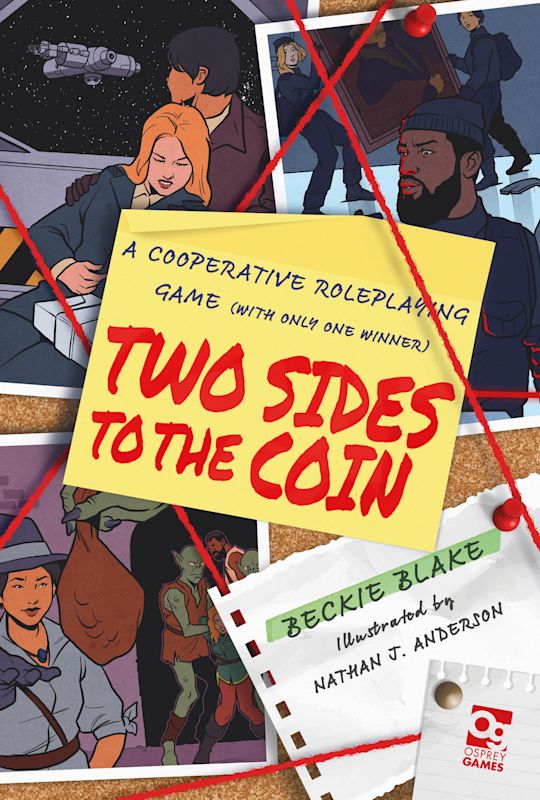
Two Sides to The Coin
Two Sides to The Coin (2STC) is one of Osprey publishing’s roleplaying line, which is always good to support. One-and-done RPGs that explore some interesting concepts, this line has ended up being refreshingly innovative and isolated from some of the hobby’s recent trends. 2STC is designed for short-form play specifically, and uses a simple dice mechanic – with a coin-flip option available to players once a session – and comes with several ready-to-play scenarios, one of which was what we played. In a fantasy setting, we had to recover a wizard’s pet. My PC was the “Village Idiot” – which gives you an idea of the tone.
And it was great fun! High drama this was not, but some great roleplaying interactions were had and I’d certainly return to it. It’ll not surprise you that the wizard’s pet turned out to be much larger – and more dangerous – than expected, and took all of our scenery-chewing and ingenuity to resolve.
What I Really Liked – each PC has “Motives” – goals for the session, that you get points and immediate advances for – one big Ulterior Motive, and several Lesser Motives. These lesser motives are either focussed on players or characters, and are – really – a bit silly. I had to get someone to lend me a dice, another player had to make somebody say the word “wheels” – and each of these gives you an advance to your stats and points for the end of the game to determine the winner. Silly, yes – but a lot of fun. This parlour game alongside the game led to some nice hijinx as we manoeuvred our lesser motives into play. Great fun for us – I appreciate there’s a section of the hobby that will find this infuriating, though!
What I Was Less Keen On – the system itself doesn’t have much – it’s a dice roll under, with stats that can be reduced for bonuses and increased when you hit motives. The consequence of this is that you’ll only really fail if you want to, which combined with the lesser motives incentivising silly play leave it a bit bereft of peril. The coin-flipping option wasn’t used by any of us during the session either, which made it (and the name of the game) a bit superfluous – you’ve always got a better than 50% chance if you’re prepared to spend points, so why would you choose the flip? Maybe we missed something.
Anyway, would I play it again? Absolutely – but I’d be careful about the group for it. Games with some silliness need players aligned in whimsy, and that can be hard to find at conventions.

