Urban Shadows One-Shots

Urban Shadows (US) is Magpie Games’ Powered by the Apocalypse (PBTA) game of urban fantasy; if political manoeuvrings with wizards, vampires, and demons is your jam, it’s a great game. It’s a great game whatever, actually, which is why I’ve developed a few tips  for one-shot play that should help you if you want to bring it to a one-shot table.

I’m going to present this in two stages – what you do before it hits the table, and what you do at the start of play. Note that the book does have some great advice for one-shots in it already, but I’ve extended some of the advice to hit my particular sweet spot between player-driven and GM-prepped narrative. If you’d like more details on running PBTA one-shots generally, there’s a post here, as well as specific advice for Dungeon World.

Before Play

Pre-select Playbooks

You can make things easier for yourself by restricting the playbook selection for your players. This has two advantages – one, you avoid any chance of selection paralysis at the table, and two, you can focus your prep towards the playbooks selected. One from each faction is ideal – and I’d go with The Aware, The Vamp, The Tainted, and The Wizard for my choices – the Hunter has potential for some nasty PvP that some of your players may find uncomfortable, and The Fae has to keep track of promises as well as Debt which can be fiddly. If you have players pre-signed or know who’s going to play, you can let them pick, of course – but this helps to focus your thoughts on where they will be relevant. If you haven’t got anyone playing the Vamp, for instance, you don’t need to think about complex vampire politics.

Pick a City

Either use one of the cities already developed in Dark Streets, the setting sourcebook for US, or come up with one yourself. All you need for this is a defined group for each of the factions – for instance, when I wrote up Manchester 1997 for the Revelation convention I had the City Ghosts as my Night faction – a group of industrial-age spectres that keep the city surviving, and The Bridgewater Club as a group of hunters and graverobbers who sought to maintain the status quo – and represented the Mortality faction. If you’re able to, you could share your city write-up with your players in advance of the session. It’s also useful to develop broad brush strokes of one NPC for each faction. You need to be careful about introducing too many NPCs in your one-shot, but it helps to have some to start with so the players can generate them. Resist the temptation to have more than one NPC for each faction! Your players will generally invent more of them, and you can always create more on the fly for them if you need to.

Think of a Bang to Start With

Before play starts, think about an unavoidable event that can be happening that will bring the PCs together. Maybe something that threatens the whole city, or something that you know the PCs will hold dear – a reason for them to stick together. In play, the start of session move will give them more stuff to do as well, so your incident might be a backdrop or might be the key action of the session, but it should be unavoidable and with clear consequences.

Good ideas are an important area or location in the city being under threat, a massive monster being released or summoned, or a deadly NPC arriving and tipping the status quo. Even if it ends up being a backdrop, it should be something that sets multiple events in motion – it’s OK to have a deadly vampire killer on the loose, but make sure that his murders trigger an all-out Vamp-Werewolf gang war in the city, and have the wizards summoning blood demons to take out the most dangerous Vamp threats to them.

As well as an inciting incident, have a few ideas about how this event will climax towards the end of the session – the battle / binding of the demon, the restoring of the status quo, the NPC being chased off. Clearly it’s a good idea to have this as loose as you can make it, but it should be a clear endgame where the threat gets resolved one way or another.

Start of Play

Do Character Generation by the book

Get the players to fill in their Playbooks as per the rules on them. Follow the book advice on one-shots (one extra advance, 3 points of Corruption, one Corruption advance). Get them to go around and briefly introduce their characters after you give a brief overview of the city and the four factions you created. For each NPC, write their name and faction onto an index card and throw them in the middle of the table.

Do Debt – and make it a massive deal

Get the players to take turns in deciding Debt, and make a big deal of it. The book does advise this, but it helps to explicitly refer to Debt a key currency in the game – this is a game of factional manipulation and politics, so who owes whom is really important. I like to stress that 2 Debt is a big deal – you owe them big time, and they can call in a suitably big favour for this – anyone who owes 2 Debt to someone has a ticking time bomb of something being called in. In play, remember to remind them when they ask for something that Debt is the way to leverage it – and that they can always refuse to help with the appropriate Debt Moves.

Start of Session Moves

It’s easy to think that the start of session move doesn’t work for one-shots, but it really sings, especially if somebody rolls a Miss. I avoid giving any hints of my inital scene before they have done the session move, so that the PCs already have a lot on their plate before their unavoidable event happens.

Don’t pull punches! If they roll a Miss, it’s entirely appropriate to start them in a terrible situation. PBTA games are really resilient at letting PCs go from tragedy to glory, and back again, in just a few Moves, so don’t feel bad about starting with your Wizard captured by a recalcitrant demon he was trying to summon. When they mark their Faction, explain how the Advancement system works and that they are just 3 interactions away from advancing – they should be actively hunting down other factions to get their ticks. In the course of the Session Move, the players might suggest additional NPCs. Write them on an index card with their faction and put them in the middle of the table.

Check your NPCs

Before you launch your starting scene, take a look at the NPCs on the table and see if you can ditch any of them. If there’s one without any debt who doesn’t seem to be of interest to the group, suggest to the players that they might not feature in the game. They might have future plans for them – which is fine – but otherwise try to trim your NPC list down as much as you can. If this means ditching all four of your starting NPCs, so be it! The players inevitably come up with much more interesting characters.

Play!

Often PBTA games suggest you take a break now and collate your notes, look at how factions interact, and check you are ready to play. My own experience is that after the start of session moves I’m often fizzing with ideas, and the players are ready to go, so it’s better to start with the inciting incident now and have a break straight after it.

One piece of pay advice I’m terrible at following myself – make your hard moves soon! In a one-shot, once that first miss gets rolled in a risky situation, it’s fine to hit the player with unavoidable consequences; the “warn someone of impending danger” move is often slow. I prefer, in a one-shot, to “put someone in danger.”

So that’s a quick write-up of how I do Urban Shadows one-shots. It’s a cracking game and a great urban fantasy experience to bring to conventions. I’ll be posting up my Manchester 1997 setting shortly, so watch out for that – and putting up more one-shot advice soon enough.

Oh, and if urban fantasy is your bag, you should check out the kickstarter for the Liminal RPG. I’m involved in editing and producing some Case Files (adventures) for the system, and possibly more content depending on how far the stretch goals go. It’s already funded, so any extra Backers just mean more stuff gets written and produced for everyone!

The Forest of Doom – a Dungeon World One-Shot

Forest of Doom imageIt’s one thing to blog about prep, but here’s some actually finished prep, ready for you to use yourselves, either as an actual session plan or as a framework. I present to you a ready-to-run one-shot for Dungeon World (DW), adapting the classic Fighting Fantasy gamebook The Forest of Doom.
There’s an awful lot of love for the Fighting Fantasy gamebooks (in the UK gaming scene anyway) – an awful lot of us had our first experience of fighting goblins and exploring dungeons in the paperbacks by Steve Jackson and Ian Livingstone.

In adapting it to Dungeon World, I went with a couple of Fronts about the evil forest and the impending troll army, and tried to sprinkle a few clues into the encounters in the forest in order to make them feel a little less random than the original game.

The download for the notes is here – be warned that it’s very much as many notes as I need to run it, and you might find the previous article to be useful in order to make sense of it.

In terms of how I adapted it, I started by playing through the gamebook four or five times (never successfully, may I add – some of the early FF games are really unforgiving!). I then made a list of the most interesting / iconic encounters, and made them the set pieces for the adventure. It was a lot of fun, and it really sang at the table – all of my players were really into the shared narration part of it, and DW does a great job of creating the camaraderie (in-jokes even) of a group of adventurers in only a few hours of play.

I ran it at Revelation, a convention entirely consisting of Powered by The Apocalypse (PBTA) games in Sheffield, UK. I also ran Urban Shadows, which I’ll blog more about soon, and played in an excellent game of Undying.

Right now, I’m tempted to adapt some more FF books for Dungeon World, since it seems such a good fit. Any requests? And if by any chance you do use this at the table, I’d love to hear about it in the comments below.

Dungeon World One-Shots

Edit: If you’re interested in an actual real-life one-shot set-up, my Forest of Doom setup is available here.


I’m mid-way between running a Dungeon World (DW) one-shot, and prepping one at the moment, so I’m thinking a lot about how to make DW hot for one-shot play. John Aegard has some excellent advice here, and I’ve blogged more generally about prepping Powered by the Apocalypse (PBTA) games before, but here’s a few other tips that I’ve developed that are DW-specific. For me, running DW at conventions means I need a bit more meat on the bones of that the PCs will actually do, while still letting them freewheel and develop the narrative situation themselves.

Let them choose

Unlike in other PBTA games, there’s no need to pre-book players in Classes. In other games, the choices they make here have significant impact on the focus of the game and how it plays out – if your Apocalypse World group includes a Hardholder, for instance, you’re going to need to put their settlement front and centre of the action and aggressively threaten and develop it.

In Dungeon World, regardless of the choices made, the players are going to be an adventuring team – so there’s no need to do this. In fact, at the start of play I try to be really explicit that the balance of classes really isn’t important in this game, just to make sure they don’t feel like they need (for instance) a Fighter to tank and a Cleric to heal people. So encourage players to have a free rein in picking their Classes and Races. I tend to restrict mine to the classes in the DW book, just because there’s more than enough there, but if one of the players has a burning desire to play a 3rd-party Class, I’d probably let them.

Pitch your Sitch

For convention games, you usually need to advertise your game in advance, and for that you need to write an exciting teaser trailer for your upcoming game. Get this set in advance and not only can you give your PCs a problem they can’t ignore, but you can also tie them into this story right at the start with link questions.

The game I’m prepping at the moment is riffing off the classic Fighting Fantasy gamebook Forest of Doom by Ian Livingstone, and so to promote my game (and set my situation), I’ve just used the text on the back of the book:

A war is raging and your help is needed to vanquish the evil trolls. To save the dwarfs, you must find the Grand Wizard Yaztromo and track down the pieces of a legendary war hammer lost in the depths of Darkwood Forest, where gruesome monsters lurk.

Now, once this situation is prepared, I write a list of link questions to ask the PCs – at least one per player, but you might want a few more. They ask the PCs about their relationship with this crisis – and allow them to define twists, NPCs, or aspects of the situation within a comfortable framework.

For Forest of Doom, my link questions look like this:

  • You served in the dwarf army before, defending Stonebridge from the trolls. Why did you leave?
  • You’ve wandered Darkwood Forest before. What dangerous beast did you encounter?
  • What have you done to earn the Grand Wizard Yaztromo’s ire?
  • Gillibran, the dwarf leader in Stonebridge, leads a demoralized and divided army. What happened to bring the dwarf military so low?
  • And so on…

I try to make these questions about what has gone before, rather than what is happening now, so that players don’t feel like they might step on narrative toes, and so that I can keep my prep useful. In play, I go through them straight after Bonds.

Fronts, Dangers, and a Map

For a single 2-4 hour one-shot, you’re not going to want more than one Adventure Front. This is the backbone of the adventure, and the closest thing to a pre-determined plot you have. Likewise, your Dangers give structure to the encounters and opposition that the PCs face; without them they might feel they’re aimlessly wandering from monster to monster. For my current prep, that’s pretty much what playing the Forest of Doom gamebook feels like, so I’m especially keen to avoid that!

I’ve not run my Forest of Doom adventure yet, so I’ll publish my Fronts and Dangers separately at a later date to avoid any spoilers for my players, but suffice to say I tend to just follow the procedures on p185 of the DW book, including adding in stakes questions (which might sometimes already be answered by your link questions above).

A lot of the available adventure starters and modules for DW include several Custom Moves for each game. Personally, I try to avoid them – DW does not need new rules for a one-shot. The only time I put them in is when I don’t see an obvious fit with the Basic Moves for how to resolve something – very often one of those moves will fit. They give great flavour in an ongoing game as the party encounters new areas and foes – and ultimately with custom moves, new rules – but I really don’t think they’re necessary in a one-shot.

Forest of Doom map

The Ideal Level of Detail on your map – Darkwood Forest

I like to have a sketch map to put in the centre of the table during play. This doesn’t contain encounter locations or details, but it grounds the players in w

hat they’re doing and makes it feel a bit less like you’re pulling encounters and events out of thin air based on how they’re doing and the pacing needs of the game – which is pretty much what you’re going to be doing, except informed by the Fronts and Dangers. This map from the gamebook is exactly the level of detail I want for my game


Set Pieces

In play, I tend to follow the player’s leads, offer them choices as to which paths and routes to take, and respond accordingly. I do like to have 5-6 ‘set piece’ encounters lined up that I hope they’ll take – usually these will be where they find items or clues that move the adventure along. In Forest of Doom, where the quest is to find the lost two parts of a war hammer, obviously two of the encounters will result in finding the parts of the hammer – but unlike the book I’m going to seed clues in the rest of the encounters to show where the hammer might be, rather than rely on random wanderings through the forest.

These don’t have to combat encounters, and should have a number of options to resolve them. You can use linked questions (eg, “Tell me one thing all gnomes hate” when they first meet a gnome) to give narrative control.

You don’t have to use all of them, but they will provide a backdrop of things to use if you suffer the dreaded PBTA “Move Freeze” when an MC move doesn’t immediately occur to you. DW is already pretty forgiving in this – in no small way because it’s easier in the fiction and implied setting to have a sudden change of pace (orcs attack!) to bring up the energy levels at the table and even buy you some time to figure out what’s going on.

So those are my emerging tips for DW one-shots. I’ll conclude by saying that it’s my belief that Dungeon World really is the most forgiving PBTA game to start MCing, and encourage you to try it if you’re at all interested in these kinds of games. I spent several months trying to grok Apocalypse World and Monsterhearts before a game of Dungeon World made me chill the hell out and realise that they were easier to run than I was thinking. What are your top tips for Dungeon World one-shots? And look out for the full prep notes for Forest of Doom after the Revelation convention at the end of February.

An Xmas Mixtape (a Mixtape is like a Spotify Playlist from olden times)

This blog is now 8 months old. While I’ve not maintained it with as much regularity as I’d foolishly expected, I’ve spent a bit of time reviewing my content – and taken the step to actually shell out some cash to make this ad-free (sorry, those of you who were wanting the chance to win an iPhone 10 every time you clicked the link).

I’ve got big(ish) plans for the blog next year, and am planning to get serious about writing (and editing) RPGs more widely – while it’s only a tiny one-shot, seeing Bite of the Crocodile God get art and layout has convinced me to get my act together a bit more.

My plan in the new year is to continue with a mixture of different things, all through the lens of one-shot play. In the meantime, in case you’ve missed them, here’s a mixtape of what you can expect more of:

Reviews, with a particular focus on one-shot play – I started trying to do all of the Fate Worlds series, but I got a bit distracted – this is probably my favourite, of the frankly bonkers Masters of Umdaar

Prep and play advice, such as this post which I’ll be rereading before Revelation (the Powered-by-the-Apocalypse convention in Sheffield, UK) on prepping PBTA one-shot games

Rules tweaks, like this for making Cypher system (and other games’) experience system fun

And the occasional beard-stroking bit of sentimentality, like this post about the nature of the hobby, and why you shouldn’t feel guilty about all those game books on your shelves.

I’m hoping to get some actual ready-to-play one-shots on the blog as well, and have several percolating in various stages ready for editing and uploading. I haven’t forgotten about the #1H1S thing, either – so expect more about running 1 hour RPG sessions soon too.

And, in case I haven’t said before, thanks for reading. I hope you continue to enjoy it. Anything else you’d like to see, stick it in the comments!

Counters and Cards – how to run a great Fate one-shot

A couple of weeks ago I went to Furnace, the original and biggest RPG con based at The Garrison Hotel in Sheffield, UK. One of the games I ran was a Justice Society game using the Fate system – to be more precise, a modified version of the Dresden Files Accelerated system. I thought I’d give a run through of how I go about prepping – and running – a Fate one-shot.

Before you play: it’s all about Aspects

Make sure that your pregens (if you’re using them – Fate is also great for semi-finished pregens that the players can add Aspects and skills to as they play) have Aspects that are both broadly applicable but also able to be Compelled. Players should never look at their sheet and struggle to find a relevant Aspect unless they are operating well out of their comfort zone and PC skill set – and even then there should be Scene Aspects they can use. Don’t over-think Aspects, just make them descriptors of character traits and abilities – hopefully with a negative side that can be Compelled to earn Fate points.

In terms of props, you’ll need some sort of counters for Fate points (see later) and some kind of cards for Aspects and Boosts. You can using ordinary Index Cards or Post-its, but the wipeable index cards from All Rolled Up are a re-usable solution as well.

For each scene in the game, design two or three Scene Aspects and have these pre-written up on cards before the game starts. If you’ve got them pre-written you’ll be much less likely to forget to put them on the table when the scene starts.

For your named NPCs, make sure that their Aspects are also broadly applicable so you’ll be able to use them at the table without having to think too much. You should be using these Aspects to survive the players initial attacks and force them to use their Fate points and Aspects to beat you, so make sure each named NPC has at least one Aspect that they can use to defend or avoid damage.

While you play: it’s all about Fate points

When running the game, as GM you should be focusing play to keep a steady flow of Fate points between the players and GM. How can you encourage players to spend more Fate points? Well, here are four ideas that I try to use:

  • don’t make the players roll for anything that isn’t important. If a roll isn’t going to be worth investing a Fate point in, it’s an unnecessary roll. Simple investigation, get-to-the-next-scene filler, can just be given to the PCs with necessary roleplaying – it doesn’t need an Overcome check to find a clue unless that clue has some danger attached to it and meaningful (and exciting) consequences for failure
  • give meaningful difficulties. Overcome should be at an absolute minimum of Fair (+2) difficulty – and often I’ll bump them up to Great (+4) if players are going to work together on them. Likewise, named NPCs should be tough enough to present a decent challenge – let the PCs eat up mooks but make the named NPCs memorable
  • refresh Fate points frequently. In a one-shot I also usually offer a free refresh about halfway through the session when the PCs reach a place of safety; they can return up to their refresh (note that this is especially useful in high-powered games where some PCs might start with a Refresh of 1 or 2)
  • model spending them. Remember that the GM starts each scene with one Fate point per player (note that this does vary in different flavours of Fate; but it’s one per scene in Fate Core). You read that right, every scene. With this in mind, you should be spending them immediately to resist the PCs efforts initially – this will also provide challenge and pace the scenes – don’t worry about this becoming predictable, as Fate dice are swingy enough to add some unpredictability to this

While you play: it’s also all about Aspects

As well as using PC, NPC and Scene Aspects, both you and the players should be using Create Advantage to make their own Aspects they can then get a free tag on to their own advantage. To encourage them to use this part of the game, you can

  • make Create Advantage relatively easy. I keep the difficulty for Create Advantage down to +2 normally unless they are actively countered by an opponent, so that it becomes an achievable option to use an action on – if a player is using their turn to create an Aspect, they should have a good chance of succeeding
  • model the behaviour you want to encourage. Show the players how easy it is to use Create Advantage by having some of your mooks do it to set up the big bad; after seeing you do it, they are much more likely to realise how powerful it is
  • don’t be shy of making Defend difficulties high. With a couple of well-placed Create Advantages, players can easily be rolling with an initial +4 without even tagging any of their own or the Scene’s Aspects, so you don’t need to be shy about having  opponents with, say, Superb (+5) resistances. Don’t make these always the case, but if you want to push the players to use all the resources at their disposal, these can make for decent fights. Remember that Fate PCs and named NPCs are pretty resilient if you negotiate Consequences that aren’t always a hindrance – and they don’t have to be.

So, a few guidelines to how to set up and play a Fate game one-shot, and to encourage the table to engage with the key bits of Fate that make it different to other RPGs out there. If all that sounds like a lot to remember if you’re running Fate for the first time, start by just getting counters for Fate points and cards for Aspects and Boosts – just having these out in front of the players is a big incentive to see them used. Is there anything I’ve missed? Does different advice apply in different genres?

By the way, if you want an example of a quick-play Fate adventure set-up, it’d be remiss of me to not recommend my own Bite of the Crocodile God, a short (as in 30-45 minute) adventure for D101 games’ Hunters of Alexandria, a swords-and-sandals monster-hunting Fate game.

Review: Thews of Iron – and Three Kinds of Resource Economies – Conan 2d20

I’m forced to admit I was wrong. I tried to be polite about it when I appeared on The Smart Party podcast and was innocently asked about the 2d20 system from Modiphius games – but it was pretty clear I wasn’t a fan. A couple of games, and a few hours spent trying to navigate character generation in Mutant Chronicles (MC), had left me switched off to this new hotness of a system.

I guess I need to admit that some of my problem with MC probably isn’t the system on its own – but there’s probably a whole other, much more snarky, blog post about that. So I gave it more time, and after playing a game of Star Trek 2d20 that left me, well, ambivalent, I had a go at running their Conan game.

And it was great. I enjoyed myself as a GM, and as far as I can tell the players had a blast as well. I might have been wrong. True, it’s crunchy as hell and relies on an awful lot of bean-counting to achieve, but it combines multiple tactical options with the opportunity for players to do pulpy awesomeness all the time.

The Fluff

I ran the adventure The Red Pit, from the Jewelled Thrones of the Earth adventure supplement, using the quickstart PCs. I had 6 players – one arriving later – and at least one of them hadn’t had much experience of gaming since D&D in their past. For balance, another of my players was Remi Fayoumi, indefatigable 2d20 evangelist and Modiphius fanboy. The adventure is a classic pulp that I know many GMs would dismiss – the players start weaponless and shackled as slaves in the Red Pit and have to fight their way out to the surface. It’s one great big series of linked combat encounters, but works surprisingly well with a few hacks. I did add in a neutral/sympathetic NPC in the form of a suspicious fellow slave who might or might not join their rebellion, and cut out some of the relentless dice rolling of the constant arrow fire, but it still allowed enough opportunity for heroics and roleplay – in part because the system is rich enough to make it interesting.

I also started the game with a pulp montage by telling the players to imagine they are playing characters in a TV series – and asking the players to describe the opening credit scene where their PC is introduced. They just have to say what they look like and what they are doing when their name appears below the credits – it helps get everyone in the right frame of mind, and set the tone for the game. I did the same for the villains too, including the ominous shadow of an animatronic giant lizard.

The Crunch – It’s a Dice Pool System

At its core 2d20 has more in common with dice pool systems than it admits to. Your dice pool is just normally two twenty-siders. You roll your pool and count successes – one for each die equal to or under your skill, and two if equal to or under your Focus – usually much lower and often just 1. You might need just 1 success, or you might need more – up to 5 for Epic tasks, which clearly you don’t have much chance of succeeding on if you’re just rolling two dice. So in order to succeed in difficult tasks, or to make sure you are really effective (extra successes generate Momentum which can be spent immediately to improve your outcome – say, more damage in combat, or extra effect on a skill roll), you’ll have to buy more dice.

The Crunch – Three Resource Separate Resource Economies

You buy extra dice in three ways – by spending Momentum or Fortune, or by adding to the GM’s Doom pool. Fortune is straightforward and gives you an extra die set to 1 – so almost always guaranteeing 2 extra successes. You start with 3 Fortune points and although there are some rules for refreshing them, I didn’t let my PCs refresh in the one-shot.

Momentum is trickier – after you generate extra successes, you can either spend them on extra effect – more damage and the like – or bank them into Group Momentum. This resource can be spent by the players to add an extra dice up to 5d20 on a one-for-one basis – but these dice, you have to roll. There’s a maximum of 6 Momentum points in the Group pool at any one time, and it reduces by 1 at the end of every combat turn, so there’s an incentive to use it or lose it.

Doom is the GM’s pool, and it starts at 3 x the number of players – the same as the total number of Fortune points. The GM can spend it like Momentum, or the players can get extra dice by adding points back into the Doom pool. Players also need to add to Doom to react to attacks – by Parrying or Dodging – and the GM needs to spend it for almost anything, so there’s a good flow of Doom throughout the game. I kept my Doom on show so the players could see it grow and fall through the session – and allowing some tactial play where one player took a telling blow rather than avoid it using Doom so that my pool was run down before the final confrontation – and there’s clearly some tactical nuances to running games with it which I like as well.

The One-Shot

In order to make it work as a one-shot, you need some straightforward resources, I think, in order to help the players make sense of a particularly crunchy system (also see this post on running one-shots with crunchy systems). I had some of these, but not all of them

  • You need 3 different sets of counters. I used skull tokens from All Rolled Up, and glass beads for Momentum, and I wish I’d had something else – maybe poker chips – for Fortune. I kept my Doom in one place in front of the players, and chucked Group Momentum in the middle of the table, but ideally two different bowls would have been great – maybe one skull-like and evil and one, er, pristine and heroic.
  • A sheet with what you can spend Doom and Momentum on would have been great. There are nuances with Momentum spends – you don’t always have to spend it on extra damage – and it would have been good to have it out in front of the players to encourage more creative use of this.
  • An actual copy of the rules. I realized half way through the game that I hadn’t downloaded the rulebook onto my tablet – while the Quickstart rules covered nearly everything, I couldn’t find the recovery rules in there and had to busk them when it came up halfway through the game.
  • You need well-marked-up, clear pregen sheets. The Quickstart PCs are great for this.

So, I’m prepared to admit my own mistakes and will certainly be running 2d20 again – Conan for sure, but almost certainly Star Trek as well, and maybe even Infinity or John Carter when they get released. Mutant Chronicles, maybe not – but that’s for a future post.

When you hack advancement, mark XP – PBTA experience in other games

In one-shot games, we often just accept that character advancement isn’t going to happen. But it’s a key feature of play in some systems, and allowing PCs to grow and develop (alongside their emergent character development) makes the game more epic. The sole exception is in Powered By The Apocalypse (PBTA) games, where the sequence of checks mean that players can, and often do, clock up a number of incremental advances even in a 4-hour slot. As a player, it’s one of my big draws of playing a PBTA game that I get to unlock new abilities quickly.

In this online article, Mike Mearls proposes replacing the somewhat arcane D&D experience system with a simpler 3-Pillar system. PCs gain experience points from discovering locations and/or liberating treasure, swaying influential NPCs, and defeating monsters, and these are equally weighted in his system. Leaving aside my biggest issue with it (the imbalance in D&D having lots of rules to support defeating monsters, slightly fewer for exploring locations, and very few for interacting with NPCs), it’s a good move. If I run D&D for in the future, I’ll certainly use it.

But I’m not sure it goes far enough. I’d like to replace this with an Apocalypse World-style XP system for D&D, as below:

Experience Checks

You have 10 XP check boxes. Write them on your character sheet

Check an XP box when

  • You defeat a worthy opponent
  • You liberate a valuable treasure
  • You explore a dangerous location
  • You win the backing of an important NPC

When you have checked all 10 off, erase all the boxes and level up.

That’s the basic system. For one-shots, I’d be tempted to reduce the number of checks to 5; this virtually guarantees that PCs will level up during the session –you may want to pre-level your pregens if this is the case in order that levelling up doesn’t take too long at the table.

Hacking for other systems

For 13th Age, I’d have a mark on the 5th check box (3rd if I was levelling up on a the 5th) for an incremental advance – with 10 checks levelling up anyway.

For Cypher System games such as Numenera or The Strange, I’d keep it at 5 and allow an advance when they’re checked off. I’d give out what the rules refer to as XP as Bennies (giving them out 2 at a time to a player and asking them to pass one on as per the rules) and only allow the players to spend them on rerolls, not on advancement.

For games that aren’t limited to levels, I’d set the track at 5 and then award a ‘package’ of advancement points that they spend all at once however they like – again, if the system is complex I’d add in a pre-levelled option for PCs.

Hacking the Triggers

Of course, it’s easy to modify what you get checks for. For instance, in a Star Trek-style space opera game you might want the following:

Check an XP box when:

  • You overcome a problem with ingenuity
  • You encounter a new planet, species, or technology
  • You defend the Federation’s values against threat

Or, just as simply, for any game you could borrow from Dungeon World and have simply

Check an XP box when:

  • You fail at an important skll check
  • You miss an attack (only award once per combat)
  • You play your character in accordance with their alignment (only award once per combat)

I should give these a slight health warning, in that I’ve not playtested these at all – but I’m planning to use them in all my relevant one-shot games in the near future, especially when using level-based systems. Are there any other XP hacks that you are keen on? And what would you set your XP triggers as?

The Long And The Short Of It

I’ve recently been in the position to plan (and in one case deliver) one-shots that have stretched the time constraints common to one-shot play. In the first, I ran a game of Vampire: Dark Ages over a full day; in the second, I prepped a 30-45 minute demo game of Hunters of Alexandria, a FATE-based historical fantasy game from D101 games.

The Long Game

A few months ago we hatched the plan for the Vampire game; a two-part, weekend-long game where I would run in the Dark Ages on Saturday and my co-GM would run (with the same PCs) a modern-day Vampire: The Masquerade game on the Sunday. What started as an epic plan led to a fair bit of chin-scratching at the challenges of it; apart from a few terrible experiences as a player in my teens, I had never run or played Vampire. All of my fellow players / GM had a wealth of experience with it. Part of my choice of Dark Ages was that I didn’t need to learn the extensive Camarilla bureaucracy or pretend to know what, for instance, a Primogen was (I still don’t – I think it’s a sort of clan boss or something? I smiled and nodded when it came up in game).

I began by reading my source book (the excellent Constantinople by Night) and making a massive R-Map of all the factions at work, and then started working out which bits I should focus on. I’m not sure I gave the authentic Vampire experience with my game, which was a race against time to find the four relics stolen from the Hagia Sofia, but I think they had fun – and it led to a more satisfying conclusion in the modern day as they re-tracked down their enemy.

In terms of what I did differently to a normal one-shot, I just had more stuff and didn’t push as hard. I put in a couple of encounters that weren’t immediately resolved, and basked in the opportunity to call back to them three or four hours later. I couldn’t quite shake my one-shot conditioning, starting the PCs in a prison cell and having them broken out by a mysterious NPC, which in retrospect was probably an unnecessarily hooky hook, but it all calmed down once they had their mission.

What would I do differently? I might, well, prep a bit more. I pulled more of the plot out of thin air than I would have preferred to; I joked at the time that I was running Vampire using Apocalypse World – I had Fronts and Countdowns for all my factions, and tried to bat through whatever choices the PCs made, but a few more ‘scripted’ encounters could have set up a more satisfying conclusion. I’d do it again, though, and am even now planning some shorter con games of Vampire (again probably Dark Ages so there’s more sword-fights with witch-hunters and fewer cocktail parties).

The Short Game

I spent last weekend at UK Games Expo, working on the D101 Games stall; we had space for demo games, so I prepped one for the FATE-based Hunters of Alexandria (HoA), a monster-hunters historical fantasy game. This was much easier prep. I didn’t actually get to run the demo, and am trying to work out when I will, but it was a blast to prep and I’m looking forward to when that opportunity arises.

I took a 3-scene approach and used the pregens in the book – they come with a range of skills, and some character portraits that looked grabby. There’s a skill check / overcome task to research some murders, a chase, and then a showdown. I’d be confident I can run it with in 45 minutes for up to 3 players; shorter for fewer, and that it gives a good overview of the FATE system. I’d post it here but there’s still a chance it might see the light of day in publication, so watch this space.

I found prepping the shorter game much easier, and I’m tempted to try it for a few more games in advance for conventions etc (aren’t there some Games on Demand things offering similar short offerings? Interested in these) as I think it can be a good taster for games.

Have you run, or played, in a particularly long or short one-shot? What was your experience?

Pregen Priorities: Crafting a Party

For most games I run as a one-shot, I provide pregenerated player characters (pregens). There are a few games, like Powered by the Apocalypse (PBTA) games, and really rules-light systems, where character generation is either a big part of the game or very quick and easy, but even for simple systems I like to give players a ready-made character. Partly this is just to get going quickly – I think you should get into the action as soon as possible, and partly because character generation is never a level playing field. Players that are more experienced will take to it more, and new players are likely to find it daunting. In fact, I think character generation is pretty overrated all the time, but I’m sure I’ll talk about that in a later post.

When creating pregens, I have a few maxims I stick to. Creating 4 or 5 PCs can be a bit of a chore (and it’s often the most time-consuming part of my prep for a con game), and it makes it less of one if I put some effort into doing it well. When I do it, these are my priorities, in no particular order:

Niche Protection

In PBTA games, each player only gets one playset – once somebody bagsies the Vampire, nobody else can – and this is worth sticking to, whether you’re running a class-based game or in a looser game. In a D&D game, for instance, I’d never have two fighters in the same groups – a fighter and a ranger, for instance, or even a barbarian and a paladin (especially in 13th Age, where the fighter is one of the most mechanically complex classes for players, where the other combat-heavy classes are some of the easiest).

Every PC should be the best in the party at something, and something useful to the scenario at that. That said, you can use wedges if you have to duplicate (in Fantasy Age, say, where there are only three classes – just make sure that one Fighter is melee-based and the other is mostly ranged; I’d also make sure they were different races).

In games without classes, you should still niche as much as you can – when I run Eclipse Phase, for instance, everyone will have a different morph – never two uplifted octopi in the same party – and different factions and skill sets. That said…

2. General Non-Incompetence

You want to make your pregens enjoyable to play, even for players who don’t know the system. To do that make them not be incompetent at anything. Having your PC be rubbish at something is annoying, even when you consciously sacrificed that skill in order to maximise other cool stuff, and even more so when that decision has been made for you.

I have learned my lesson from building pregens with limited combat ability. A couple of years ago at Go Play Leeds, I ran a Star Wars Age of Rebellion game (arctic Tauntaun chases across Hoth – it was great!) featuring a tech specialist with limited combat ability. The player, despite his experience, complained bitterly. My thinking was that techie PCs get lots of opportunities to shine in science fiction games anyway, and he had a bellow ability that could stun opponents in combat, but I realise now that having a rebel fighter on Hoth who just couldn’t shoot a blaster made for poor fun levels for that player – and didn’t sit with the genre either. Lesson learned.

3. Laced for Conflict / Rivalry

Even in an explicitly non-PVP game, I try to give the players reasons to disagree and argue. In some games this is achieved by different factional alignments, and in the best games these can be tied to the scenario the players face (I ran a one-shot Burning Wheel game several years ago where one of the all-dwarf party had an entire subplot around freeing the elves his party had captive).

I used to use Victoria Lynn Schmidt’s 45 Master Characters to pick archetypes for my pregens – giving them the best chances of interaction and growth – and I still turn to it every so often, but usually I just go with my gut and try to make the PCs as distinct as possible.

It’s best to make these sources of disagreement outward-facing to avoid the players going full-out PVP. For instance, have one player who thinks that orcs are inherently evil and must be exterminated, and one who thinks they can be educated / civilised. This is richer, and safer, than having one player who thinks that orcs are inherently evil and must be exterminated, and another player who is an orc.

4. General Competence

Even in the lowest of low fantasy settings, PCs should feel like they can achieve something. This doesn’t mean then need to be powerful, but it does mean that the opposition they encounter should leave them feeling they can achieve something.

This isn’t the same as opposition being a pushover; opposition should be hard, require a herculean expenditure of effort to overcome, and nevertheless be overcome. 1st level D&D characters can have this experience (and, by the way, I’d never put an encounter at lower than “Difficult” for D&D – you’re not going to have enough fights to wear them down like in traditional play) if the opposition is right, and as long as they don’t meet any other competent adventurers – they should be the heroes of their stories. Mouse Guard is a great example of how PCs can be weak and fragile and yet still epicly heroic (and it’s a great example of lots of other things too!).

So, they tend to be my pregen priorities. Also, I like to make my own sheets (with any relevant rules information on them). Character portraits and standees I can live without, but I may try them out soon as they become more ubiquitous in convention play.

Viking Hats All Round! – Prepping GMless Games

Fairly regularly, I run games at conventions or other meet-ups that function without the traditional GM role. GM-less is a bit of a misnomer, as really the GM role is shared out between the rest of the group; some writers prefer the term GM-full, but that just reminds me how much terrible food I eat at conventions, so I prefer GM-less.

Over the past few years, I’ve run, among others, Fiasco (Jason Morningstar’s Coen brothers movie emulation game), The Final Girl (Brett Gillan’s game of Survival Horror – a low-key gem of a game), and most recently Melancholy Kaiju (Ewen Cluney’s slice-of-life giant monster soap opera).

It’s not quite the easy ride you might assume to run games like this at a con – with your name at the top of the sign-up sheet, you still feel responsible for everyone’s fun at the table, and you are devolving even more of the power to make or break that to your players. Often what I think I’ll gain in not having to prep pregens and plot I make up for in stress about the system. Here’s my advice for doing it as painlessly as possible:

1. Advertise honestly

Make sure that you state in your game ad that it’s GM-less, and that players will be expected to contribute to the plot. Playing a game like this at a convention is a great way for gamers used to traditional games to experience it, but not if it grabs them by surprise. Give some indication of the resolution system, or lack of it, and whether the players will keep the same characters or not.

For example, in Fiasco there isn’t really a resolution system at all – just a feeling from the rest of the table for a positive or negative outcome – but players are always playing their own PC if they are in the scene (if they aren’t, they’ll be picking up an NPC, but they have final say over their own PC’s actions). In The Final Girl, there’s a direct resolution system with cards to decide who dies, and the PCs aren’t ‘owned’ by anyone – at the start of a scene you can pick any character card up and play it. Some folks will find one, or the other, of these things weird, and will want to know in advance if that’s the case. So tell them.

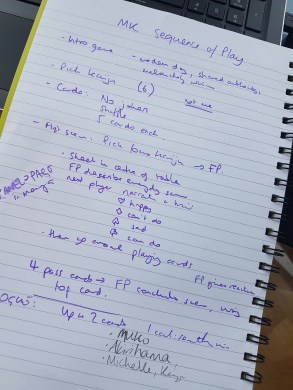
2. Know the rulesMelancholy Kaiju prep

Absolutely essential that you know the rules, and in particular, the procedures of play, in the game. These games have a formalised sequence of play and events, and this is what you need to know inside out, like you would know the plot of the adventure you were running in a more traditional game. Personally, I like to write out bullet point summaries for the sequence of play. I have these in front of me at the table to refer to, but usually I don’t need to look at them – the act of writing them out internalises them enough that after a couple of scenes we all know what’s happening. To the right are my notes for running a game of Melancholy Kaiju last weekend – I think I wrote these out before breakfast on the morning I was running it.

3. Set Tone and Tropes

Make sure you’re clear to the players what kind of game this is likely to produce, and ask them to reinforce it. This can be tricky depending on genre – for instance, in Fiasco, it’s absolutely essential that you pick a playset that all the players are familiar and comfortable with. Every time I’ve had a sightly flat game of Fiasco, it’s been directly because of us not quite gelling with the genre. Good ones for first time players are Gangster London (at least in the UK, everyone can do a Guy Ritchie movie), Touring Rock Band (again, Spinal Tap is etched pretty deep in our national consciousness), or one of the Cthuhu / D&D playsets. Bring a selection and get the rest of the table to pick – it does actually say in Fiasco to do that, but I’ve certainly ignored that advice in the past.

Alongside the tone in the fictional setting, set the tone in real-life as well. Call breaks when needed, check everyone is okay with the pace and the plot, and take the lead in explaining and/or adjudicating. Usually the procedures of play will moderate between player disagreement, but be prepared to be the referee yourself if needed – or if one player is dominating or fading into the background.

4. Play hard

Important advice for every game, but remember that you’ve got to model player behaviour as well in a game like this. Pursue your PC’s goals and embrace the situations they will end up in, and you will encourage the other players to do likewise.

Remember to be an audience as well – and model this. When you have a good scene, break character to point it out, so that other players do too; this feedback loop is important in GM-less games, as players will often be wondering if they are ‘doing it right’ if they introduce elements. Reassure them they are by pointing out awesome stuff as it happens.

As I said at the start, running GM-less games at conventions are a great way to mix up your experiences – they also feel quite different to run from games with a traditional GM role, so it gives you a bit of a break as a GM if you’re running a few. What have been your experiences of running GM-less games at conventions? Any positive – or negative – experiences we can learn from?