I started writing this for Unconventional GMs, and thought I’d share on here, as my ‘ready-to-run’ (scare quotes intentional) scenarios and campaigns often provoke a bit of discussion. I’ve not got any maps, any game statistics (except for adversaries in the core book), and my descriptive notes are either concise or sparse depending on your tastes. Either way, I’d be interested in how this compares to your notes. It’ll be out on UGMs soon (we’re recording next week), so you can check it out in play there!
It was originally written for the Colossus of the Drylands campaign frame, and with 4 PCs in mind of Level 3, but I’ve shaved the non-SRD stuff off it to upload onto here. Just imagine a fantasy wild west full of monsters (although if you’re using this, I guess you’ve got the campaign frame to hand in the core book). Enjoy!
Introduction / Prologue
You have travelled many miles across the hills of the Caradondo Mountains – you’ve heard there’s a soul gem nearby, and your old ally Father Baltesar has gone forward to scout it, heading for the village of Andejoz, a small settlement high up in the hills.
While you’re reading this, I should tell you about my Patreon. Patrons get access to content 7 days before they hit this site, the chance to request articles or content, and the chance to play in one-shot games, for a very reasonable backer level of £2 per month. If you like what you read, want to support the blog, and have the funds for it, please consider supporting here. Telling people about the blog, and sharing links/retweeting is much appreciated also – thanks!
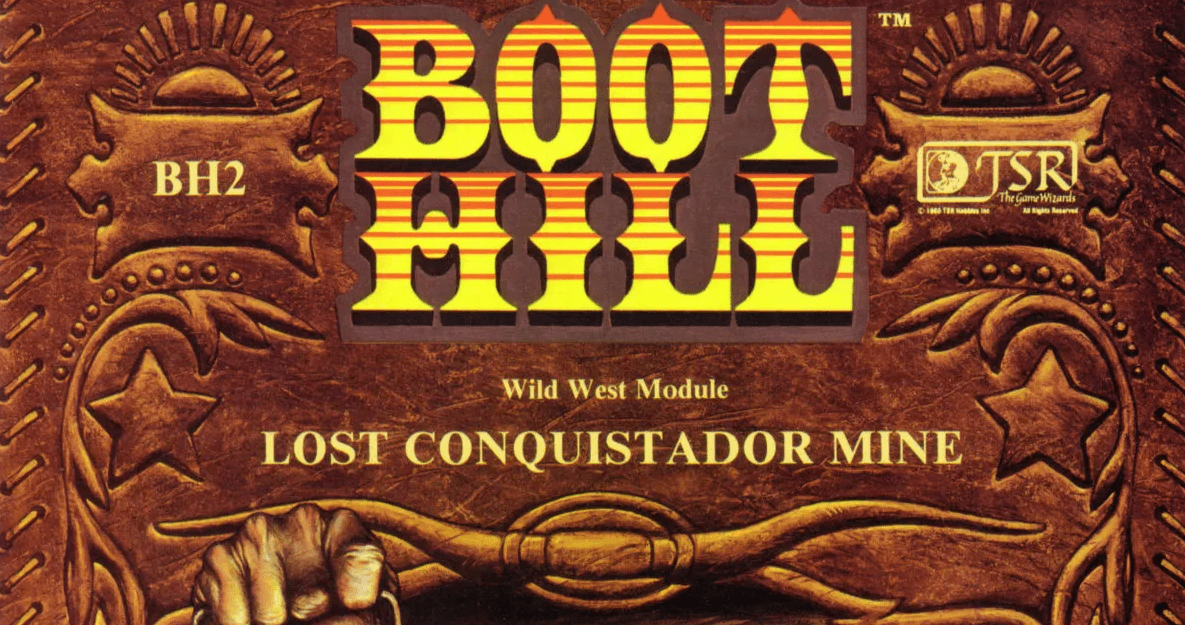
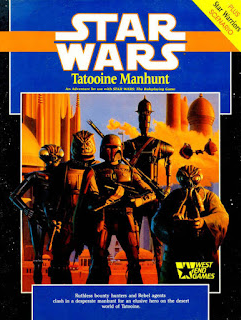
I’ve been converting quite a few ‘classic’ adventure modules for more modern systems recently (check out these Star Wars Outgunnned! adaptations), so for the CRIT online convention I thought I’d run this Boot Hill classic tournament module for Index Card RPG.
The Original Module
Let’s start by talking about the original module. There’s a frontier town, Dead Mule, and a hook to an ancient mine full of gold. There’s then 9 town encounters, 9 wilderness encounters on the lengthy and involved hexcrawl to the mine, and a short ‘dungeon’ for the mine itself. The town’s got a map to it and description of locations, which obviously are triggered in the encounters, and there’s the aforementioned enormous hexcrawl to the mine when the PCs eventually find the map to it.
While you’re reading this, I should tell you about my Patreon. Patrons get access to content 7 days before they hit this site, the chance to request articles or content, and the chance to play in one-shot games, for a very reasonable backer level of £2 per month. If you like what you read, want to support the blog, and have the funds for it, please consider supporting here. Telling people about the blog, and sharing links/retweeting is much appreciated also – thanks!
I’ve been doing a fair bit of adapting old “classic” adventures for modern systems recently – this was one that I did from the old WEG d6 Star Wars system into Outgunned! Here’s the notes for it – presented, as usual, in pretty raw form – if you’re a Patron, you can get the pregens I used for it too! (They’re the same as the Strike Force Shantipole ones, if you’ve already downloaded them).
I’ve included the CATS that I did with the session – just to encourage more people to do this explicitly in one-shots; it really helps to put everyone on the same page with the game. You’ll need, as with Strike Force Shantipole, both a copy of Outgunned! and the original adventure to use this – you should be able to get away without Action Flicks for this one, as there’s no starship combat in it.
While you’re reading this, I should tell you about my Patreon. Patrons get access to content 7 days before they hit this site, the chance to request articles or content, and the chance to play in one-shot games, for a very reasonable backer level of £2 per month. If you like what you read, want to support the blog, and have the funds for it, please consider supporting here. Telling people about the blog, and sharing links/retweeting is much appreciated also – thanks!
I’ve started a new year resolution in 2023 – in 2022 I managed 86 game sessions through the year, and I’m determined to get it back over 100 (2021 was 106, and 2020 was 161 sessions – wonder why that was?) in 2023. So far, so good; I played 12 sessions in January, a month without any big conventions for me, and giving me a projected total of 140 sessions which would be a nice return to form (yes, I do have a spreadsheet).
While you’re reading this, I should tell you about my Patreon. Patrons get access to content 7 days before they hit this site, the chance to request articles or content, and the chance to play in one-shot games, for a very reasonable backer level of £2 per month. If you like what you read, want to support the blog, and have the funds for it, please consider supporting here. Telling people about the blog, and sharing links/retweeting is much appreciated also – thanks!
I’m determined in 2023 to play as much as I can, and while I’ve got a few advantages to doing this (I’m relatively short of family commitments and have both a group of fairly local conventions and one-shot days I’m a regular at, and a group of gaming buddies all in the same time zone) – there’s a few approaches that I think can help everyone get more games in.
Playing Games Is Better Than Reading Games
I guess first we should ask “Why?” There’s a big section of the hobby that consists of collecting and reading games and game paraphernalia, and this isn’t meant to be a slight on that. Well, maybe it is, just a little bit. But games are meant to be played, not read! I’ve lost track of the number of rules that didn’t really shine until the dice hit the table, or plots that were better in the playing than the reading. A few years ago, I decided to make all my reviews on here play-based, and I’ve stuck to that – every review or written piece here is based on a game session, and that’s how it should be.
Make Game Nights Resilient
There’s numerous memes about how hard it is to schedule TTRPG sessions, but there are a few things you can do to help reduce cancellations. Having one more player than you need is an excellent move – our Tuesday night group is 5 of us, which is probably one more than we’d ideally have for online play, but it means we can carry on playing even if one person drops out. This keeps the momentum and makes future cancellations less likely.
We also alternate GMs – if you can find a group to do this with, it really helps. Playing seasons of 4-10 sessions and then swapping over keeps everything fresh and, again, maintains momentum. If I was setting up a new D&D / traditional fantasy groups from scratch now I’d probably go for 5 players, with an explicit expectation we play with 3 or more – unless the canceller is the GM, you’re good to go.
Obviously, sometimes it doesn’t make sense to continue playing without all players – the first session of a new season, for example. When that happens, try to get a one-shot down, so that you’re still meeting up and playing – we did this recently with my “Star Trek” group (which I’m currently running Avatar Legends for – but we started playing Star Trek, hence the name) – a Trophy Dark one-shot which was a complete break from everything we’d been doing.
Go To Conventions / Meet-Ups
It won’t surprise you that I’m a huge fan of one-shot games, and I really believe if you only play in long campaigns you’re missing out. There’s lots of conventions and one-shot meetups advertised all over the place now, and going to a few of these to mix up the people you play with is a great opportunity to get more games in and broaden your experience of the hobby. If you can’t find one convenient for you, you can always post in your local Geek Retreat to see if anyone fancies a one-shot – I did this during the summer holidays a few years ago and ran more 1st level D&D for new players than I’ve ever done since!
Don’t ignore online conventions, too – or online gaming generally. Most of my sessions (about 70% of them, according to the spreadsheet) are online, and it’s a great way to maintain a regular group without having to leave your house.
Do Prep
Having a few ‘back pocket’ games is a great way to keep playing – those one-shots when your group can’t meet up rely on somebody having something ready. Luckily there’s lots of opportunities now to use starter sets and introductory adventures, so it doesn’t even have to be loads of prep – just read them and be ready to run.
If there’s a game you’re keen on getting to the table, ask yourself if a group came round tomorrow could you run it? Get the prep ready and you stand at least some chance of it happening. I’m at that stage now with both Ironclaw and Rhapsody of Blood, both games I’ve wanted to run for ages but never really got to the table – and without anything prepped for them, I’m unlikely to.
Solo Stuff
Don’t ignore some of the solo gaming options out there! I’m very much a newcomer to the solo RPG world, and I confess I still find it a completely different experience to group play, but there are some excellent games that work really well for solo play (Ironsworn and the new Rune are the ones I’m thinking of) and some great tools to play solo (I like DM Yourself for published adventures, and the Mythic GM Emulator is the old hand for it). I’m no expert, as I say, but a quick glance at youtube shows lots of people who are having great times doing this – and it’s a good way to master as system ready to prep a group game, too – so give it a look if you think you might fancy it.
So, can I keep up to my 140 expected games in 2023? I certainly hope so, and I’m trying to broaden out some of what I play too – there’s a few conventions coming up that I’m keen to try new games at, so I’ll keep you posted here with how they go.
I don’t really like “sandbox” play – where a setting or location is provided with NPCs, some interactions, and the players are left to wander around finding an emergent plot. I think it’s some youthful games of Traveller where my fellow players just traded and avoided any kind of danger, but they’ve always been slow, unwieldy things where the emergent plot hasn’t been satisfying.
While you’re reading this, I should tell you about my Patreon. Patrons get access to content 7 days before they hit this site, the chance to request articles or content, and the chance to play in one-shot games, for a very reasonable backer level of £2 per month. If you like what you read, want to support the blog, and have the funds for it, please consider supporting here. Telling people about the blog, and sharing links/retweeting is much appreciated also – thanks!
But genuine choice is a real feature of one-shots, which can easily be railroaded affairs, so I’d like to get better at them. So, for one-shots or longer-form games, I present my solution – or at least, the solution to my problem with sandboxes – the Grand Theft Auto Sandbox.
I’ve named it after GTA as that’s the first video game I encountered that looked like this, but it’s generally how open world games are structured now, and I’m sure GTA3 wasn’t the first. In it, as the world opens up, you always have a few missions on your plate, that you can follow in whatever order, some main plot and some side quests. The choice and setting makes for an entertaining game where you really feel in charge of your characters destiny.
As it’s been developed, in games like Red Dead Redemption you have side quests that turn out to be main quests, and a few branching storylines – all immersing you in the world, and making your characters choices feel important even though they aren’t always.
What’s Wrong With Sandboxes?
Well, there’s a few things, in my experience. Some of these, to some players, may be more feature than bug, but for me they do my head in:
PCs, faced with a dangerous and less dangerous option, will always choose the less dangerous first
The sandbox often doesn’t change. Whenever you go to the town, it’s often the same location they saw before
Side quests are either not present, or too independent of the main plot – they’re either too tempting or not tempting enough
The players disagree about what to do. With too many options, it’s hard to see what to do
Building Your Sandbox
Have a limited, bounded location. Give some interesting-sounding adventure sites – these can just be names for now
Imagine an antagonist, and the plot your PCs will work against. Sketch out some possible escalations of their plan that can happen during the sandbox
Add a couple of neutral/antagonistic factions that aren’t the main antagonist that the players can butt up against. Work out how they feel about the other factions, and what they want
Prep a straightforward, action-oriented first session that introduces the main factions and locations and sets up a the next two or three options for quests
Playing Your Sandbox
Give two or three missions at once. Missions that aren’t picked up may stay available, or may vanish as they pursue others.
Steal published adventures for quests – either with or without the serial numbers filed off
Have some side quests ready that the players can do at any time. Maybe these have a simple twist ready that link them to the main antagonist – or maybe they don’t
Ask the players what they do next time at the end of the session. This way, you only have to fully prep what they’re doing next, rather than the whole shebang.
Lay out tracks in front as you go. You might know where you’re heading, but you might also want to play to find out – especially if you’re running a more player-driven game.
Occasionally, interrupt and put them on rails – especially if the antagonist reacts. If they’ve been particularly successful against them (or another faction), have the trouble come to them and them have to deal with it
So, there’s my basic principles of GTA Sandboxing. I’m going to provide some more examples later in the week of how to use this in action, and how it applies to a one-shot. If there’s any particular settings or systems you’d like to see use this method, let me know in the comments.
I’ve had some rum luck with illness recently – a chest infection a few weeks ago, and now Covid (I’m recovering, thankfully) have meant I’ve missed two #TTRPG conventions that are genuine highlights. Owlbear and Wizard’s Staff is excellent beery fun in Leamington Spa, while Furnace is a centrepiece of the Garrison Conventions and the place that first got me into convention GMing.
While you’re reading this, I should tell you about my Patreon. Patrons get access to content 7 days before they hit this site, the chance to request articles or content, and the chance to play in one-shot games, for a very reasonable backer level of £2 per month. If you like what you read, want to support the blog, and have the funds for it, please consider supporting here. Telling people about the blog, and sharing links/retweeting is much appreciated also – thanks!
So, I’ve been left with an excess of prepped games, and no-where to run them – so I’ll be putting them out on here. First up, a game that was planned for Owlbear, for Roward Rook & Decard‘s Heart: The City Beneath. In Heart, your desperate treasure-hunters delve into the living, beating dungeon beneath the occupied city of Spire to find eldritch treasures – and themselves.
Yes, the art is all this good – as you’d expect from RRD
Full disclosure – I haven’t actually run this, although I’m sure it will get an outing soon. If you’re Heart-curious, this might give you an idea what to expect in the game. If you’re a Patron, feel free to message (on here or twitter) and I’ll send you the pregens I did for it as well, giving you a fully ready-to-run game. Also, this is based on an adventure seed in the actual book – there are loads of them in there – but fleshed-out to be runnable for a one-shot. I’ve got more to say about prep for loose-improv games like Heart and Spire, but that’s another blog post.
Into the Underhang
A Heart: The City Beneath One-Shot
Into the Underhang is an independent production by Burn After Running and is not affiliated with Rowan, Rook and Decard. It is published under the RR&D Community License. Heart is copyright Rowan, Rook and Decard. You can find out more and support these games at rowanrookanddecard.com.
Scene 1 – Derelictus
We begin in the city between the cities, a sprawling, semi-underground mirror of Spire, Derelictus. From Platform 1, where all manner of equipment can be sourced, to Platform 2, where we find ourselves now – with Ostrer, a mad researcher, is cutting you a deal.
Hang Station was built as a tourist trap; suspended over a vast subterranean sea, so that aelfir could see the captured, sleeping monster beneath, captured from the far north. Hang Station is on Tier 2 of Heart – so will need at least a couple of delves, stopping off at a waypoint on the way. He wants to get a sample of the beast’s blood – and he needs your help.
There appear to be two notable routes towards Hang Station (a Technology) – through the singing, open railways of the Vermissian Railways – maybe hoping to catch a train some of the way, or a darker, lower way, through Sump Station (a Warren) – the flooded remains of an old station now submerged. Darker, but less likely to attract attention
In Derelictus, each PC has a chance to prepare – they can try and get hold of a D6 piece of equipment for the journey, or research another route – perhaps one going through a more favourable area for them. After a skill roll each, and potential stress (always D4 at this stage, and usually to Supplies or Fortune), they must set off
Scene 2 – Delve to Tier 1
This is a delve they will take to either Sump Station, Hang Station, or another location
Route: Between Derelictus and Sump Station
Tier: 1
Domains: Technology, Warren
Stress: D4
Resistance: 10
Description: A tramp through foot-deep, the knee-deep, flooded tunnels, in fading light and with labyrinthine corridors. Occasional relics of machinery or rails puncture through the floor – and occasionally pumps still churn. It smells bad initially, then turns to a warm, cleaner smell.
Events: Jonjak and his gang of gutterkin will track the PCs from Derelictus, and attempt to jump them to find out what they are doing; a sudden overflow means they have to wade chest-deep or lower; strange fluorescent fish swim under the water and circle the PCs; a warehouse of fishmongery where Mikkel the Fish waits to serve them
Connection: Capture the glowing fish for Mikkel and he will teach you the secrets of the eddies
Route: Between Derelictus and Hang Station
Tier: 1
Domains: Technology, Occult
Stress: D4
Resistance: 10
Description: A walk along high, ruined walkways alongside the tracks which have collapsed in places; crystals line the path eventually; the smell of incense and sulphur. Damaged rope-ways line each pathway
Events: Jonjak and his gang of gutterkin will track the PCs from Derelictus, and attempt to jump them to find out what they are doing; a clattering of a passing train requires jumping out of the way – or onto it; the singing of crystals in the ceiling above as one falls and shatters
Connection: Repair the rope-ways linking to the paths
Scene 3: The Mid-Point
At this point, they have arrived, either in Sump Station or Hang Station, and have a chance for respite. Ostrer insists that they need to purchase some supplies – ropes and pulleys – but at this point you encounter the rival delvers, Protector Baram and his men.
They accost the players as they explore the haven, asking them their business and mocking them. They know that the beast has laid eggs, and can see that Ostrer wants one as well. Depending on the PC’s approach, they may suggest an alliance, or try and sabotage their equipment. Either way, he will wish them luck.
As with Scene 1, PCs may make 1 test to try and recover equipment or preparations for the further delve.
Scene 4: Into the Underhang
From their location, they need to venture deeper into the Heart, to Hang Station and the underground lake.
Route: Between Tier 1 and Hang Station
Tier: 2
Domains: Cursed, Technology
Stress: D6
Resistance: 10
Description: Trekking through walkways suspended over still lakes, or raging torrents – creaking at the wind that blows through them. The smell of tar, and then of some big, fishy beast. The crackling of magical energy from long-decayed dampers and siphons. The echoes of fellow hunters, or ghosts, around them.
Events: A crackle of energy covers the ground in front with a web of occult power that must be bypassed; the walkway shatters and falls, meaning they must form a new route; Jonjak, still tracking, ambushes them on a walkway; Baram makes his move as they approach; a ghostly engineer seeks aid in repairing conduits and walkways
Connection: Repairing the conduits will allow them to lay the ghost to rest.
Scene 5: The Harvest
They emerge onto a vast creaking observation platform, a sparkling lake below them swaying gently. A huge whale-beast has broken the surface of the water below, and a light snore echoes around the cavern – but the eggs are on the other side.
They must
Somehow get down to the lake. There are maintenance rowboats and rafts available, ropes and pulleys, that could be fashioned
Recover the eggs from the egg sac beyond the creature – they could dive in, or trick it into rolling over
Avoid the attentions of the rival gangs, who will attempt to ambush them
At their moment of triumph, a roar echoes through the lake – the beast has awoken, and they must escape
NPCs
Ostrer the Mad Researcher
Motivation: Find and recover the eggs of the Hang Station beast
Sensory Details: Thick, clouded goggles with no light; the smell of dusty books mixed with oil; a dirty, flapping lab coat
At the Table: Close eyes when speaking
Jonjak the Tunnel Brigand
Motivation: Find a score big enough to retire on
Sensory Details: Filthy overalls and cloak; scarred face and hands; odd limp
Motivation: Gain freedom from Jonjak, or at least more pleasant employment with him
Sensory Details: A mob of 8 or 9 gullboys and heron-girls; squawking and clambouring over one another; rusted, broken knives with alarming speed
At the Table: Look this way and that while skwarking in semi-speech
Resistance: 8
Protection: 0
Stress: Knives D6, Unreliable
Mikkel the Fish
Motivation: Serve his narcotic fishes to the discerning
Sensory Details: A scale-clad shaved gnoll with rings everywhere; stares oddly at everything; the smell of oil and tar
At the Table: Keep mouth open when not speaking
Protector Baram, Drow Rival Delver
Motivation: Be the first to recover a beast-egg for his masters
Sensory Details: The smell of cheap perfume, a shiny well-maintained leather coat, the clip of heels on ground; accompanied by a pair of cackling gnolls, Forrad and Vorrad
At the Table: Alan Rickman-esque villainy
Difficulty: Risky
Resistance: 10
Protection: 1
Stress: Whip D8 Tiring, Pistol D6 Ranged One-Shot
The Hang Station Beast
Motivation: To eat, sleep and breed
Sensory Details: A thick smell of fur, fish and sweat; blue-grey skin covered in slick water; a light, echoey snore
Last year, I started writing about Prep Techniques – ways to structure your prep for a one-shot session to build a good structure for your session. One-shot and short-form play is all about having a clear structure of ideas so you’re not left floundering at the table, and these were designed to encourage that, with practical advice to turn an idea into a ready-to-run set of prep.
I contrast these with Table Techniques, which are things you do during the game that often don’t need any prep beyond creating the conditions for their deployment – Shared Narration is an example of this (well, several examples) – and I’ll be providing more examples of them over the next few months.
While you’re reading this, I should tell you about myPatreon. Patrons get access to content 7 days before they hit this site, the chance to request articles or content, and the chance to play in one-shot games, for a very reasonable backer level of £2 per month. If you like what you read, want to support the blog, and have the funds for it, please consider supportinghere. Telling people about the blog, and sharing links/retweeting is much appreciated also – thanks!
There hasn’t been a full list of my Prep Techniques posts before now, so here’s a summary of what’s here. If you’re just starting prepping a one-shot and not sure what to do first, you could do worse than pick one of these and follow the method described.
Essential prep – gathering your props
The 5-Room Non-Dungeon is Johnn Four’s 5-Room Dungeon method, applied more broadly to give a series of linked scenes. This is a great place to start if you’re beginning running one-shots. I actually think it works better out of the dungeon than for dungeon games.
Three Places is a way to structure investigative, location-based play where you want your players to have genuine choices as to how they approach the problem.
Another one that’s not mine, I did a deep dive of Sly Flourish’s Return of the Lazy Dungeon Master prep method here – even if you don’t use the whole method, the list of unconnected secrets and clues is a great technique to have in your back pocket, or to go through before a session to give things for the players to discover.
Another good way to get started is to write a convention pitch for the game, and use that to focus your thoughts – guidance here. Technique also applies for writing actual convention pitches!
For a more loosely-structured game, where you expect to think on your feet, you need a bag of tricks to throw at the players. The guidance in this post is relevant for PBTA, FitD, and other similar games like Spire and Heart. It’s easy to try and go in raw with these sorts of games, but in my experience having some prep thoughts done beforehand really help to make them sing in a one-shot.
Or for a more simple structure, start by thinking about the Boss Fight and work backwards from there. There’s a couple of examples of this approach here.
I’m not saying there won’t be more Prep Techniques shared in the future, but here’s all there are for now. My focus for the next few months is two things – putting out ready-to-run one-shots for a few systems (most of which are my own con game sessions from over the summer) and Table Techniques, which will give techniques that can be done during play to add interest and excitement to your games. Let me know if there’s anything you’d like to see!
Over at Patreon, one of my backers requested a post about starting a new campaign. I’m always happy to take requests from my noble backers, so here’s a step by step of what I do when I’m starting to set up a campaign or longer-form game. To give my bona fides, until 2020 I don’t think I’d ever run what I’d consider a successful campaign game – but the advent of lockdown, and a dive into online gaming, has changed that. I’m currently running an ongoing D&D game, a Star Trek Adventures game (where we are skirting around the Shackleton Expanse campaign), and in the process of pulling together a One Ring game. So – what do I do to start with, when I’m about to launch a campaign?
While you’re reading this, I should tell you about my Patreon. Patrons get access to content 7 days before they hit this site, the chance to request articles or content, and the chance to play in one-shot games, for a very reasonable backer level of £2 per month. If you like what you read, want to support the blog, and have the funds for it, please consider supporting here. Telling people about the blog, and sharing links/retweeting is much appreciated also – thanks!
Set the Scope
Firstly, think about how long the campaign is going to last, and agree with your group. I’d strongly recommend splitting a longer campaign into seasons of max 8-12 sessions in order to keep things fresh, and I’d consider starting with even fewer sessions than that. Having a defined end point will stop your campaign from fizzling out, and keep everyone in the game and focussed.
Based on how often your group meets, work out how long real-time this will last for – and make sure you’re up for that. If you meet once a month and want to run a 12-session campaign, that’s a year’s worth of gaming for the group! If you’re weekly, 12 sessions is still 3 months of play. Make sure that you – and your players – are clear about that commitment and happy with it.
Of course, you might have an in-game end in mind – for my D&D campaign, we’re running through Rime of the Frostmaiden; that campaign finishes when they’ve brought the sun back to Icewind Dale and defeated Auril the Frostmaiden. Even with that, I’ve worked out that with 2 sessions at each level of character, this is about 20 sessions. I’d planned a mid-season break after 10, but as it happens we ended up cancelling some sessions anyway, so we’re good to go with the second part of it.
Get the Big Picture
The approach to this stage varies a little depending on whether you’re plotting your own campaign or running something pre-written. In either case, though, you will sketch out the broad picture of how you expect the campaign to play out.
If you’re rolling your own, a great tool to use (taken from Dungeon World) is Fronts. Consider your campaign’s big bad, and sketch out some steps that it might take. Sly Flourish also has a discussion of using this for D&D that streamlines the process a bit.
Having a campaign finale in mind helps – even if your Roll20 presentation isn’t up to much
If you’re using a published adventure, this is when you need to skim read the whole thing. If you’re running something popular (like a D&D campaign) it’s also well worth googling it to see if folks like Sly Flourish or Justin Alexander have notes on how to run it. There will be some of these on here soon as my ‘Deep Dive’ series extends – currently I’ve got Rime of the Frostmaiden Chapter 1, Shadows over Bogenhafen, and the first Vaesen adventure compendium A Wicked Secret to write up.
Once you’ve got this, sketch out how the sessions might look – for instance, I expected for Rime we’d probably hit one of the Ten-Towns quests per session, along with some additional personal stuff, for the first 6 sessions before hitting Chapter 2 and the more open-ended part of the game. As it happens in a couple of sessions we doubled up adventures, but we were able to mesh some of the scenarios into the PC backstories anyway (for a session-by-session report written by one of my players – and ongoing – check out Fandomlife’s blog here).
Running published campaigns requires slightly different prep to rolling your own
If the start of your campaign is going to branch off and be more of a sandbox, think about how you’ll structure this. I’m a big fan of getting players to decide what they’ll do next time at the end of a session, so I can focus on those bits for the following session. Also, think about how long you’re prepared to let them play in the sandbox – is there an element in your Front, or a lead you can drop, that will force them to leave and stop them wanting to talk to every NPC and find every secret?
Imagine Some Specifics
Once you’ve got your big picture, you could run right away, but now I like to start thinking about specific scenes, encounters, locations, and NPCs that might come up. These can be just sketches to start with, but by having a file ready to note these in before the session zero, you can add to it. For example, in a campaign of Legend of the Five Rings I ran a couple of years ago, I had a few scenes in mind before chargen started – but when one of the PCs had a morbid fear of dogs, of course the bandits were led by a dog-faced demon who took an instant dislike to them.
With a published adventure, you might want to think about a few NPCs using the 7-3-1 technique if they are likely to recur or be important – I’ve got a wizard lined up for the next couple of sessions who I sketched out a personality for right at the start – or how some encounters might play out in the first few sessions. This isn’t unlike the Bag of Tricks prep technique I’ve used for one-shots – it gives you some go-to scenes and moments that you’ll be able to use later in the campaign.
Session Zero
At this point, you’re ready to get the players involved. My personal agenda for a session zero covers Content / Chargen / Play, but sometimes fitting in all of these can be tricky. If character generation is something that will be dreary to all sit round and do together, get your players to come to the table with something lightly sketched out, and do a bit of in-character bonding in that first session instead. Absolutely would recommend the final part though – getting a bit of play in makes it all worthwhile!
For Content, you want to discuss any safety tools you’ll be using, as well as invite your players to contribute to Lines and Veils and Tone – again, The Gauntlet has an excellent blog on all of this. Alongside this, you want to cover housekeeping – how often you meet, who brings the snacks, what to do if you can’t make it, that sort of thing. For my games I generally have a hard rule that if 3 players and the GM can make it, we play – and we’ll work out a way for the others to catch up later. This does fall down a bit if I can’t make a session, but it gives a bit of insulation against having a run of cancellations.
For the Play bit, just a half-hour encounter is fine – but I’d go with something action-y that involves rolling the dice instead of something roleplay-focussed. Start them around a camp, and have some goblins attack, and then the goblins tell them about the problems in the area. Getting some dice rolled makes the session zero fun, and starts to build momentum for the game proper.
Session-By-Session
Now you can run it! For me, I’m never more than a session ahead of where the party is up to, and I prep in between sessions – I can’t imagine doing it any other way. I’ve blogged before about session prep for campaigns being like for one-shots, but to summarise – I’d recommend making each session a coherent episode if you can, even going so far as to give it a name.
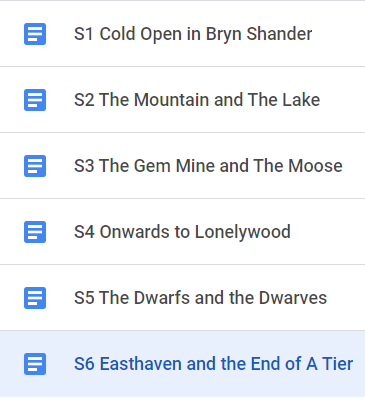
6 sessions of prep files – complete with corny titles
In my prep, each session gets a Google doc, and follows a fairly similar format, which is either a scene-by-scene breakdown followed by NPC notes, or a Sly Flourish Lazy DM set of notes. I’ve found that for my own prep, I like a defined scene-by-scene breakdown, but for published games that I’m running the Sly Flourish technique works best. I think this helps me to break down components and be a bit more prepared for players going in different directions – whereas with my own games I’m already able to do that without any help.
I’m conscious of my own practice as well (or at least try to be) – and one of the things I’m trying to work on is more memorable NPCs – so at the moment I make sure there’s a few ‘tells’ for each one in my prep notes to make sure I put the effort in to try and do this.
Be sure at the end of each session to get some feedback – either as Stars and Wishes (now rebranded to Spangles and Wangles by my Friday group) or a more informal method, and be prepared to tweak where the campaign is going if needed. I’d also recommend having some ongoing contact with your players, whether about the game or not, between sessions – it helps to keep momentum, which is one of the main things you need to keep a campaign going.
So, step by step campaign planning! I’ll try and get a couple of examples down too, and as always happy to accept Patreon post requests! Let me know in the comments if you’d like to see more.
“Don’t split the party!” is a classic refrain from the early days of D&D that still holds a surprising amount of traction. It’s also absolute rubbish; your games will be much more fun if the group separates and gets back together during the course of an adventure. This is especially true in investigative games like Vaesen or Call of Cthulhu – but even in your classic F20 game it can lead to much richer play. Here’s why.
While you’re reading this, I should tell you about my Patreon. Patrons get access to content 7 days before they hit this site, the chance to request articles or content, and the chance to play in one-shot games, for a very reasonable backer level of £2 per month. If you like what you read, want to support the blog, and have the funds for it, please consider supporting here. Telling people about the blog, and sharing links/retweeting is much appreciated also – thanks!
More Content!
If you’ve got two potential leads out from a scene, why go to each in turn? Send a couple of PCs to talk to the old woman, while the others poke around in the merchants’ quarter. By cutting between them, you get a nice contrast, and it’s easier to be an audience for the other pair when things are being resolved by the others. Things move quicker with fewer PCs on the scene, too.
In-party roleplaying in action
More (In-Party) Roleplaying!
Four PCs in the same place, talking to someone – they might talk to each other, but the focus of their investigation is going to get more of their time. Two PCs in the same place, it’s much more natural for them to talk to one another – and it will happen more. This is especially true online, where a conversation between more than two people needs structural help to avoid talking over each other.
Mix up the pairings a few times, and you’ll soon get some neat character interactions going. If you’re doing this in a very trad game, or as a one-shot, you might want to lay the groundwork for this with some in-party setup questions.
More Verisimilitude!
Another cliche from the early days of roleplaying is the Cthulhu investigator team – six men with shotguns showing up in the suburban street to talk to the little old lady about her neighbours. In genre fiction, it’s very rare that the whole ensemble cast go together to resolve a problem – this is reserved for the finale (and maybe the start of the episode).
If you’re looking at a one-shot structure like the Ur-Plot, it could be as simple as the middle bits are with the party separate – you’ll end up with a grabbier plot, that’ll move faster and cover more in-party chat – all for the good!
How To Make It Happen
First, let’s make sure we’ve got the conditions for this to happen. You need to banish any sort of adversarial “the-GM-is-out-to-get-us” mentality from your players – which means, try and not give them the obvious potential risks from splitting up. Eventually, you probably want to throw that ambush – and the subsequent rescue – but to start with you probably just want peril to be the consequences, not actual character death.
Keeping the PCs in contact – with cell phones or the fantasy equivalent – should also make them more comfortable splitting up. Eventually, you want to remove these and cut them off, but that will only be effective as a change from the norm, so keep that in reserve for the first couple of times.
You can also put a timer on it – if there’s only 3 hours until the next killing has been foretold, and there’s two temples to search for the anti-ritual, there’s a big incentive to split up and cover both places.
Getting Into Trouble
I’m certainly not advocating that when the party is split up it should be peril-free; the scenes should be exciting and dangerous, or what’s the point of them. But the peril doesn’t have to be combat. Skill checks or challenges (even longer-term ones) work just as well with 2 players as with 5, so plan some of these for big payoffs.
There’s a knack to getting spotlight right with this – you don’t want one group making a single Persuade check while the other has some multi-layered challenge to resolve their scene – but you can always give the successful Persuaders something else to do.
And, combat doesn’t have to be off the table. Balance it carefully, and make sure there’s an objective behind it – one group getting ambushed or captured and having to be rescued makes for great drama. In games with tight combat design (like D&D), 2-PC combat does some really interesting/weird things sometimes, which can make it exciting and dangerous even if you adjust the opposition’s level challenge.
For any action-based challenges while the PCs are split up, and even for investigative scenes, smash cut between the two groups frequently – try to aim for cliffhangers, even if minor ones. Techniques like this keep the momentum going, and help players be good audiences for their other group – which spares you having to do an awkward roleplaying scene later where they tell each other what they’ve just found out. It’s unnecessary – they already know – so encourage them to cut to the analysis of their discoveries, not the reporting.
Even in the Dungeon…
A lot of this advice has been focussed on investigative games, but I should say it all applies just as much to more traditional fantasy games. How often do parties in F20 games send the rogue first to scout out the next room, and how often do they actually get separated? Take that as the consequence of a failed perception or find traps roll, and you’ve got an extra layer to your dungeoneering.
Have you ever split the party? Are your players reluctant to do so, or do they just need a bit of a push? Let me know in the comments.
I’ve got another 1st level D&D adventure for you here, ready-to-run, and this one is even playtested – at Go Play Leeds last year. It’s pretty rough-and-ready, and contains a collapsible set of scenes in the middle so you can expand or contract to fill the available time. I’d be generous with any alternative plans that the PCs make to get to the dryad’s grove – but all paths will eventually lead to the druid.
While you’re reading this, I should tell you about my Patreon. Patrons get access to content 7 days before they hit this site, the chance to request articles or content, and the chance to play in one-shot games, for a very reasonable backer level of £2 per month. If you like what you read, want to support the blog, and have the funds for it, please consider supporting here. Telling people about the blog, and sharing links/retweeting is much appreciated also – thanks!
If you want to toughen up the fight, add a few twigblights into the mix – although the big bad Garrett, designed using Matt Collville’s villain actions, is pretty effective as a solo boss. Villain Actions take place out of initiative order after a player’s action – usually one per round in the first three rounds, although feel free to tweak this if they’re needed in order to survive. He also has a Bonus Action and a Reaction that make him a bit more survivable – I’d recommend a watch of Matt’s youtube video for some good examples of building boss monsters with Villain Actions.
In terms of NPCs, I got a lot of mileage from making Prince Kyle a feckless loser convinced of his own heroism, and Mayor Goodbarrow as a somewhat sinister leader. I used regular 1st level characters, using my simplified character sheets, for this.
Background
Twenty years ago, Green Goodbarrow, mayor of Clearview, struck a deal with the fey of Clearview Forest. In return for Clearview’s continued prosperity and protection, he offered the services of his son to the dryad Qualan – confident that he would be well looked after, and his wife would bear more children for him.
A difficult birth followed, and Gwen Goodbarrow gave birth to twins. Rushing both dying mother and twins to Qualan’s glade, he begged for the deal to be cancelled – but he had already been elected mayor, and bargains with fey cannot be undone. The mayor’s son, Garrett, was taken by the dryad into the Feywild, to serve her as an apprentice and guardian of the forests. The daughter, Gynnie, was left to grow up with her father.
Time passed and Clearview prospered – the bandits and goblins that had troubled the other villages of the forest never troubled Clearview, and it became wealthy and prosperous. Garrett was comfortable enough serving the fey, and his druidic magics grew, even as he wished to return to his own, human world.
Clearview’s prosperity will be sealed now – for the great beauty of Gynnie Goodbarrow has attracted the attention of Prince Kyle, who has courted her and arranged a marriage. As he and his love walked in the forest, the talking trees of the forest saw them steal a kiss – and reported it back to the fey court – where Garrett heard of it.
Enraged to be reminded of all he has missed, and the life he could have lived, he turned on his former wards, capturing the dryad in a feywild prison and breaking the vows that protected Clearview. Even now, though, Prince Kyle and his Kingsguard yomp through the forest for their wedding, unaware of what has happened – with Garrett no longer serving them, the forest will demand the other child…
Prelude – The Forest Path
There is a wedding in Clearview, where Gynnie Goodbarrow, daughter of the town Mayor, is to be wed to Prince Kyle – youngest and least impressive of the King’s son, but a Prince nonetheless! You are making your way there…
Ask each player:
Why have you got an invite to, or are attending, this wedding?
As they round a turn in the road, they come across quite a scene. A mean, one-eyed bandit brandishes a crossbow from the trees at a well-dressed travelling group – surely the Prince and his Kingsguard. In a plummy, high-pitched voice, the Prince speaks –
You would challenge me? Fair know it, that I am a master with the sword, and in fact I insist that my guards stand down and allow me to slay you single-handedly!
A crossbow bolt flies from the woods and slays a Kingsguard, and combat ensues.
It is assumed the PCs will join in. They will face 5 bandits (AC 12, hp 11, +3 club for 1d4 or +3 crossbow for 1d8+1) plus One-Eyed Isaac (same but hp 18) – the bandits will engage the dangerous-looking Kingsguard first until they have been attacked.
The Kingsguard are utterly useless, and the Prince is worse.
Once they are vanquished, the Prince introduces himself – and tells you how lucky that his two Kingsguard, Erlin and Harlin, were there to save them – despite them doing almost nothing.
They can then proceed to the wedding – allow them a long rest as they are fed and watered at Clearview.
Scene One – The Wedding Party
Before the wedding, there is a great, drunken, feast, around the Clearview Oak, a huge tree in the centre of the village. During the festivities, they can attempt to find out about the wedding
Clearview is richer than it has ever been – it is said the forest is blessed, and even bandits don’t dare to interfere with Clearview’s prosperity
Green Goodbarrow is a good mayor, but he’s been more and more melancholy as the wedding day has approached – maybe memories of his late wife – who died giving birth to Gynnie – have been bothering him
The mayor has been taking many long walks in the woods of late – last time he returned looking like he’d seen a ghost!
Clearview is blessed by the forest – even the beer is the best in the forest! (as she says this, she takes a big swig, frowns a little as if it’s not as she expected it, and then returns to pretending it is good)
At the height of festivities – from the Clearview Oak burst 1 Needle Blight and 8 Twig Blights. A pair of Twig Blights grab Gynnie and pull her into the oak – immediately she is in the Feywild and captured again. As they do, the wise woman Ernestine shouts out
They come to take their prize! What is owed to them?! Where is the other child?!
Once they are defeated, Green Goodbarrow is extremely upset. He demands that people go after and rescue his daughter – of course, the Prince and his Kingsguard immediately volunteer. He also eyes up the heroes and asks them to go, but the Prince will have no truck with it – nevertheless, he promises at least 200gp of his considerable wealth if they can ensure the wedding goes smoothly. He suggests they travel to the dryad Qualan, the guardian of the forest – maybe something has happened to her that means the forest’s blessing may be ended.
Scene Two – Forest Exploration
Clearview’s forest paths are dim and oppressive.
There are a number of encounters the players can have, depending on time available, until they find the dryad’s grove – if you are short of time, feel free to skip ahead to that.
Talking Trees
The Trees used to be a source of wisdom, but are grumpy and angered now the curse has landed. They must be entertained – with a joke, a dance, or similar – a DC 13 Performance or similar check – from all the PCs (group check, needs half successes) to talk to them.
They can tell the whole legend of a boy taken as a price for the prosperity of Clearview, and that there was another child – a beautiful girl – and a dying mother.
The Pool
You come across a tranquil pool, with lilies floating on it and an idyllic bridge tripping over it beyond thick, impassible forest. As you take the first steps over it, though, strange bubbles emerge from the pool, and a thick mist begins to cloud your vision.
The PCs must all make Con saves to remain awake, and then succeed on a group check (half successes needed) of Athletics or similar to cross the bridge – further failed Con saves inflict 1d4 hp damage. If all PCs fall asleep, they awaken in the dryad’s grove in the Feywild, and are awoken by the dryad by it’s dying breath after Garrett soliloquises the reason for his anger.
The Webs
They hear weak shouting ahead – from the Kingsguard, trapped in spider’s webs – a proper chance to save them! Luckily the Giant Spider who snared them is out hunting, but his three children – stats as Giant Wolf Spiders – stalk and will attack. After three rounds, their mother arrives – hope they have saved the Kingsguard by then!
Scene Three – The Dryad’s Pool
The Dryad’s Pool is clearly in trouble. The water is stagnant and stinking, and the tree looks to be dying on it. Arcane symbols scratched around it indicate a passage to the Feywild, recently used.
A DC 10 Arcana or Religion check will allow them to enter the Feywild and confront Garrett – they emerge on a scene of Qualan tied to a tree, and Garrett will tell them the history and why he feels aggrieved. Qualan tells them he is right – that for the blessing to continue Gynnie must be taken by the forest instead. Either way, Garrett attacks – Qualan using her last energy to Long Rest the PCs, if needed. If it looks sketchy, one of the Kingsguard tosses a PC a healing potion – they are much too terrified to join in the actual fight.
AC 11 or 16 (assume Barkskin), hp 52 (40 if just 4 PCs) Speed 30ft Multiattack 2 of – – make one shillelagh attack (+4 reach 5ft. damage 1d8) – make a sling attack (+4 range 30ft, damage 1d4) – cast a spell (Entangle, Thunder Wave, or Dust Devil) Spells – Thunderwave (15ft cube, Con save or 2d8 damage and pushed 10 ft away – save for half and no push) – Entangle is a 20ft cube – Dust Devil is a movable 5ft square Bonus action – get an additional save vs. an effect Reaction – when struck by an attack, cast Barkskin to raise AC to 16 Villain Action Round 1 – Cast Entangle on all opponents within 50ft, Str save or restrained Villain Action Round 2 – Immediately cast Longstrider on himself and move (no attacks of opp) up to 40 feet Villain Action Round 3 – Summon a Dust Devil (Str save or 1d8 damage and pushed 10 feet away) against all opponents engaged with him
Scene Four – Return
The wedding is back on – or is it? Will the PCs tell the village the truth, or will they keep their counsel. Prince Kyle, in a rare show of bravery, is determined to marry Gynnie no matter what – and can be persuaded to reveal the secret or not by the PCs.
End with a montage of the next scenes in the PCs’ lives, showing how they move on from these heroics.

 Burn After Running: RPG One-Shots