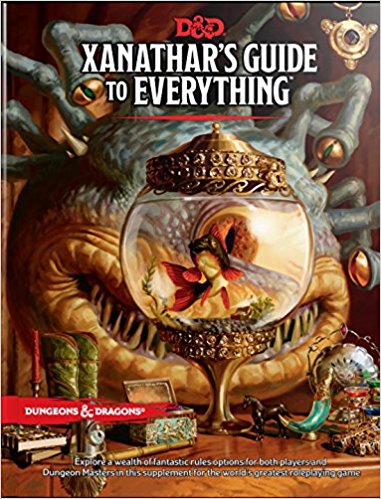
Review: Xanathar’s Guide to Everything (D&D5e)

I’ve been saying for a while that playing, and running, more 5th edition D&D is definitely something I want to do this year; and in this post, I dissected the beauty of random tables and promised a review of the product that inspired them, Wizards’ latest D&D5e supplement Xanathar’s Guide to Everything. Well, here it is. Disclaimer first: I’m hardly the most knowledgeable person to talk about D&D5; if some of the new rules are imbalanced and hazy, I probably won’t have noticed them – other reviews are available, that will no doubt have a different focus to mine. I’m not going to be analysing the mechanical balance and options of each subclass presented, for instance – as usual in my reviews, I’ll be looking in broad brush strokes at what’s useful for one-shot games in the publication.

The Fluff – Roll 1d6 for your next three adventure hooks

While at first glance Xanathar’s contains little in the way of setting information, background or explicit ‘story,’ it is filled with is implicit, flexible background. Each character option and random table populates your game’s world with NPCs, factions, and hooks – and these are yours, not some silent D&D canon. This is a map-free book, but in using the optional rules just for your PCs you’ll find setting leaping out at you fully-formed.

What and how? Well, each background has additional tables, and there are a set randomly-rolled life events for each character. Each class has them; and they’re short and simple, easily picked though and just the relevant ones used. Wizards, for instance, now have three 1d6 tables that they can optionally use to determine what their spellbook looks like, what their mystical ambitions are, and what eccentricities they have developed through their studies of the art.

There’s also a set of random encounter tables by terrain and tier that give a good inclination of what different areas are like. It’s a long time since I’ve used any sort of random encounter table (and my procedure tended to be to roll up 2-3 in advance, make them tied to the world and interesting mechanically, and throw them at players if they came up, rather than rolling directly on them while in play) but they give a good sense for the setting and just what kinds of D&D creatures inhabit each kind of terrain.

Another nice bit of fluff is rules for Common Magic Items, which are cantrip-like magic items that provide small, but useful, functions – like the candle of the deep which never goes out, even underwater. Each one suggests multiple different uses – I can imagine a city beseiged by seasonal storms to have a roaring trade in candles for when the storms come, both from the wealthy seeking to keep their houses well-lit and those wanting to do business under cover of them.

The Crunch – there is a lot of this

Let’s start with the big stuff, the stuff that most readers will go to immediately – there are tons of character options, at between 2-4 new subclasses for each class. Some are familiar (I was pleased to see the Cavalier back, as well as the Kensai , Swashbuckler, and Hexblade) – and some are funkier suggestions (there’s a drunken master monk style, and a samurai). I’d really appreciate these when rolling up pregens for one-shots, as they provide a really clear distinct concept for players to latch onto. Because they’re subclasses, they don’t really add extra complexity to play, either, as they’re a one-off option that replaces other rules options in the class.

There’s lots of new spells, too – and extended trap design rules and systems for downtime. There’s tables and rules for buying, crafting, and selling magic items – not likely to see play in a one-shot, but fills in a handwavey part of play that’s been really poorly supported in previous editions. Back in youth of playing D&D, we’d always be heading back to town trying to fence yet another longsword +1 or potion of feather fall, and it always felt we were at the DM’s mercy as to how generous he was feeling.

There’s a new reading of the encounter design system, which appears much simpler and easier-to-use than the previous one in the DMG. My own experience from building encounters for one-shots right back from 3rd Edition would be to make every encounter harder than the rules say – you’re aiming for exciting, dangerous combat rather than the gradual resource-drain of regular dungeon exploration – and on the face of it this system makes it easier to twiddle those knobs to make that work.

Also there are extended rules for using tools – which I can see being really useful in a one-shot to make non-combat skill use a bit better supported in the game. Each set of tools is also linked to which skills are used with it – and if you’ve got any kind of mystery or investigation, these are good sources of inspiration for where clues might come from.

The One-Shot

Truth be told, most of the use this will see in a one-shot is embedded in the options above, but there are 3 excellent pages in an appendix at the back that are really useful. They detail how to setup and run a shared campaign, and although they clearly are geared towards running Adventurer League games, there’s some useful estimates such as how long combat encounters should take and how you can pace experience so everyone stays on the same page. I’m a big fan of linking one-shots into episodic campaigns, and this gives you most of the tools to do so, as well as sharing GM duties.

In an ideal world, for me this would have been 30 pages, not 3, and maybe explored using D&D for one-shots, different campaign formats (the 3-session minicampaign, sandbox play with a player pool like in West Marches, etc) – ook at structuring games and giving players ownership and genuine choice while also managing your prep (stuff like The Alexadrian’s Node-Based Design) – but hey, if it had all that stuff in, there’d be less for people to blog about, I guess.

To sum up, Xanathar’s brings an awful lot of extra ‘stuff’ to the game, but in a format that makes it pretty easy to drop in bits of it at a time to add to, rather than complicate, your game. I’ve still got a lot more thinking and exploring to do about running D&D5e as a one-shot (and I’ll be posting my thoughts here), but Xanathar’s increases the range of tools available to do so. What approaches or prep have you found useful in setting up a D&D5 one-shot, and am I right in thinking that using supplements like Xanathar’s and Volo’s can add richness without complexity?

The 3-Session Campaign Part 2 – Build to the Finish!

In Part 1 of this series, I talked about setting up and planning a 3-session mini-campaign, with a focus on online play specifically (although most of the techniques are just as applicable to face-to-face play). Here, I’ll talk about what to put in Sessions 2 and 3, and where to shift focus.

Between 1 and 2 – Review, Check Focus, Get Feedback

After Session 1, you’ll have a good idea how well your drafted plot is going to fit into the group of players you have. It’s a good chance before the next session to look at your plans for Sessions 2 and 3 and see if they will fit. Also, if the players have established or given detail to any NPCs or parts of their backstory in Session 1, you should try and incorporate them into the coming sessions, to give them a sense of placement in the world.

I’m terrible (which GM isn’t?) at getting feedback from players, and now is a chance to check in with them if there’s anything they like or don’t like about the way the game seems to be going. If any want to tweak their characters, this is a point where I’d let them, after they’ve seen them in play. I’d also be quite generous with experience and rewards as PC development also makes the campaign feel more epic.

Session 2 – Walk Across Middle Earth and Have Some Fights

As the subtitle suggests, you’re looking at The Two Towers here; characters should be developed enough their personalities should be emerging through play, so this session should be a fast-paced series of challenges and activities that give context for character development and roleplay.

In terms of pacing this session, it’s likely that if you gave the characters multiple options at the end of Session 1 you have to make whichever solution they pick the most interesting, and I don’t think there’s anything wrong with this in this format of game (or, basically, ever – but I think that’s another discussion to have!). By the end of this session, the PCs should be in no doubt that they are approaching the climax of their quest – if your game calls for a climactic confrontation at the end, feel free to end Session 2 just before it – don’t feel you need to save extra content for Session 3.

Session 3 – Final Confrontation, then Jumping on Frodo’s Bed

By this stage, you probably have a fair idea of any subplots that your PCs have developed in advance of the final climactic battle, and it’s a good idea prior to this to have a look through this and try and re-incorporate any loose ends into the session. The majority of this session will be the final confrontation with the ‘enemy’ you have set up, and you should pull out all the stops for this. This is the stage at which you can, and should, put up the “death flag” and be prepared for PCs to make the ultimate sacrifice; leave the players in no doubt that this is the end of the campaign.

But leave enough time for a look at the world after the end of the campaign too, to set it in context and provide some finality for the characters that your players have invested in. It doesn’t have to be quite as corny as the scenes in Return of the King where they all visit Frodo, but short vignettes of each PC’s life immediately following, and perhaps further in the future from, the climax of the adventure help to set the game in context.

Conclusion

So, that’s my plan to get more online play into my life – although most of the plans are taken from running short campaigns in real life. What are your online gaming plans to make finite-length campaigns easy to schedule? Do you have any other preferred methods for online play, or have a favourite medium to use for it? Hope to see some of you at games in the future – either round a table or at the other end of a Hangouts screen!

The 3-Session Campaign Part 1 – stretching the One-Shot format

I’ve blogged before about making the one-shot RPG ultra-short, and also about how a one-shot can be slightly longer form. One of the things I’m pondering as we come to the new year is how I’m going to get more online gaming done next year (via Hangouts / Skype), and I’ve come across the crux of the dilemma (for me anyway, but I suspect a lot of gamers).

Thing is, I don’t have the time to commit to a weekly (or even fortnightly) game – either face to face or over G+ – and so an ongoing campaign seem unlikely. And my own limited experience suggests that one 2/3-hour online session doesn’t quite have the hit of a regular convention one-shot. The medium means you don’t get quite as much contact, even if you’re playing with folks you know in real life, and it takes a while for characters to develop and become enjoyable to play.

So, I’m going to propose myself a solution: the 3-session Campaign. Three 2-hour online sessions, preceded by a not-necessarily-concurrent chargen and setup session. I’m hoping that this format will let me get more online gaming done, and that it might work for people with similar scheduling difficulties to me. I should note that this is advice I’ve largely gathered from my experience running face-to-face for 3-sessions, but I’ve put it in the context of online play because I think it provides a useful solution to the scheduling difficulties above.

The Pre-Session: Chargen and Links

In this session, which I’d go over a chat app like Facebook Messenger or a private G+ community, I’d get my players to generate characters (or generate them myself with their guidance / support if they aren’t familiar with the system) and build links between the PCs. I’d try in generating characters to follow good examples from one-shot play to ensure, for instance, that there are sufficient differences between characters and the group fits together with some consistency, as there won’t really be scope for this to develop during play to iron it out.

While some games have structures for this (Dungeon World’s Bonds, Apocalypse World’s Hx splits) that require some turn taking, the order of these is mostly arbitrary, so there’s no real need for everyone to be online at once – or, if they are, they can be sat doing something else with the phone/tablet at their side carrying out the process.

For games without this process, I’d try and establish connections – maybe with focused questions, which could be as basic as “how do you know X?” or, for instance, “when was the last time you brought a PC back from the brink of death?” (for a cleric PC). While this is going on, I’ll scribble it all onto a relationship map that I’ll then share so everyone has an up-front picture of the rest of the party – it especially helps in online play to know who the face at the bottom of the screen is pretending to be. In terms of sharing resources, for online play I think it’s helpful to have a precis of the setting and access to at least the basic rules so that players can engage with these and be ready to go from the off.

Session 1 – Your Regular One-Shot

The structure I tend to use for 3-session play is the movies of The Lord Of The Rings; for this first section, you’ve already done a substantial chunk of the exposition in the pre-session prep chat. I’d follow the regular introductory one-shot format for this: a task set for them to do, a practice combat/action sequence (to clear out any rusty rules), some investigation, and a final conflict that can be a little harder and reveals the extent of the problem facing them.

Pacing is key here; although in my experience, while online play does demand more focus from the players, the interface encourages it – everyone really does have to listen to every other player speaking, because if you don’t pay attention, you’ll be lost. Any rules clarifications, pass them to another player to resolve in text chat – and feel free to make notes of anything in that chat as well. My best experiences of online play have been basic in terms of technical aptitude – there’s nothing wrong with letting players roll their own dice and telling you what they get, and I’ve enjoyed having that physical connection to the game rather than using a dice roller (until I have a run of bad luck – then I usually switch to the dice roller).

I’d also recommend Session 1 being fairly obvious in terms of what the PCs should do and what the campaign is about. Chekov’s Gun applies here as it does in all one-shots; if you introduce an NPC, a location, or a faction at play in Session 1, if the players are interested in it you should make sure it re-appears in Sessions 2 and 3.

Well, that’s how to set up and run the first session of a 3-session campaign; tomorrow I’ll look at Sessions 2 and 3 and the prep between them.

Xanathar’s Guide to Random Tables – adding story to D&D5e

D&D 5th edition is a bit of a gap in my gaming experience. While it’s hardly explicitly designed for one-shots (for me D&D hews pretty closer to the zero-to-demigod progression than any other levelled game), I’ve had great experiences playing it. It captures the sweet spot of nostalgia and actually working. I’ve never actually run it, but certainly intend to set that right in the new year. And, like Starfinder, it certainly can support one-shot play – a lot of its complexity is hidden in easily-parsed references to older editions!

Storifying D&D: it can / can’t / should / shouldn’t be done!

A common thread about ten years ago on various Indie game communities used to be how to add storygaming elements to ‘trad’ games like D&D. It was met with a range of responses, from the zealous “you shouldn’t bother, just play a game that will actually support what you want to do” to more helpful suggestions, like John Aegard’s excellent piece on making D&D 4th edition a player-led sandbox.

The foundation for story-based games lies in character (or pregen) generation – if you have characters with links to the world and NPCs in it, beliefs and motivations to act beyond money and orcslaying, everything else will come, and feel natural. So after a preorder of the new Xanathar’s Guide to Everything arrived and sparked a guilt about how little attention I’d given 5th edition, I decided to give it a run through.

Xanathar’s deserves a proper review on here when I’ve fully dissected it for one-shot play, because apart from a bunch of sub-classes, encounter design guidelines, additional uses for equipment, it also contains a few pages of shared campaign guidelines (which are absolutely golden if you want to design a one-shot, brief though they are). But what initially caught my eye were the piles of random tables.

A lot has been made of the random tables that have returned for D&D5e, and I can’t get enough of them. Right there, using the ones in the PHB alongside those in Xanathar’s, you can randomly generate characters with rich, punchy backstories. I tested them out by rolling up a 1st level human fighter, Robert (oh yeah, his name was random as well – there’s 18 pages of random name tables at the back of the book as well). The tables for family backstory, combined with the backgrounds from the PHB, have made my ‘standard issue peasant fighter’ into something much more exciting, an army deserter using adventuring to find his estranged father. Don’t believe me – here’s his rough character sheet, with the table results combined with a pre-written backstory (NB: I’ve kept any links to the background and location deliberately vague, with only a dubious-evil Baron for Robert to rage against)

Robert

Race: Human (5′ 7″, 154 lbs)

Class: Fighter

Background: Folk hero

Alignment: Neutral Good

S 16, D 15, C 15, I 11, W 14, Ch 11

Languages: Common, Orc

HP 12; AC 19

Proficiencies: All armour, shields; simple weapons, martial weapons; carpenter’s tools, vehicles (land)

Saving Throws: S +5, D +2, C +4, I +0, W +2, Ch +0

Skill Proficiencies: Animal Handling, Athletics, Perception, Persuasion

Fighting Style: Defense (+1 to AC when wearing armour)

Second Wind: Use a bonus action to regain 1d10+1 hp each short/long rest

Combat: Longsword +5; 1d8+3 slashing. Light crossbow +4; 1d8+2 piercing. Dagger +5; 1d4+3 piercing.

Equipment: Chain mail, longsword, shield, light crossbow (20 bolts), explorer’s pack, carpenter’s tools, shovel, iron pot, common clothes, belt pouch with 18gp, dagger.


Origin: Know who your parents are; born at home; no siblings. Raised by single mother (father was imprisoned); modest lifestyle with no permanent residence – you moved around a lot; others saw you as different and strange, so you had few companions

Background decision: A mad old hermit spoke a prophecy when I was born, saying I would accomplish great things

Fighter training: I joined the army and learned how to fight as a group

Defining Event: You broke into a tyrant’s castle and stole weapons to arm the people

Personality: If someone is in trouble, I’m always ready to lend help

Ideal: Sincerity – there’s no good in pretending to be something I’m not

Bond: I have a family, but I have no idea where they are. One day, I hope to see them again

Life Events: A relative bequeathed you a simple weapon, spent time working in a job’

Flaw: I have trouble trusting my allies


Born to simple carpenters, the prophecy that the mad gnome Oppleby spoke when Robert was born would prove to be his downfall. His father stayed at home from the work-gang to care for Robert following the prophecy, and though they tried to evade the Baron, Robert’s father was captured and imprisoned soon after by the Baron’s men. As Robert and his mother Emma moved from town to town, earning what little they could from odd jobs and the kindness of strangers, Robert’s heartbreak at seeing his father dragged away led to steely resolve to find his captors and bring them to justice.

Knowing he would need a strong sword arm to bring the Baron to justice, he joined the army, where he quickly became successful as a carpenter in the engineering division while his martial expertise grew. But seeing the lash of his sergeant’s whip on his comrades, Robert fled the army, defecting with his squad after stealing from the company supplies. In the escape his squad-mate Manfred was fatally injured, and he gave Robert the engraved dagger his own father had given him, begging Robert to continue his quest.

Robert found himself again moving from town to town, and making use of what carpentry skills he had, until the opportunity for adventure and making good on his prophecy came to him. He knows he will only bring danger to his mother if he returns to her, but still seeks to find his father, and free him from the Baron’s oppression.

See what I mean? It’s corny, and I guess a little obvious, but the table results just determined that juicy backstory naturally. Later I’ll be blogging here about adapting published adventures, but for a party including Robert you can bet that either (i) the Baron’s men are all over town getting in his way, and/or (ii) the adventure’s big bad has links to the Baron. Have you got any examples of how random tables can develop grabby character backgrounds?

An Xmas Mixtape (a Mixtape is like a Spotify Playlist from olden times)

This blog is now 8 months old. While I’ve not maintained it with as much regularity as I’d foolishly expected, I’ve spent a bit of time reviewing my content – and taken the step to actually shell out some cash to make this ad-free (sorry, those of you who were wanting the chance to win an iPhone 10 every time you clicked the link).

I’ve got big(ish) plans for the blog next year, and am planning to get serious about writing (and editing) RPGs more widely – while it’s only a tiny one-shot, seeing Bite of the Crocodile God get art and layout has convinced me to get my act together a bit more.

My plan in the new year is to continue with a mixture of different things, all through the lens of one-shot play. In the meantime, in case you’ve missed them, here’s a mixtape of what you can expect more of:

Reviews, with a particular focus on one-shot play – I started trying to do all of the Fate Worlds series, but I got a bit distracted – this is probably my favourite, of the frankly bonkers Masters of Umdaar

Prep and play advice, such as this post which I’ll be rereading before Revelation (the Powered-by-the-Apocalypse convention in Sheffield, UK) on prepping PBTA one-shot games

Rules tweaks, like this for making Cypher system (and other games’) experience system fun

And the occasional beard-stroking bit of sentimentality, like this post about the nature of the hobby, and why you shouldn’t feel guilty about all those game books on your shelves.

I’m hoping to get some actual ready-to-play one-shots on the blog as well, and have several percolating in various stages ready for editing and uploading. I haven’t forgotten about the #1H1S thing, either – so expect more about running 1 hour RPG sessions soon too.

And, in case I haven’t said before, thanks for reading. I hope you continue to enjoy it. Anything else you’d like to see, stick it in the comments!

Trains and Games

As I write this, I’m sat on a train just south of Doncaster, on my way to the Dragonmeet convention in London. I’ve been listening to The Smart Party podcast say that everyone who’s been a guest on their show will probably be there, and they’re probably right. I’m helping on the All Rolled Up stall selling gaming accessories and Cthulhu Hack goodies, but I’m most excited about the chance to catch up with lots of friends.

Indulge me while I talk about my dad. My dad liked trains. He liked traveling on them, he had lots of books about them, he built little model kits of them. He’d go to model railway exhibitions held in community centres and hotels and wander round stalls and buy models of locomotives he probably didn’t need. He had mates that he would go round to and look at their models and talk about obscure branch line developments. He had hundreds of train magazines, some in languages he couldn’t read. He had more model kits than he could hope to build, and had prized models of locomotives and carriages that he’d display on bookshelves next to his stacks of books about trains.

As a kid I remember traipsing across cities every holiday, in search of model shops he’d heard about. When he died, a specialist second hand bookstore held an advertised event to sell his railway books, “from the collection of an enthusiast.” It was a proper hobby, and he treated it as such. He must have spent a fortune on it, and I’ve no doubt it was all money well spent.

Does any of that sound familiar? Hobbies are ace. Don’t feel bad about investing time and money in games you might never play, or accessories you might never use at the table, or reading blog posts about the best ranger builds in Pathfinder. If it gives you pleasure it’s enough. You can always flog it on eBay. Treat it like a proper hobby, and cherish the friendships that you make over a cocked d20.

I’ll be on the All Rolled Up stall – pop by and say hello.

Review: 7th Sea, Second Edition

7th Sea, Second Edition, is a trojan horse RPG – a hippie-smoking narrative indie game disguised as a big-budget trad game. Even its pseudo-European setting and swashbuckling, piratical leanings imply it will have rules for swimming, climbing rigging, initiative even. And it doesn’t, really – it has one unified resolution system for everything. It’s beautiful, fast-playing, and very, very good.

The Fluff – “Are we doing accents?”

In the pursuit of high-stakes swashbuckly pirate action, 7th Sea sets itself in a squished up map of Europe where each nation in Theah is very easily identified as its real-world analogue. Even the map is recognisably European, so if you can’t work out that the red-haired kilt-wearing barbarians of the Highland Marches aren’t Scots, you can check an atlas. I’ve no problem with this – and it is of course just an iteration of the setting of the first edition, which was apparently a much-loved aspect of the game. I’d expect a good deal of outrageous accents in play if I’m anywhere near the table.

The setting descriptions in the rules are a bit, well, basket-weavey. I’m not sure if I really needed to know what the average Castillan peasant eats to jump into the game, and it feels rather like a potential barrier to play rather than a boon; I found myself skimming once I’d worked out it was Spain, and then coming back to find the adventure hooks hidden within the descriptions of fashions and history. And this is the first bit where it comes across as a traditional game; there feels like an expectation that you should read the 96 pages of setting chapter before you start creating your character, even though there’s probably no need at all.

It’s worth giving a shout out to the system’s alternate settings – The Crescent Empire, which is the near / middle East analogue, is out now, and offers an inventive take on Arabian Nights-style swashbuckling, and New World – Jaguar Knights and pseudo-Aztec sacrifices and Ifri – their Africa – are lined up for release. I’ve only really dived in The Crescent Empire, and it really is impressive – and probably merits a separate review which I’ll get to soon.

The Crunch – Ready you magnetic fish!

As I said in the introduction, this is the most indie you’ll find in a shiny 300-page hardback. You roll a pool of dice, count Raises (which you make by summing dice to 10), and take action in order from them. That’s how you do everything. Action Scenes see you act in order of the number of Raises you have at each turn, Dramatic Scenes use a more narrative initiative order (as in, one determined entirely by the GM as suits the fiction). There are no difficulty levels, and an implication that players might try to use whatever combination of Trait and Skill they like to accomplish their task, under some negotiation with their GM.

One wrinkle is that every challenge or scene seems to be bespoke to the specific situation, and there’s advice that the GM will pre-plan these out, which makes it seem more complex than it is. What 7th Sea really needs is some general examples of, for instance, a shipboard battle, a tavern brawl, a chase through alleyways, a high society ball – that the GM can quickly grab and pick options from to invent scenes on the fly.

At every turn, it feels like there’s more to the system – and many of the early commentators on the system I think were disappointed in this – but, brilliantly, there isn’t. PCs have various Advantages that tweak the rules in certain circumstances, but like Fate’s Stunts, they are exceptions rather than interfering with the core mechanic. Even duelling, which adds the most additional rules, really just allows you to zoom in on the action in a combat sequence. Villains have two stats and one dice pool, and  groups of mooks – Brute Squads – just have a Strength.

The sole exception to the unified-system appears to be magic, which is specific to each Nation and both game-breakingly powerful and awesomely cool. You won’t be slinging spells regularly, but you can be sure that if there’s a magic-user in the group they will have additional – and very flavourful – ways to interact with the story and bring trouble their way.

The One-Shot

In fairness, there are a couple of cool things about the system which I don’t think translate well to one-shot play. Firstly, the experience system (such as it is) is player-specific multi-step Stories that are collaboratively written and plan out what the PC needs to achieve to get his next XP boost. The villain rules have resource management stuff for the villain to try schemes to raise his strength and an economy for sending stuff after the PCs. I can see an awesome game (not a one-shot) where the players just arrive with their own stories and the GM plays his villain’s schemes and gets in the way of them – but I’m not certain how that would work for one-shot play, although setting it up in a similar way to player-led PBTA might work.

These are the pregens I’ve made up for this game, and they give a fair indication of how straightforward the system would be to grasp for players – although you want to ensure that a player who is happy to get to grips quickly with additional rules and exceptions takes any PCs with magic or dueling. The setting is certainly easy to grasp, and the unified system will certainly make sense – but, as with everything, watch out for players who are drawn to a big hardback book expecting more rules than they find!

I’m looking to tidy up my own quickstart adventure and post it on here, and I might even have a bash at some generic scenes for the game and put them out there – but in short, this game might be my new hotness for a while.

Running Blind – Prepping a One-Shot for the First Time

This Sunday, at Go Play Leeds, I’m set to run 7th Sea 2nd Edition, John Wick’s game of fantasy swashbuckling set in the pseudo-European world of Theah. I’ve never run the game before, and I haven’t played it either. Normally I’d always say that the best prep for running a one-shot is to be a player in said game – it’s much easier to learn a system by doing than it is to read the rules. Not having had this luxury, I’ve had to find my own way with the game. I’m just about ready, and I thought I’d share my tips for prepping a game you haven’t played before:

Start with the Pregens

I started by creating my pregens, trying to use my own guidelines here but also ensuring a simple concept to bind them together. I’ve gone for a ship’s crew, seeing them as a roving band of ne’er-do-wells not restricted entirely to piratical interests but also unaffiliated to any nation. I had a few ideas about core archetypes – so I have a big bruiser, a quick duelist, and a socialite – and can hope they fit together.

Generating a party not only familiarises you with the resources on the character sheet (7th Sea 2nd Ed has a good skill economy), but it helps to have internalised them, so you’re not looking for the right skill or power at the right time. On my pregen sheets, I give brief rules for each advantage and/or power, and writing them down helps me learn the options my players have.

EDIT: I’ve added a link to the pregens to the downloads page, or you can find theme directly here.

Know the Rules

Some folks would say to read the rulebook cover to cover, but I’m not sure how useful it actually is to prep from cover to cover. Generally I think you need to know what you need to know well rather than knowing everything well; depth is better than breadth of knowledge in this case. I’ve read (in this order) the resolution mechanics, the character generation chapter, skimmed the GM advice section, and then followed character generation, while skipping back to the backgrounds of the Nations of my characters to check that my concept fits. Much of the rest of the book I’ve skipped, and will absorb further down the line.

I wouldn’t necessarily recommend this approach for every game, but also that’s probably what I do for every new game. I try to make sure that I know really well the stuff I actually have to know. I’ve ignored, for instance, the ship combat rules for now – I’m going to run that like a normal Action Scene, and lots of the GM rule sections on stuff Villains can do between adventures.

Keep It Simple

My adventure plot is pretty straightforward, and is structured using the scene resolution mechanics presented in the book (note that I’m planning one of my short reviews of 7th Sea soon after I’ve run it, but in a nutshell, I’m convinced that this is a loosey-goosey narrative indie game disguised as a mid-90s trad game, and disguised really well) tightly. There’s a fight scene, a sandboxy high society party for them to investigate in, an infiltration and a final confrontation.

As always, my starting scene is heavily framed and launched (in fact, it begins with the PC’s ship being boarded and in the middle of a pitched battle) and the options spread out from there. There’s some collapsible elements to allow for how much time is left – I’m not sure how quickly the game will play out, and at least at Go Play I’ve got a good amount of time to play with – I can take anywhere between 3 and 5 hours and there’s no session following my players have to get out for. My structure was scribbled out on one page of an A4 notebook, and while it took a while to get down in between reading and thinking about the game, it was an important step before I started my prep proper.

Bash out a Draft

After this, I’ve actually written out in Word what I want to happen at each scene. By forcing myself to write this up – which I wouldn’t do for, say, 13th Age, or a game I’m more experienced with – I force myself to actually consider the structure and order in which I introduce and teach the game. So far my draft runs to just over 2000 words, which is probably my norm for a fully-formed con game draft for a new game; I’ll add a few notes to it as I get ready for the actual game and tidy it up, it’ll stay around that mark in terms of length.

Come Clean

I’m running the adventure on Sunday, and I’ll share my prep after that. I’ll be telling the players straight up that I’ve not run the system before, and that while I’ll be the main arbiter of the rules, feel free to pipe up if I miss something. We’ll muddle through, and I’m confident that the bits of the game that I’ve prepped will work. The bits I’m missing out – which include the Story system, which I’m going to replace with an alternative XP system – are all easily missed from a one-shot.

So, now I need to have another pass at my adventure and get the last bits of laminating done. After I’ve run it, I’ll share my prep on here, as well as the pregens I’ve created for it. How does your experience of prepping a new game differ from mine?

Ready, Set, Game! – in Search of the One Hour One Shot

Earlier this year, in preparing to fulfil my regular gig as D101 Games‘ stall monkey at UK Games Expo, I sketched out a demo adventure for the Fate game Hunters of Alexandria. It was designed to play in 30-45 minutes for 1-3 players in a crowded convention hall, and although it never got the chance to hit the table at the Expo, it’s just been released as a free download. It’s made me think about an idea I think we should all try to make happen – the One Hour One Shot (1H1S) RPG Game.

At the same time, Baz from the Smart Party podcast has been mulling over some prep for a 1 hour demo of Blades in the Dark… I can’t give you more details but watch out for it, because what I’ve seen of it looks really good!

Why?

The key resource that keeps the RPG entry point high for the casual potential gamer isn’t money (you don’t even need to have your own dice) or exposure (pretty much everyone knows what D&D is these days), it’s time. How can you sell a hobby that involves 3 hours of your time every week? Even if you’re going to restrict yourself to one-shot / episodic games at conventions and meetups like Go Play Leeds, this means an informal commitment of one 4 hour session every month. That isn’t easy to get your head around if you’re not sure if you’ll like the game.

At the same time, more people are playing board games – and geeky board games – than ever before. I have seen copies of Pandemic on the shelves of some of my least geeky friends’ bookshelves; board games are mainstream now.

Also, aren’t there lots of games you want to try out? If you allocate even a short, sharp 4 hour session to each of them, you’ll be here forever working your way through them. One hour, though – even the busiest gamer can spare an hour, surely…

How?

At the moment this is early in the design stages, so I’m not exactly an expert, but I’ve got a few ideas of how the 1H1S game might look:

  • simple, grabby pregens that give an easy idea of what they can do in the setting and game
  • a really tight structure – 3-4 scenes that showcase the setting and what the PCs do
  • an opportunity to learn the rules. Think about the first level of a well-written videogame, and how it teaches you to jump and move around before you learn to shoot; an attempt to walk through the core mechanics in a logical way
  • leave them hungry. Add hooks to further adventure, an obvious way out that they can lead on to if they want more. Aim to leave them wanting to know what else happens to their character, and how they can continue the game
  • really clear social structure. Some of this will come out in the way the GM (who we’ll assume has played RPGs before) presents it, but also with clear guidance. The social setup of a tabletop RPG is arcane if you haven’t played one before, and your players need as much help as you can get. Even games that explicitly spell out the social structure of play such as PBTA games get misinterpreted, and we’ve all been in games where the loudest player gets to hog screen time

What next?

Well, I guess the next step for me is to actually get on and prep some 1 hour demos. I’m confident that Bite does what it says on the tin and is a possible model for Fate or similar games, but I’d like to write the same for some of those games I haven’t played enough of, too – especially ones with interesting rules twists like 7th Sea or Dogs in the Vineyard. What else is out there? Have you run any 1H1S games, succesfully or otherwise? Let me know in the comments!

Counters and Cards – how to run a great Fate one-shot

A couple of weeks ago I went to Furnace, the original and biggest RPG con based at The Garrison Hotel in Sheffield, UK. One of the games I ran was a Justice Society game using the Fate system – to be more precise, a modified version of the Dresden Files Accelerated system. I thought I’d give a run through of how I go about prepping – and running – a Fate one-shot.

Before you play: it’s all about Aspects

Make sure that your pregens (if you’re using them – Fate is also great for semi-finished pregens that the players can add Aspects and skills to as they play) have Aspects that are both broadly applicable but also able to be Compelled. Players should never look at their sheet and struggle to find a relevant Aspect unless they are operating well out of their comfort zone and PC skill set – and even then there should be Scene Aspects they can use. Don’t over-think Aspects, just make them descriptors of character traits and abilities – hopefully with a negative side that can be Compelled to earn Fate points.

In terms of props, you’ll need some sort of counters for Fate points (see later) and some kind of cards for Aspects and Boosts. You can using ordinary Index Cards or Post-its, but the wipeable index cards from All Rolled Up are a re-usable solution as well.

For each scene in the game, design two or three Scene Aspects and have these pre-written up on cards before the game starts. If you’ve got them pre-written you’ll be much less likely to forget to put them on the table when the scene starts.

For your named NPCs, make sure that their Aspects are also broadly applicable so you’ll be able to use them at the table without having to think too much. You should be using these Aspects to survive the players initial attacks and force them to use their Fate points and Aspects to beat you, so make sure each named NPC has at least one Aspect that they can use to defend or avoid damage.

While you play: it’s all about Fate points

When running the game, as GM you should be focusing play to keep a steady flow of Fate points between the players and GM. How can you encourage players to spend more Fate points? Well, here are four ideas that I try to use:

  • don’t make the players roll for anything that isn’t important. If a roll isn’t going to be worth investing a Fate point in, it’s an unnecessary roll. Simple investigation, get-to-the-next-scene filler, can just be given to the PCs with necessary roleplaying – it doesn’t need an Overcome check to find a clue unless that clue has some danger attached to it and meaningful (and exciting) consequences for failure
  • give meaningful difficulties. Overcome should be at an absolute minimum of Fair (+2) difficulty – and often I’ll bump them up to Great (+4) if players are going to work together on them. Likewise, named NPCs should be tough enough to present a decent challenge – let the PCs eat up mooks but make the named NPCs memorable
  • refresh Fate points frequently. In a one-shot I also usually offer a free refresh about halfway through the session when the PCs reach a place of safety; they can return up to their refresh (note that this is especially useful in high-powered games where some PCs might start with a Refresh of 1 or 2)
  • model spending them. Remember that the GM starts each scene with one Fate point per player (note that this does vary in different flavours of Fate; but it’s one per scene in Fate Core). You read that right, every scene. With this in mind, you should be spending them immediately to resist the PCs efforts initially – this will also provide challenge and pace the scenes – don’t worry about this becoming predictable, as Fate dice are swingy enough to add some unpredictability to this

While you play: it’s also all about Aspects

As well as using PC, NPC and Scene Aspects, both you and the players should be using Create Advantage to make their own Aspects they can then get a free tag on to their own advantage. To encourage them to use this part of the game, you can

  • make Create Advantage relatively easy. I keep the difficulty for Create Advantage down to +2 normally unless they are actively countered by an opponent, so that it becomes an achievable option to use an action on – if a player is using their turn to create an Aspect, they should have a good chance of succeeding
  • model the behaviour you want to encourage. Show the players how easy it is to use Create Advantage by having some of your mooks do it to set up the big bad; after seeing you do it, they are much more likely to realise how powerful it is
  • don’t be shy of making Defend difficulties high. With a couple of well-placed Create Advantages, players can easily be rolling with an initial +4 without even tagging any of their own or the Scene’s Aspects, so you don’t need to be shy about having  opponents with, say, Superb (+5) resistances. Don’t make these always the case, but if you want to push the players to use all the resources at their disposal, these can make for decent fights. Remember that Fate PCs and named NPCs are pretty resilient if you negotiate Consequences that aren’t always a hindrance – and they don’t have to be.

So, a few guidelines to how to set up and play a Fate game one-shot, and to encourage the table to engage with the key bits of Fate that make it different to other RPGs out there. If all that sounds like a lot to remember if you’re running Fate for the first time, start by just getting counters for Fate points and cards for Aspects and Boosts – just having these out in front of the players is a big incentive to see them used. Is there anything I’ve missed? Does different advice apply in different genres?

By the way, if you want an example of a quick-play Fate adventure set-up, it’d be remiss of me to not recommend my own Bite of the Crocodile God, a short (as in 30-45 minute) adventure for D101 games’ Hunters of Alexandria, a swords-and-sandals monster-hunting Fate game.