In my previous post I talked about how Perception (or whatever your skill is called) is often disappointing, and made some suggestions to fix it. Since then, I’ve been very self-conscious of using perception in my own games, as you might imagine, and so have come up with a few more ideas to make perception less rubbish than it generally is.
You All Notice Different Things
I’ve found this a surprisingly decent way to fix everyone making a Perception check, which can’t always be avoided – if one player wants to make one, it’s expected all of them can make one. Just make every successful PC notice something different, ideally tied to their own specialism. You might want to plan these ahead of time, but once you know your players it’s fairly easy to just busk these as long as you’re happy to give out exposition this way.

As an example, in a recent Shadow of the Demon Lord game, the players were accosted by Boneguards on the way up a cursed mountain. I’d reskinned them a bit to foreshadow the rest of the adventure, making them quartz-eyed and sleepwalking, as the next scene involved facing a nightmare monster that would invade their dreams.
Perception checks ensued as they rushed to battle them, and the wizard determined that, despite their quartz-for-eyes and non-decayed appearance, these were definitely undead, and likely vulnerable and immune to the regular undead stuff. The fighter noted that they appeared to be sleepwalking chaotically, making them possible to trick or evade, and the rogue noticed that their clothes were just like those of the pirates they’d seen earlier in Float Town. By spreading the information around, it made everyone’s roll feel important – and gave a mechanic to share exposition in a more interesting way than just doling it out (or, worse, the after-combat interrogation, which always bores me).
Let Perception Deliver Resolution
“I search the chest for traps” – rolls – success
“There’s a poison needle trap here, a good one, but you deftly reach in and disarm it, draining the poison reservoir and clicking the lock open.”
Consider why we have to roll to find, and then roll to disarm, a trap? Sometimes there’s even a roll to evade it in the middle as well. Fold it into one roll – the trap-disarmer is likely to be good at all the elements of it, so just roll once. Similarly, for an ambush, let the players roll to spot their ambushers, but have the consequences solid – either they’ve got a knife at their throat (or an arrow in their back) or they’ve got the drop on their attackers – with possibly different outcomes for different PCs. Make Perception lead directly into resolution, rather than being a separate information gathering check.
Perception in the Action Economy
Consider adding “assessing the battlefield” as a combat action. On a successful check, you can liberally dole out clues as to what’s going on in the scenario, along with something that will offer a mechanical benefit as well – which could be how to make a called shot to get through armour, or just something abstract like granting Advantage to the next attack.
There’s a whole other discussion about exposition through action scenes, and how much of the plot / investigation can be folded into a mid-combat revelation, but this is a good way to make your players appreciate the value of the skill – make sure it’s a generous benefit each time though – if it needs a skill check it should be more effective than, say, aiming for a round, if that grants an automatic bonus.
So, there are three more suggestions to try and “fix” Perception. I’m still moving towards just removing the skill, but these at least offer more options to make it interesting. If you’ve got other suggestions, or would like to suggest another type of skill check that needs fixing, let me know in the comments.


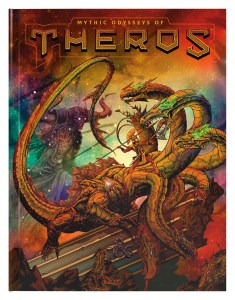 First up, the new rules stuff – well, apart from humans you have centaurs, satyrs, tritons, minotaurs, and leonine (cat-people, like Tabaxi but significantly less annoying) – each gets the full treatment and goes a long way towards making Theros feel different, even though I’m pretty sure they could have snuck some dwarves in. There’s an extra Bard College (Eloquence), a Paladin Oath (Glory), and an additional Backgroun (Athlete) as well.
 As befits a game with such a strong following, there’s no shortage of game advice for Call of Cthulhu. There’s a wealth of stuff in the
  If the NPC they meet in the coffee shop is important, make her sound and look important; give her quirks and mannerisms, and have her drop clues pointing to sources of information. Offer skill checks and even more clear signs: she nervously grasps her handbag, glancing down to the corner of a book kept within. Justin Alexander explains it better than me when he talks about the
  There are variations, of course – in Delta Green, you’re likely to want a mission briefing at the start – but try starting with their first encounter of the mission and covering the briefing in flashback – it’s not as if they have an option to take it or not (especially in a one-shot). In Vaesen, often you’ll begin with a letter inviting you to investigate – but you get to pick your Advantages for that adventure – start in the carriage or on the train to the site of the investigation, and do this in flashback.
 Investigation scenes should do one or two things – they should advance the plot, bringing the PCs closer to their ultimate adversary, or they should grant some advantage in that confrontation. “Advantage” is relative, of course – in Purist Cthulhu it might just be a good escape route.
 Burn After Running: RPG One-Shots