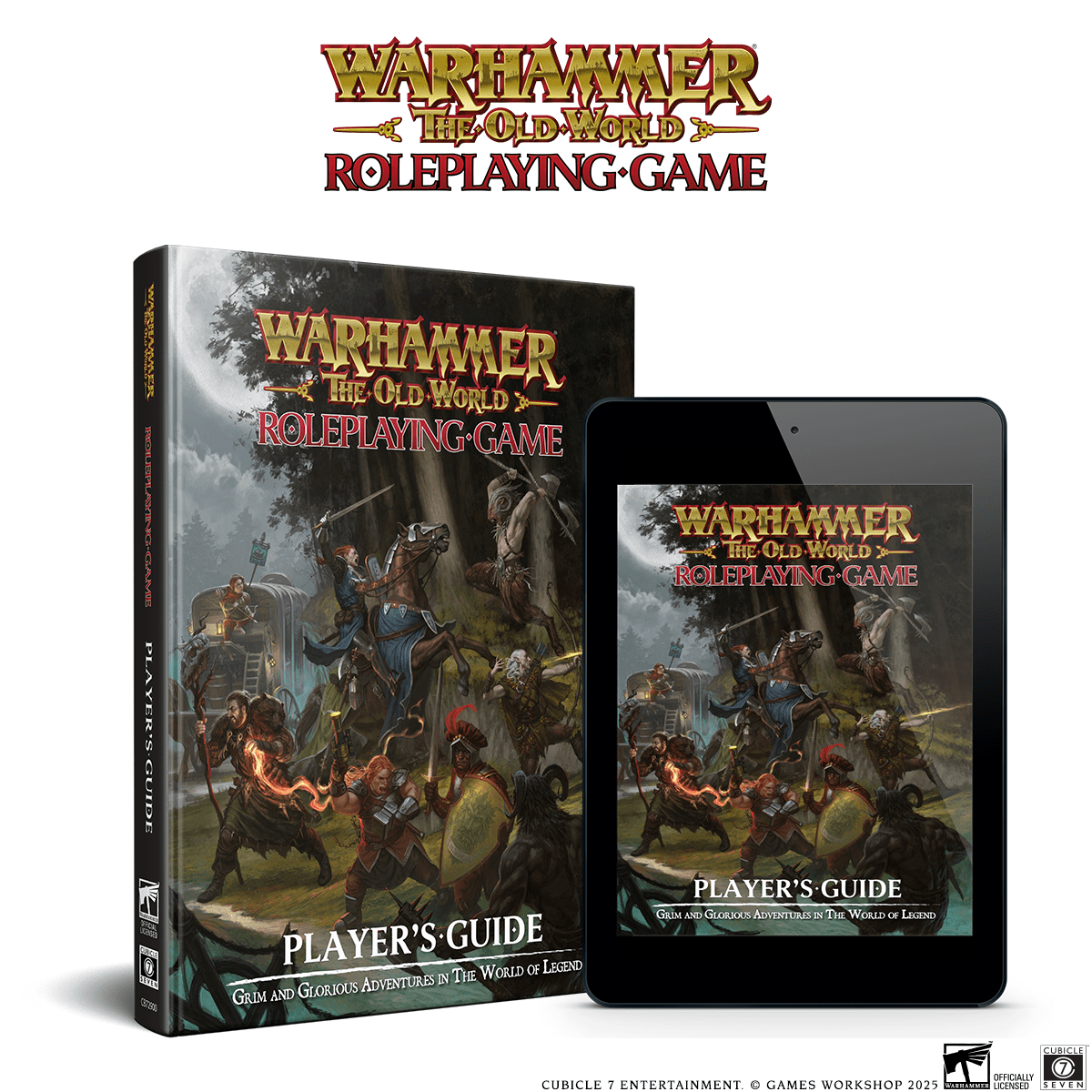
As many readers know, Warhammer Fantasy Roleplay (WFRP) will always hold a special place in my heart; and for any American readers, it’s hard to overstate the impact it had on the UK scene in the 1990s, and the shadows it still casts over Britain, let alone Bogenhafen. For many of us over here, the slightly satirical grimdark middle European vibe was what fantasy roleplay was – D&D was just its brasher, more gonzo cousin from across the Atlantic.
And now, Cubicle 7 has another Warhammer RPG. Along with WFRP 4th edition and Soulbound, both still continuing product lines, and Imperium Maledictum and Wrath and Glory, we’ve now got five Warhammer RPGs in print. Do we need that many? And do we need 2 of them to be fantasy, in the same world?
While you’re reading this, I should tell you about my Patreon. Patrons get access to content 7 days before they hit this site, the chance to request articles or content, and the chance to play in one-shot games, for a very reasonable backer level of £2 per month. If you like what you read, want to support the blog, and have the funds for it, please consider supporting here. Telling people about the blog, and sharing links/retweeting is much appreciated also – thanks!
Well, the more the merrier, I say. Warhammer: the Old World (WTOW) shows enough in its Player’s Guide that it’ll be a very different experience in play to WFRP, and one that I’m keen to explore.
Bona fides first – I got a .pdf sent through to review from Cubicle 7 – but this isn’t a review; I’ve not played the game, nor really can I until the GM’s Guide is released (which is thankfully imminent). However, from a first look, I can guarantee I’ll be getting it to the table, and I’d expect it’ll be out on Unconventional GMs as a one-shot too.
So, here’s a few things that I think WTOW does really well, based on my first look.
It’s a New System
Yes, completely new – some rumours implied it’d use Soulbound’s D6 dice pool, but this is a D10 dice pool, with variable target numbers for successes. You roll D10s equal to your Attribute, trying to get equal or under your Skill on each die. Each one’s a success, and you usually just need one success to achieve your aim.
There’s a pleasantly concise list of skills (16, two for each Attribute) that seem to cover most situations, and the standard Warhammer Attributes. I think there’s a case to be made that the “Ballistic Skill” attribute is the most baroquely-named attribute in currently published TTRPGs, but it’s part of the Warhammer canon, I guess.
Chargen is Fast and Flavourful
I took the character generation for a spin and it took me a little under half an hour to get Skoth of the Mountain Holds, my Dwarf Townsguard, rolled up. Alongside Attributes and Skills, you have Talents from your background and career, which are one-off boosts (like in WFRP and Soulbound), and each choice is a random roll or choose – you can roll and ignore if you prefer, but if you take the random roll you get an extra XP. I like this combination random-pick method, much as it doesn’t always help me with convention pregens. You get Dwarves, Halfling, two kinds of Elves, and two kinds of Humans (I love me a Bretonnian) in the core book – all have different Talents and Attribute spreads.
The Careers are flavourful, and some old favourites are there – there’s the Ratcatcher, the Dwarf Slayer (and a few other restricted-to-origin ones), there’s the Witch and the Wizard. Most of chargen is rolling a few dice or picking from a few options and it’s all very flavourful. Even the tables for “Physique” and “Demeanor” at the end of chargen really sing – Sloth is “Grey-haired, venerable, worn-down as pebbles,” and “fierce as brightstone.” It’s touches like this that make chargen pass the engagement test – it makes you want to play the character straight away!
The Contacts System is Great
One thing that stands out is the Contacts you get as a starting character – you get two, from a set of random tables which determine both the contact and your relationship with them. Each table has 5 named contacts on it, each with 4 relationships – so there’s every chance within your PC group that you might duplicate, but you’re unlikely to duplicate relationships. So my character, Sloth, knows Amelinda Hertwig, the Priestess of Taal, as someone who absolves him of his sins – but another PC might debate them on spiritual matters, or get them to bless their home on Geheimisnacht.
Having named NPCs common to the group (and indeed, to every other Old World playgroup) is an excellent way to embed players in the setting, and generate some plot hooks right from the start. I’m also a real fan of these being standard across campaigns; Amelinda Hertwig I’m sure will show up in lots of WTOW campaigns across the world, and it’s nice to have those common reference points.
Combat is Zonal – Magic is Deadly
The combat system revolves around Zones and has some clever-looking stuff around giving ground, conditions, and morale – I’d really need to see them in play to properly analyse, but it looks somewhere between WFRP and Soulbound in terms of complexity, and certainly more elegant than WFRP.
Magic, as you’d expect, is as deadly for its casters as their enemies – and feels a lot more flexible than in WFRP, with options for improvised spells and no need to declare what spell is being cast when a wizard starts to gather the energy for it. There’s a hefty chance of a miscast, too, which builds with a miscast pool of dice, and it can be pushed for extra dice as you take more risks when casting. Again, a proper run out in play would be needed to really comment, but it all looks workable.
So, do we need another Warhammer?
Well, I think we do. This feels very different to WFRP, and not at all unpleasant. Just as Soulbound brings a completely different feel to Warhammer, ushering in high fantasy superheroes in a riven world, so this provides a bit more of frontier monster-bash than WFRP, with a straightforward set of rules that nevertheless give tactical depth. As I said earlier, I haven’t played this yet – and I’m resisting just homebrewing some monster stats and getting it to the table anyway – but I can guarantee that I will.
Have you played or looked at Warhammer? Should we do a full comparison of the 40K books as well? Let me know in the comments!


[…] Warhammer Old World RPG Player’s Handbook review. […]
LikeLike
[…] What’s the Britpack… on First Look: Warhammer the Old… […]
LikeLike