Following David Lynch’s passing, I’ve started rewatching the first season of Twin Peaks. It’s excellent, and I’d recommend it to everyone (I mean, watch the first ep – it’s possible you’ll hate it, in which case don’t watch any more). And, as you’d expect from something that casts such a long shadow in media, there’s a lot of stuff in there that made me think about gaming, and lessons we can learn from it. If you like this, I’ve done this before with the 1931 Todd Browning Dracula film – check that out as well.

While you’re reading this, I should tell you about my Patreon. Patrons get access to content 7 days before they hit this site, the chance to request articles or content, and the chance to play in one-shot games, for a very reasonable backer level of £2 per month. If you like what you read, want to support the blog, and have the funds for it, please consider supporting here. Telling people about the blog, and sharing links/retweeting is much appreciated also – thanks!
First, core concept. Like most investigative roleplaying games should, Twin Peaks makes it fundamentally clear that it’s not really about the mystery. Let me put some context to this. The plot of the show revolves around the town of Twin Peaks, thrown into chaos when homecoming queen Laura Palmer’s body is found murdered and wrapped in plastic in the lake. Almost immediately, the dark underbelly of the town gets revealed, from the townsfolk’s dark secrets to actual magic stuff. The tag line of the show purports to be “Who killed Laura Palmer?” – but it’s not actually about that. It’s about the location, and the people in it, exploring that and watching what happens when the body’s discovered and Kyle MacLachlan’s FBI Agent starts poking his nose into places and people.
I think this applies generally to investigative games. We’re not really concerned with “Where are the missing children in the forest?” – what we’re doing is exploring the forest, and discovering its secrets. Place and people are more important, and the investigation is actually the backdrop to what happens to the PCs. In some games, it can become all about solving the puzzle, and such investigative RPGs often fall a bit flat – because we’ve got an imperfect clue delivery system (the GM) and some imperfect and inexpert clue interpreters (the players). So keep in mind, it’s about the place and the people – and see if this logical flip helps.
But alongside this, there’s specific things that Twin Peaks does well that we should steal in our games.
The Clue-By-Four
When clues are discovered that lead to the next step of the investigation, they’re multiple and obvious – and the scene cuts to the next step of the thread immediately. So the receptionist hears the boys talking about a ‘biker,’ and Cooper sees the reflection of a bike in the video of Laura, and then we (the audience) see the bike. We’ve seen it before, and it’s obviously the same bike – we are in no doubt that’s the person the boys are talking about, and the person that filmed the video.
There’s half a heart necklace and a clear message from Cooper again “We need to find the other half of this necklace” – and then we cut to the person holding it, and it’s the same dude with the bike. The core clues, that progress the story forward to the next scene, are obvious and tight.
In games, we can make sure that we double- or triple-up on clues (Justin Alexander has blogged eloquently about this too – the three-clue rule is a great piece) – there’s no need to obfuscate or confuse – the players will do that themselves. In the show, it’s the additional details and inconsequential details that mask the simplicity of the investigative thread – and they’ll do the same at the table, as long as you
Scenes Have “Inconsequential” Details
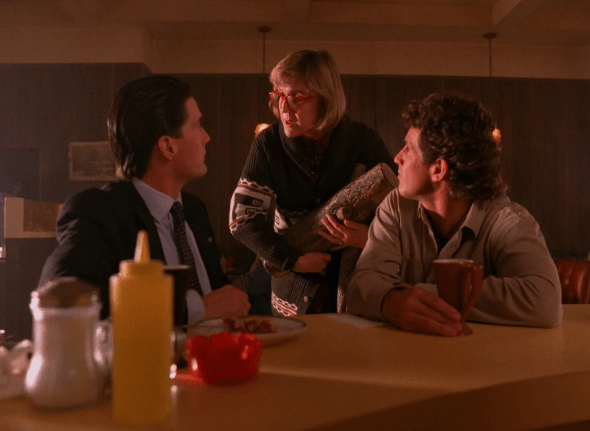
Alongside Twin Peak’s huge cast of eccentric townsfolk, all of whom hold some sort of dark secret, a lot of what people recognise as “Lynchian” comes in the weird stuff that appears in every scene. When they visit the bank to collect a safety deposit box, there’s a taxidermy stag’s head on the table. The business machinations of the town’s patriarch revolve initially around getting a big group of Norwegian businessmen to buy the lumber mill, who behave oddly before leaving in shock at news of the murder.
These extra details provide two things, and they’ll do the same in your games. Firstly, they contrast with the clear thread of scenes to investigate things – it’s never obvious if they’re important or not, or if we’ll need to come back to them later. Secondly, they add a sense of dread to the whole town – alongside the obviously dark secrets coming out, there’s just something not right about it – or maybe all towns are like this? You can pick your extra details in scenes to reinforce the feeling you’re looking for – it doesn’t have to be looming existential dread – at least, not every game.
NPCs have their own messy lives
Alongside the extra details from the scenes, the townsfolk in Twin Peaks all clearly have hanging lives that are waiting to be explored – and in some cases, make no sense. The idea that everyone has a secret isn’t new, but consciously thinking about what’s really going on with your NPCs will help to add some richness to your player’s interactions with them.
For these, instead of revealing them immediately, you can keep them in the background a little bit until revealed – they don’t all need to be thrown out there all at once. In some ways, you can gauge your table’s reaction to them and see what sticks – if their beloved dwarf weaponsmith turns out to be having an affair with the head of the thieve’s guild, there’s an adventure growing there that they’ll be invested in if they discovered the affair and promised to keep it secret.
So, a few ideas from Twin Peaks that we could pick up in any TTRPG – and while your obvious choices are Unknown Armies or Delta Green, I’m sure there’s plenty of other games that would benefit from stealing some of these techniques. Let me know how it goes, and here’s hoping you get some Damn Fine Coffee in your gaming!

