The “How To” book the Hobby’s Been Waiting For – Review: So You Want to be a Game Master?

For a hobby with a lot of techniques and ideas to master, we’re terribly short of advice books. Aside from a wealth of excellent blogs, there’s really only the occasional book that looks at how to start GMing. The chapters in RPG books can be variable at best, and there’s a lot to the craft of GMing.

One of the best blogs out there for GM advice is The Alexandrian, and Justin Alexander has focussed a lot of his thoughts from there, and expanded on them, to release “So You Want to be a Game Master?” – a book focused on taking you right from the beginning of prep to running successful games.

Continue reading →

Guiding the Ironlands – how to run Ironsworn as a One-Shot

Ironsworn, Shawn Tomkin’s RPG of dark fantasy with solo, guided, and GMless modes, is one of the most exciting releases to the hobby in recent years. With its sci fi sequel, Starforged, now established it’s beginning to get some decent play on the convention circuit – and it plays really well with a GM (in ‘guided’ mode) as well. So here are some tips if you want to get it to the table.

Continue reading →

“I hit it with my axe” – fostering better player narration in TTRPGs

Player narration lies at the heart of top-class game sessions. As the Bakers say in Apocalypse World, roleplaying is a conversation, and when only one side (or neither side) are contributing much, it can feel flat. Even in the most trad game, when players describe their characters actions, it lands better if they add some flavour to it. Compare:

  • I pick the lock to the door with the demon face #rollsd20
  • We see Cherbol pressed against the door, his face to the carved demon, as he carefully rotates the picks in his hands, elf-ears pricked up to hear the click #rollsd20

Deeper player narration, or even action description, leads to a more engaging and exciting table. So what techniques can we use to foster it?

While you’re reading this, I should tell you about my Patreon. Patrons get access to content 7 days before they hit this site, the chance to request articles or content, and the chance to play in one-shot games, for a very reasonable backer level of £2 per month. If you like what you read, want to support the blog, and have the funds for it, please consider supporting here. Telling people about the blog, and sharing links/retweeting is much appreciated also – thanks!

Start Simple

I’m going to try for some definitions here. I’ve written previously about giving players more narrative weight in games, and some of these techniques foster a different kind of player narration.

Action Narration is where a player describes what they’re doing – it can be as simple as the first example above, or developed further. 

  • I step towards the door and, mindful of the demon face, slip my greased lockpicks into the lock and begin to turn.

Scene Narration is where the player sets the scene as well. The second example above is a possibly over-flowery example of this.

Some players, tables, and GMs don’t like scene narration from players. That’s fine, to a point; although if you’re playing a game like Feng Shui or FATE some scene narration is embedded in the game mechanics so I’d strongly advise you to use it – but some people prefer a harder distinction between player and GM. Occasionally people talk about “Immersion” and say that scene narration is ruining gaming, and they take issue with other people using it – these people are idiots, so back away slowly and ignore them.

If your table doesn’t want to push towards scene narration, start them out with action narration – and use some of the techniques below to encourage it. If they’re brand new, and/or you’re happy with it, go straight for scene narration – even completely new players will often find it just as easy to work with

Techniques to Use

There’s no one fix for this, but there are a few you can try to encourage this. I’m not at all a fan of 

Ask For It – any time a player wants to half-ass some action description, you can always ask for a bit more from them. I use this particularly if they’ve given almost no description at all, or if they’ve stated a game action instead of fiction

  • Can I roll Acrobatics?
  • Of course you can! What are you doing when you roll it?

Ask for a Bit More – particularly in open-skill challenges or extended tasks, asking for more flavour is also allowed – particularly if there’s a stretch to it

  • I’ll try and find a cure for the virus
  • Great, it’s probaly Reason+Science – can you give me a bit of flavour about what we see your PC doing?

Describe Locations Loosely – make the setting of scenes you describe flexible and open to player input. This includes using theatre of the mind whenever you can – there are some GMs online who’ll put out gridded maps all the time, even for non-combat encounters, and it’s really hard to not take the details on those maps as immutable fact (hey, there’s three barrels to the north- what’s in them?)

  • You’re in the back of the warehouse. You can see the goons are about to unload. There’s teetering piles of boxes, shelves, an idle forklift truck, and a workbench with some tools on it. You look like you’ve got the drop on them – what do want to do?

Give Permissions Generously – if a players asks if they can do something, with any sort of narrative justification, default to YES unless you think it’ll grate with the rest of the table. Want to use Command to inspire the science team to help defeat the virus? Of course you can. Want to Force open the door instead of picking it? Yeah, that works – a skill roll’s a skill roll. 

If you’re worried this will lead to players using their best skills all the time, the fix for that is that unusual approaches usually only work once – and sometimes I’ll even (with players with particular penchants for stretching) say they can only do it once per session. I also have some hard limits on what can be done. When I’m running Star Trek Adventures, you can pretty much use whatever on an Extended Task if you can narrate it in – but when you fire a phaser in combat, it’ll always be Control+Security.

What To Avoid

There’s some other approaches I’ve found less successful, and in particular one very common one. Don’t give bonuses for extra description or exciting narration. Your mileage may vary, but my experience is that player rewards for “good roleplay/narration” just reinforce a GM-in-charge attitude that undermines the other approaches. It’s not a good-roleplaying doggy biscuit. Cool player narration should be the standard, not some unusual extra effort they’ve made so they get an extra dice.

An exception to the above is where games come with some sort of ‘fan mail’ mechanic where the whole table has a resource they can use to reward – this can really work, and gets everyone engaged in the process.

Similarly, where possible default to the same difficulty and approach as if they’d made the roll normally. If they want to get past the guards by causing a distraction by spooking the horses with Animal Friendship, cool – it’s the same difficulty as the Stealth check they’d make to sneak past, or the Deception check to lie to them. You’ve got to apply a reasonableness test at times, of course, but if you’re defaulting to yes and being generous, your players will realise this is only a one-off ruling and it won’t put them off being more inventive in future.

So, some ideas for encouraging player narration. What do you do at your table? Let me know any that I’ve missed.

Prep Techniques: Dilemmas

Credit for this technique goes to the game in which it is most explicitly modelled, John Harper and Sean Nittner’s Agon – a game of Greek heroes travelling home by way of a series of perilous islands – and each island begins something like this:

  • Will you command Meletia to use the island’s gold to restore the ruined temple of Hera and receive divine protections? Arts & Oration vs. Meletia.
  • Or will you command Ionestes to cease speaking false promises of divine aid and instead support the construction of practical defenses? Arts & Oration vs. Ionestes

(Agon, Isle of Kryos)

Each choice offers a chance at resolving the conflict introduced, and taking sides in an ongoing dispute – the following scenes will differ depending on which approach they take (and whether or not they are successful). These happen right at the start of the adventure, as the players arrive in the isle, and thrust them directly into the action. But there’s no reason we shouldn’t use these with other games, and they’re a really effective way of launching a session.

While you’re reading this, I should tell you about my Patreon. Patrons get access to content 7 days before they hit this site, the chance to request articles or content, and the chance to play in one-shot games, for a very reasonable backer level of £2 per month. If you like what you read, want to support the blog, and have the funds for it, please consider supporting here. Telling people about the blog, and sharing links/retweeting is much appreciated also – thanks!

Why They Work

They give players clear options and genuine choices and let them engage with the adventure immediately. Particularly for one-shots, it can be easy to start with a fight that is just thrust upon the players, and they can feel like they’re just setting off on a railroad – this gives them a choice right at the start. There’s also no need for them to be limited to the options you’ve suggested – they can come up with their own approach, but you’ve given examples to help them make that decision.

By choosing one option, they also cut off the other, and there will be NPCs on each side that will want to engage with them to resolve the choice. Ultimately, either choice might lead in similar directions, but how that direction appears will be coloured by their choice – and whether or not they are successful.

How To Prep Them

Begin with your initial scene and think of a couple of ways they can be resolved. This doesn’t have to be amazingly original – your players may come up with other choices, too, when you’ve shown them two, and that’s fine. Have an immediate call to action inherent – either a threat to something the PCs care about, an ongoing mission that will take them directly into this conflict, or a personal link to the issue.

Then, give some thought to how each option could be resolved. Try to make them equally exciting – you might balance a combat with a skill challenge of some sort, or a series of skill rolls with accompanying risk. They don’t have to be equally difficult, of course – but try to avoid offering an obvious answer to the dilemma.

Examples

Let’s say you’re prepping the most vanilla D&D plot ever, of a village in danger because of raiding goblins in the forest. You’ve, correctly, thought to start with an encounter with bandits on the way to the village – who are desperate because of the goblin displacement and could even be useful to find the goblin camp later – and had originally planned for them to leap out and attack the caravan they are guarding.

Instead, let’s have the PCs come across a robbery in progress. Around the corner, they see a merchant being turned over, with crossbow-wielding bandits in the trees above trained on them as they try to bargain with them. The merchant in front is clearly having none of it, and it looks like it could turn nasty – he hasn’t seen the robbers in the trees.

Do you charge in and intercede on his behalf, and try to cow the bandits with your force of arms and courage?

Or do you sneak around and dispose of the bandits in the trees to even the odds?

Or perhaps try and tackle the leader by surprise before his archers have a chance to react?

We’ve got a trilemma there, and although most of them probably lead to combat, it’s a much more vibrant and interesting initial scene. We’re assuming that heading into the forest to avoid the bandits isn’t an option – if it is, there’s always goblins to tackle them.

In cases where the PCs have a clear mission, your dilemmas can be more like options for them to pursue. For instance, if your PCs have arrived at a party to steal a crown from the host, we should add a bit more action. So begin with them seeing a drunken guest causing trouble, about to challenge another noble to a duel.

Do you attempt to sneak behind the scenes straight away, looking for a route upstairs while the guards are distracted?

Or do you intercede on either nobleman’s behalf, trying to create more chaos and maybe win some allies here who might know about the crown?

It’s an interesting challenge to try and add this to a session you’ve already prepped – particularly in the initial scene, where it will have the most impact. As I said, for more examples, look at Agon or the Paragon family of games, who all model this excellently. Have you used dilemmas in your games during the starting situation? Let me know in the comments.

Wyrm’s Teeth: 13th Age Glorantha – A Retrospective on a Short Campaign

I’ve just spent a sunny afternoon prepping the final session of a short 13th Age Glorantha campaign, and it’s been great to get through a short season entirely home-written. I’ll have run 6 sessions by the time the finale is over, and we’ve taken 3 PCs from 1st level to the cusp of 4th level – we might come back to them at 4th level for a sequel, when we can rotate it back into the schedule.

While you’re reading this, I should tell you about my Patreon. Patrons get access to content 7 days before they hit this site, the chance to request articles or content, and the chance to play in one-shot games, for a very reasonable backer level of £2 per month. If you like what you read, want to support the blog, and have the funds for it, please consider supporting here. Telling people about the blog, and sharing links/retweeting is much appreciated also – thanks!

And it’s been great. I thought I’d review and share some of the prep techniques that worked for me. In fact, I’m going to look at adapting it and getting it up on the Jonstown Compendium, Chaosium’s fan-made storefront. In advance of this, Patrons are going to get sent my unedited, raw prep notes – they can let me know if they think this is a good idea.

Run What You Know

I’ve never actually run an ongoing 13th Age game before, although I’m fairly sure I’ve run more 13th Age Glorantha at conventions than anyone else over the past few years. I’ve a real love for the crunchy narrative combat / freewheeling player agency interlude bit of 13th Age, and this was a great chance to see it fly with players that were involved with it. 

So, if it isn’t too obvious, pick a game you like and ideally one you know the rules to pretty well. This gave me a good feel for making combat balanced and exciting (pretty important in a game like this) and how to handle the narrative techniques like montages.

Have A Campaign Plan

By “Campaign Plan,” I literally mean just a bullet point for each session. I didn’t follow it exactly, but it helped make prep easier as I wasn’t starting from an empty page each time – I’ll be doing this again with every season going forwards.

In fact, this was what it looked like:

  • S1 – Defeat cattle raiders, learn of encroaching chaos L1
  • S2 – Investigate chaos, learn of lunar magics upsetting balance L1
  • S3 – Secrets in the Cackling Caves – dungeoning L2
  • S4 – Consult with corrupted Silver Wolf tribe
  • S5 – Travel to Jonstown to find who could have learned of this – citycrawl beset by lunar spies L2
  • S6 – Fight the lunar spies in the Compendium / somewhere else exciting L3

We ended up going to six sessions, partly because session 1 was a sort of combined session 1 / session zero with character generation folded into it – so the first session took a couple of sessions really. Jonstown, too, ended up a bit different, because I thought it’d be a good idea to have the city burned down and besieged by Lunars. Session 6 is also completely different – they’ve dealt with a Lunar ghost and now have to find how to finally lift the curse on the lands.

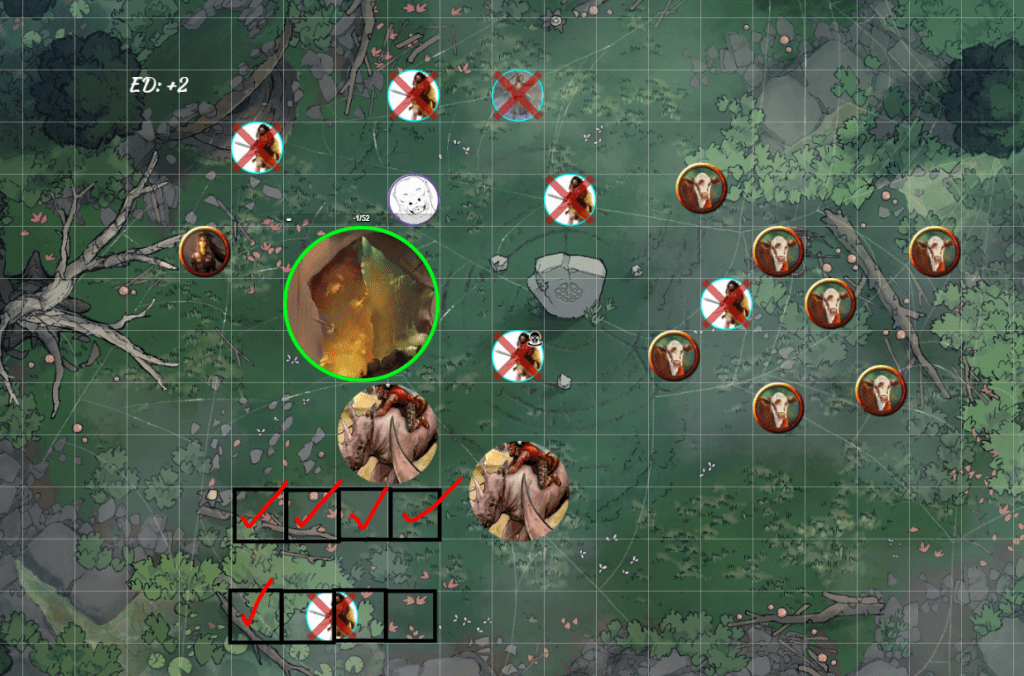
Starting the campaign with a cattle raid, classic Glorantha. The presence of two rhino riders is a result of Roll20 teething problems.

Then Prep A Session At A Time

After that sketch was done, I stuck to only going one session ahead at a time. Why? Well, this allowed me to reincorporate player ideas. 13th Age has montages, hazards, and other opportunities for players to add elements to the story, and this let me re-use them in following sessions. I’ve written before about how effective reincorporation is, and this let me respond to it without having to feel like I was improvising too much.

This led to an entire session changing – I’d thought of the Cackling Caves as being a Broo encampment, but this became a corrupted Brown Elf shrine when elves were introduced in a montage the session before. I did a fair bit of checking in with the players for what they wanted more of through Stars & Wishes, too – which meant I had plenty of material to work with each session. Adding parameters, like with anything creative, usually makes things easier rather than harder, and this is a campaign I’ve genuinely enjoyed prepping.

Use Random Generators

Speaking of the Brown Elf Shrine, I actually used a random dungeon generator (well, sort of) for it – and similarly for the Silver Wolf tribe. In fact, I used the same generators each time – the tools in Kevin Crawford’s excellent Worlds Without Number. There are many more available, and although I’d recommend these, use whatever you want to spike inspiration within the parameters set.

Make Up Monsters

While 13th Age Glorantha has a great bestiary in the game, it’s also been fun to lean into 13th Age’s recommended way to freeform monsters. Most of the time I’ve either reskinned existing monsters, but I’ve also used the standard stats in 13th Age core – flavour counts for more than statistics in a game like 13th Age, and so picking up a few of these has been great.

So, a run down of how I’ve prepped a full campaign for a (relatively) trad game. I’ve learned a lot from these processes, and a lot of them I’ll use again. Are there any go-to prep techniques that you use for campaign planning? Let me know in the comments.

Lonely Fun, Or What To Do When You’re Not At Expo

We’ve all been there – a convention you couldn’t make, or just didn’t fancy, and the FOMO that sometimes hits when you see the pictures of the happy gamers on your social media. Even worse, sometimes you see the swag they’ve bought! For a number of (happy) reasons, I wasn’t at UK Games Expo last weekend, and although it’s not a con I hold in much affection (it’s just too big – and it’s not really about the games), I did get a few wistful feelings about it.

So I did what every self-respecting gamer does – some game stuff, and then I felt better about it. Feel like you’re missing out on game stuff, either through cancelled sessions, a missed convention, or a spare evening you could have been gaming? This sort of stuff used to be called “lonely fun,” which I think sounds a bit too sexy, but here’s a few things to do to cope with not being at a convention.

While you’re reading this, I should tell you about my Patreon. Patrons get access to content 7 days before they hit this site, the chance to request articles or content, and the chance to play in one-shot games, for a very reasonable backer level of £2 per month. If you like what you read, want to support the blog, and have the funds for it, please consider supporting here. Telling people about the blog, and sharing links/retweeting is much appreciated also – thanks!

Get That Back Pocket Game Prepped

I’m a great exponent of everyone having a few back pocket games ready for when a game night gets cancelled, or when you’ve got to fill in a convention slot. For this you’ll need pregens, a few scenes, and a sketch of the start and end. If you’ve nothing but a game idea, start with pregens – if you can get a solid set made, you’ve already done the hardest part of prep. If you aren’t quite up to that, try an easier set-up – a DCC one-shot with the character generators at Purple Sorcerer, or read through a quickstart and make some notes. Myself, I was getting the new Candela Obscura prepped to run a YouTube game of it – watch out for it soon!

Do Some World Prep

If you’re not ready to prep a whole one-shot, why not get some prep done in a game setting. The original lonely fun (to a certain definition of fun) is, I guess, rolling up Traveller worlds, but there are so many random generators out there it’s a great opportunity to get a setting sketched out – and maybe then an adventure will come from that!

Notable resources that are well worth digging out to do this include Stars Without Number (or indeed any of Kevin Crawford / Sine Nomine’s stuff – most are available in free or deluxe versions), Tome of Adventure Design, or any number of old-school procedurally generated stuff (1e DMG, anyone).

Alternatively, why not dive into a rich, detailed setting? I often don’t have enough time for this, but Glorantha, the Forgotten Realms, or even Dune offer lots of options to dig into a setting. A proper setting sourcebook should spark a bunch of adventure ideas, which you might or might not come back to – who knows?

Play a Solo Game

I’ve got more detailed posts coming about solo gaming, but in case you’re curious, you could check out Ironswon or Starforged for a way to play solo that embeds the game into this approach. Alternatively, try the Mythic GM Emulator with your system of choice (you might still need pregens, mind). There’s been a real explosion of solo games recently – and some will give you a really close approximation of a traditional game. I found this interview from the Grognard Files with Jon Cohen, the host of Tale of the Manticore really useful to picture how a solo game of a more trad game might look.

Watch Some Actual Play

Okay, I’ve said what I’ve said about Actual Play, but there are some good ones. I’m planning to be contributing to the good ones soon with Unconventional GMs, but in the meantime try Jason Cordova’s youtube channel for some great demos of PBTA games, or the One Shot Podcast.

Or, as I did, you can spend yet more time trying to learn some basic photoshop and video editing to get yourself onto the AP scene. Still a way to go there.

So, four options for your lonely fun. What does your coping-with-con-absence prep look like? Comment below or catch me on other social media.

Bad Player Habits – And How To Avoid Them (Part 1)

Recently on twitter I posted about one of my gaming bugbears (not the furry kind) – players avoiding risk when the rest of the group is embracing it. This generated a lot of responses about similar play that can come up in one-shots, and make it harder as a GM to produce an enjoyable session for everyone. So, looking at some of these behaviours, I decided to think about what we, as GMs and fellow players, can do to discourage – or avoid – them. I’m going to look at my top three Bad Player Habits (BPH) – Risk Avoidance, Revisiting, and Un-Roleplaying. In this post, we’ll look at Risk Avoidance – one of the most common, and most problematic – particularly in one-shots.

While you’re reading this, I should tell you about my Patreon. Patrons get access to content 7 days before they hit this site, the chance to request articles or content, and the chance to play in one-shot games, for a very reasonable backer level of £2 per month. If you like what you read, want to support the blog, and have the funds for it, please consider supporting here. Telling people about the blog, and sharing links/retweeting is much appreciated also – thanks!

First, though, so you know I’m not a monster:

But maybe the players don’t know any better!

This was a response I got from several commenters – that I was unfairly victimising poor players who just preferred to play in a different way to me. To this, I say two things – firstly, in one-shots you really need to be explicit about expectations, and in almost all of the games I play at conventions, people are. And in any case, “This game is deadly and survival is more important than pace. So play carefully and check every room for traps,” is weak-sauce GMing – don’t do that.. 

Every time I’ve played and these have come up, of the n players at the table, n – 1 of them have had a very clear understanding of the game premise and the kinds of behaviours encouraged – it’s been clearly explained and understood by everyone except the player performing these things.

But what about new players? – I can categorically say that these are not behaviours that I see in gamers who are new to the hobby, but exclusively by old hands who really should know better. In all cases they’ve been oblivious to the annoyance that this has caused to the rest of the table, even when other players have directly challenged them about it.

Risk Avoidance

This is my top BPH. To be fair, I can see how it develops, sort of, if you’re used to an adversarial GM style where you need to check every door for traps and search every room in case you miss something. Careful play is fine – in some one-shot games that I run, it’s encouraged to an extent – in Warhammer Fantasy Roleplay, you want the players to see combat as dangerous and to avoid, say, fights with the city watch. But it’s when one player is doing this and the rest of the group are playing normally that it’s irritating.

“I’ll stay in the van while you explore the warehouse”

“I’ll stay in the control room and monitor the cameras”

“I’m not very good at combat, so I run away when the monsters attack”

All of this is poor because you’re caught as a GM between including them in the game – when they’ve opted out of the action – and letting them have the satisfaction of avoiding the danger that they clearly crave. They’re also leaving the rest of the group at higher risk from any danger that emerges – which is the real problem with this. When that player runs away, they make it harder for the other players who now have to fight with one fewer combatant. Add to this that very often these same players will back-seat drive the play from their position of safety, despite very clearly not being there.

So how to avoid this?

Well, first of all – and this goes for all of these – be explicit. Both at the start of the game, and during, make the level of risk-taking clear. If you’re running Mork Borg, it might just be to say:

“Look, this is a deadly game and the dice are going to fall where they may – some PCs might die, and that’s just fine – I’ve got a bunch of extra pregens and we’ll bring them in immediately. It’ll be more fun if we all just embrace this, rather than avoiding doing anything.”

Sometimes, you’ll find the whole group gets distracted by a perceived danger – sometimes what they perceive is even actually dangerous, but they can’t get past it and wind up in circular discussions about it. Here, it helps to have a friendly NPC who can drop in some clues as to the most fruitful route – having a local guide to point out that, while the deserts of Ja’darr are very dangerous, he’s pretty sure that heroes of the PC’s stature will be able to cope with them.

The other way is to demonstrate competence early. Begin with an action scene (often, although not always, a fight) where the PCs can win. An easy early scene lets the players learn the rules if they need to without too much peril, and also demonstrates that they can triumph in similar scenes.

Another prep technique is to have multiple options at each stage – if they are really hung up over the Deserts of Ja’darr, maybe there’s another way to cross them to the temple – they could try and hitch a ride on a passing roc to get them there. These alternative options are still dangerous, of course, but letting the players choose the one with less perceived risk satisfies some of the careful players’ needs.

So, there’s some techniques to counter risk avoidance and encourage all players to be on the same page about their approach to play – next time we’ll look at the other two.

Target Rich Environments – Making Set Pieces Pop

Often, TTRPG one-shots or sessions coalesce around big set-piece scenes, where players need to achieve multiple goals and spend significant amounts of time – a party where they need to find the murderer, a train they need to rob, a castle they need to conquer or defend, an abandoned village they need to exorcise of ghosts. 

While you’re reading this, I should tell you about my Patreon. Patrons get access to content 7 days before they hit this site, the chance to request articles or content, and the chance to play in one-shot games, for a very reasonable backer level of £2 per month. If you like what you read, want to support the blog, and have the funds for it, please consider supporting here. Telling people about the blog, and sharing links/retweeting is much appreciated also – thanks!

These are often difficult to prep – you can over-think or over-simplify them, and either can be frustrating to run. Likewise, you can often end up railroading players if you try and prep thoroughly for one of these scenes, as you sketch out the various sub-scenes that could feature. I’ve got a technique that can help with that – design such scenes as a Target Rich Environment.

Be Clear About Goals

What are the PCs trying to do in this zone? They might need to accumulate clues (in which case write out a list of clues independent of sources as well as tying up likely ways they can get them), or they might just need to find somebody or something hidden. Think about where it is and why it is hard to find.

Big Open Spaces, Multiple NPCs

Give yourself an overview of the space the scene will take place in – even if it’s just with a map, it’ll give you an idea of how it can fit for the players. There should be multiple ‘zones’ within the scene, so that PCs can split up effectively (so at your party, you might have the bar, the dance floor, mingling with the guests, and backrooms with the staff) – and have a good number of NPCs lightly sketched who they can interact with. 

Lots of Targets

Give the players lots of options of stuff to do, and lots of plot-related hooks that can be pursued multiple ways. To paraphrase from The Alexandrian’s Three-Clue-Rule, work out at least three ways each vital piece of information or goal could be achieved, and sketch out what that might look like in-game: is it a social challenge, a skill check, or some sort of longer skill challenge?

Narrow Down The Start

As the PCs arrive in the environment, you want to spur them into action straight away – so give them at least two options that you explicitly present to them (do you mingle with the socialites at the bar and try and work out what the gossip is, or go straight to the dancefloor to try and ingratiate yourself with the princess and her party, or something else?) Giving concrete options helps prevent decision paralysis and keeps the pace up – and gives you the best of both worlds for sandbox/linear play.

Descriptions and Moments

Now that you’ve got a rough structure for the scene, add some pithy descriptive touches for each of the areas. I like to do this as bullet points, as they’re easy to scan and incorporate into descriptions without too much hassle. Moments – things that can be witnesses that serve as background flavour – also help to make the scene sing. Credit to Trophy as the first game I saw them in, although other Gauntlet publications like The Between also make use of them.

In summary, give your set pieces a little more thought  – and prep – than usual, and you can make truly memorable scenes for your one-shot or ongoing TTRPG game. Have you had any memorable target-rich environments in your games? Are there any good examples in published adventures? Let me know in the comments.

Playing The Apocalypse – being a better player in PBTA games

Last weekend, I was at Revelation – possibly the world’s only PBTA face to face con. It’s in Sheffield, UK, and I’d recommend it to anyone who wants to get a big dose of PBTA or PBTA-adjacent gaming (games of FITD and similar drifts are allowed). It got me thinking on best practices for playing these games, which often take a bit of a shift in mindset to get right. There’s tons of GM/MC advice around, but I think these games – particularly the factiony / PvP ones – need a shift in mindset from everyone at the table, and so here are my player top tips

While you’re reading this, I should tell you about my Patreon. Patrons get access to content 7 days before they hit this site, the chance to request articles or content, and the chance to play in one-shot games, for a very reasonable backer level of £2 per month. If you like what you read, want to support the blog, and have the funds for it, please consider supporting here. Telling people about the blog, and sharing links/retweeting is much appreciated also – thanks!

Talk Hard

If you’re having a ‘proper conversation’ with a PC, or NPC, try to push it towards a move. What are you really trying to get out of them, and how can you get it? It’s fine to remind the GM what you’re shooting at, or to negotiate with them for what you’re going for, but in PBTA the split between roleplaying/talking scenes and action/combat scenes in many cases doesn’t exist. 

Often the “Find Information” move is underused in PBTA games – the questions you get to ask often develop plot really well – so pitch towards them where you can. You should expect to be triggering moves when you’re, for instance, asking about the murder or trying to persuade the cops to leave you alone.

Think One Step – But Only One Step – Ahead

In some player-driven games like Urban Shadows or Apocalypse World itself, there’s often an expectation on players to drive plot. The GM might well turn to you and ask what your PC does next, or even ask you to set the scene. This can be daunting! To avoid this, think about what your character’s next step is, and be ready to try and achieve that. It might be fairly loose – if I’m starting out as a Vamp in Urban Shadows, my first plan might just be to get some allies – so I’ll be visiting some established NPC or PC and trying to negotiate a mutual deal.

A word of caution – PBTA games thrive on twisting plots and loyalties, so thinking more than one step ahead is unlikely to be a fruitful exercise. But having a broad plan of action, and your PC’s next step, will give you something to shoot at.

Be An XP Hunter!

Many PBTA games have advancement, or XP systems, deliberately built to drive good play. So keep one eye on how you can earn XP, and be prepared to do it. For instance, in SCUP, you get an XP for the first Honor move you do each session, so you’re incentivised to bring your Faction into play and spend Honor points – do it! 

Many games have moves that allow you to earn XP by complying with other players – it’s absolutely fine and encouraged to set up these situations so you can both earn XP. Advancement will just unlock more options, many of which will drive plot and offer more interesting things to do, so feel free to use this as a driver when you’re picking your next step to do.

Don’t Overthink It

Playing RPGs in your head is rubbish. Your big secret plan, or long-contemplated backstory, is worth nothing if it isn’t shared with the table. This is always true, but even more true in PBTA! If you want something, go ahead and get it – don’t worry about showing your hand, or sharing your secrets, at the table. PBTA overwhelmingly works better when players know one another’s secrets and can bring them into play as well – as an author or an audience as well as an actor – so wear your heart on your sleeve.

Do What The Game Says

Having a moves sheet in front of you helps to show you the kind of things you can do (but obviously don’t look to it for the answer of what to do – for that you need your next step plan). The game will likely have advice on the playbook, or in the text, about best practices for play – and Player Principles – these are an actual part of the game. If you’re not following the Player Principles, the game won’t work – like MC Moves and Agendas, they’re as much part of the game as rolling 2d6 and adding a bonus.

So, there’s my top tips for PBTA play. If you’ve got any that you think I’ve missed (or that you think I’m wrong about – I’m aware there’s a school of thought that says move sheets should be kept MC-only!) – let me know in the comments!