Three Step Prep – my new method

I’m always looking for ways to approach my game prep that results in great gaming experiences that are fun for my players – and, importantly, easy for me at the table. I’ve used a few methods, and I’ve got a few go-to structures that I often use for one-shots. But alongside this, I’ve started doing my prep in three stages, and it’s producing great results – so I thought I’d share it here.

Basically, I do my prep in three stages – each of them, ideally, a few days apart. Now, I know there’s conflicting advice on this – Lowell Francis has blogged on Age of Ravens about doing his prep an hour before the session – but I’m trying to invest a little bit more time than that. This is often prep to feature on Unconventional GMs, so it needs to be tight enough to run for the first time confidently, and clear enough that I can speak without filler words on camera. Looking back at some earlier videos, I really didn’t have enough prep – you can tell by counting the “ummm”s!

While you’re reading this, I should tell you about my Patreon. Patrons get access to content 7 days before they hit this site, the chance to request articles or content, and the chance to play in one-shot games, for a very reasonable backer level of £2 per month. If you like what you read, want to support the blog, and have the funds for it, please consider supporting here. Telling people about the blog, and sharing links/retweeting is much appreciated also – thanks!

Continue reading →

Random Adventures : Tome of Adventure Design, 1st edition

I’m going to start my ‘reviews’ of random generators here, with the Tome of Adventure Design. After using this, I discovered a recently-released 2nd edition, but I’d already done the leg work with this one, so I guess a disclaimer is that I’ve done this using the 1st edition. On a quick glance at the 2nd edition they’ve tidied it up and added loads of extra bits to make it easier, so I’ll give that a go soon too; but this used the 1st edition.

As mentioned in the previous post, I’m interested in broad-brush strokes randomness; I don’t need individual detail (I’ll be using a tried and tested structure for that) but I do want some ideas to get me going. We’ve got a game of Shadow of the Weird Wizard, Rob Schwalb’s new-ish high fantasy game, booked in in a few weeks – so I thought I’d see what this threw up.

While you’re reading this, I should tell you about my Patreon. Patrons get access to content 7 days before they hit this site, the chance to request articles or content, and the chance to play in one-shot games, for a very reasonable backer level of £2 per month. If you like what you read, want to support the blog, and have the funds for it, please consider supporting here. Telling people about the blog, and sharing links/retweeting is much appreciated also – thanks!

Continue reading →

Five Room Dungeon Hacks, Part One – Multiples

I’ve blogged before about the 5-Room Dungeon here, and why its structure needs a bit of help sometimes to make it really shine in one-shots. I’ve been thinking about it more lately – inspired by this post which talks about 5RDs being scene sequences instead of locations. That post was talking about location-based design… but I’m interested in scene-based design as well. So what can we do to hack 5RDs a bit more flexible and epic?

While you’re reading this, I should tell you about my Patreon. Patrons get access to content 7 days before they hit this site, the chance to request articles or content, and the chance to play in one-shot games, for a very reasonable backer level of £2 per month. If you like what you read, want to support the blog, and have the funds for it, please consider supporting here. Telling people about the blog, and sharing links/retweeting is much appreciated also – thanks!

Continue reading →

Prep Technique: The Solo RPG

You can’t escape that there’s been a massive rise in Solo RPGs over the past few years. A glance at itch.io makes it look like the industry is drowning in solo journaling games, and there’s a whole culture of youtubers and streamers who play solo and share their thoughts and approaches. 

It’s true, it can feel a bit awkward to start with. But if you’re ignoring this part of the hobby, even if (like me) you’d much rather play with a group, I think you’re missing out. In fact, solo RPGs can be a huge part of your prep arsenal, giving benefit to your group play.

While you’re reading this, I should tell you about my Patreon. Patrons get access to content 7 days before they hit this site, the chance to request articles or content, and the chance to play in one-shot games, for a very reasonable backer level of £2 per month. If you like what you read, want to support the blog, and have the funds for it, please consider supporting here. Telling people about the blog, and sharing links/retweeting is much appreciated also – thanks!

I’m going to talk about three ways Solo RPGs can help you prep for group play, and then go through what you might use for them.

Continue reading →

Step-By-Step Prep: Ghost Mountain (Index Card RPG), Part One

I thought I’d try something new for this week’s post – a worked example of how my prep looks for a one-shot, from conception to delivery. After Deadlands and Weird Frontiers on the Unconventional GMs Channel, we talked (me, Gaz, and the players for those games) about doing some more wild/weird west games. It seemed as good an idea as any – and of course what could be more authentic than a bunch of British people playing at America’s great mythic tradition – and so I started looking at other RPGs.

While you’re reading this, I should tell you about my Patreon. Patrons get access to content 7 days before they hit this site, the chance to request articles or content, and the chance to play in one-shot games, for a very reasonable backer level of £2 per month. If you like what you read, want to support the blog, and have the funds for it, please consider supporting here. Telling people about the blog, and sharing links/retweeting is much appreciated also – thanks!

Continue reading →

Bad Player Habits – And How To Avoid Them (Part Two)

A while back on twitter I posted about one of my gaming bugbears (not the furry kind) – players avoiding risk when the rest of the group is embracing it. This led to part one of this post, where I looked at Risk Avoidance, probably the biggest – and most frustrating – Bad Player Habit (BPH). Now it’s time to look at the other two big BPHs – Revisiting and Un-Roleplaying. 

While you’re reading this, I should tell you about my Patreon. Patrons get access to content 7 days before they hit this site, the chance to request articles or content, and the chance to play in one-shot games, for a very reasonable backer level of £2 per month. If you like what you read, want to support the blog, and have the funds for it, please consider supporting here. Telling people about the blog, and sharing links/retweeting is much appreciated also – thanks!

Remember, this isn’t me dicking on noobs – in my experience these are always done by players who should know better – experienced roleplayers who probably do this every single game. And, again, whenever I’ve seen this it’s been one player not realising the effect they’re having on the rest of the group – maybe spotting these is something players should think about too.

Revisiting

GM: Right, so you’ve discovered the Ruby is in the Caves across the Desert of Ja’darr – and secured a guide who thinks he can trick a roc to get there. So as you creep across the mountain to the rocs nest….

Player: Wait, before we set off I want to talk to the merchant again. What does he know about rocs?

GM:….

Player: And does he have any more clues about the Caves?

GM:….

Player: Also, I want to buy a new sword.

This is the enemy of pace, and it can be frustrating for everyone at the table. It’s not hard to see how it develops – some types of games reward methodical analysis, and risk missing important pieces of information if every room is searched and every possible witness interrogated. These types of games are rubbish, by the way – avoid them.

How To Avoid It

One way you can mitigate this is by being clear when all the information is extracted – “so, the merchant has told you everything,” and even add in whatever in-game reason to prevent further investigation “well, the sun is nearly down, I’d better pack up for the day – I cannot talk any more!” Do this in-character first, and then move to direct, in-game if the hint isn’t taken. It’s also fine to say no if the player wants to go back in time – if everyone else at the table, including you, wants to move to the next scene, you can certainly go to the next scene. 

The passage of time also helps – I think having a pace in investigative games of each location, clue, or witness taking at least half a day is a good pace to start with. Prep your clues sufficiently far apart to support this, and any investigation game needs a looming countdown or other pace-setter to help investigation be done at speed.

Un-Roleplaying

GM: The merchant eyes you across the table… “Aye, I could tell you how to cross the desert, but I promised to never speak of it to outsiders again…”

Player: We knew he’d say this. Can we bribe him?

GM: …

Player: Why doesn’t he want to speak to us? I’ll Intimidate him (rolls dice)

GM: “Outsiders must never discover the secrets of Ja’darr…”

Player: Is 16 enough? Will he tell us now?

Look, I get it. There are some players who do not want to talk in character. I have a particular balance of tastes about the amount of in-character talk at a table, and I’m left cold by the lengthy in-character discussions that some streamed games have (it’s an audience/player distinction, though – I get why they do it). But you can get players who will actively resist any kind of character interaction, including just saying what their player 

But if you get just one player who actively resists talking in character, it can mean nobody at the table does. And while we all might have different tastes, I’d like more than zero of it in a session. If they really don’t want to, narrating what they say is fine (“I ask him what his problem with outsiders is” is a way round that doesn’t interrupt the rhythm of the game).

How To Avoid It

So how can we encourage a bit of in-character talk? Well the first thing is by baking in some character relations in our pregens or session zero process. If they’ve got some stuff to talk to each other about, they might actually do it. The other is by having some NPCs to start the conversations, who can ask in character for players to respond to. Having some sort of feckless ally travelling with them into the dungeon is a great way to make sure there’s some in-character chat even in the most barren of RP landscapes, and they can provide a helpful Greek chorus-echo of what’s going on.

The amount of in-character chat is a good thing to handle at the start of a one-shot or in a session zero, too – getting this element of play culture aligned is really crucial.

So, there’s the top three BPHs covered. Do you have others? Or are some of these acceptable at your table (let me know, I can pass some players your way at the next convention we’re both at!) Let me know in the comments below.
Prep Techniques: Dilemmas

Credit for this technique goes to the game in which it is most explicitly modelled, John Harper and Sean Nittner’s Agon – a game of Greek heroes travelling home by way of a series of perilous islands – and each island begins something like this:

  • Will you command Meletia to use the island’s gold to restore the ruined temple of Hera and receive divine protections? Arts & Oration vs. Meletia.
  • Or will you command Ionestes to cease speaking false promises of divine aid and instead support the construction of practical defenses? Arts & Oration vs. Ionestes

(Agon, Isle of Kryos)

Each choice offers a chance at resolving the conflict introduced, and taking sides in an ongoing dispute – the following scenes will differ depending on which approach they take (and whether or not they are successful). These happen right at the start of the adventure, as the players arrive in the isle, and thrust them directly into the action. But there’s no reason we shouldn’t use these with other games, and they’re a really effective way of launching a session.

While you’re reading this, I should tell you about my Patreon. Patrons get access to content 7 days before they hit this site, the chance to request articles or content, and the chance to play in one-shot games, for a very reasonable backer level of £2 per month. If you like what you read, want to support the blog, and have the funds for it, please consider supporting here. Telling people about the blog, and sharing links/retweeting is much appreciated also – thanks!

Why They Work

They give players clear options and genuine choices and let them engage with the adventure immediately. Particularly for one-shots, it can be easy to start with a fight that is just thrust upon the players, and they can feel like they’re just setting off on a railroad – this gives them a choice right at the start. There’s also no need for them to be limited to the options you’ve suggested – they can come up with their own approach, but you’ve given examples to help them make that decision.

By choosing one option, they also cut off the other, and there will be NPCs on each side that will want to engage with them to resolve the choice. Ultimately, either choice might lead in similar directions, but how that direction appears will be coloured by their choice – and whether or not they are successful.

How To Prep Them

Begin with your initial scene and think of a couple of ways they can be resolved. This doesn’t have to be amazingly original – your players may come up with other choices, too, when you’ve shown them two, and that’s fine. Have an immediate call to action inherent – either a threat to something the PCs care about, an ongoing mission that will take them directly into this conflict, or a personal link to the issue.

Then, give some thought to how each option could be resolved. Try to make them equally exciting – you might balance a combat with a skill challenge of some sort, or a series of skill rolls with accompanying risk. They don’t have to be equally difficult, of course – but try to avoid offering an obvious answer to the dilemma.

Examples

Let’s say you’re prepping the most vanilla D&D plot ever, of a village in danger because of raiding goblins in the forest. You’ve, correctly, thought to start with an encounter with bandits on the way to the village – who are desperate because of the goblin displacement and could even be useful to find the goblin camp later – and had originally planned for them to leap out and attack the caravan they are guarding.

Instead, let’s have the PCs come across a robbery in progress. Around the corner, they see a merchant being turned over, with crossbow-wielding bandits in the trees above trained on them as they try to bargain with them. The merchant in front is clearly having none of it, and it looks like it could turn nasty – he hasn’t seen the robbers in the trees.

Do you charge in and intercede on his behalf, and try to cow the bandits with your force of arms and courage?

Or do you sneak around and dispose of the bandits in the trees to even the odds?

Or perhaps try and tackle the leader by surprise before his archers have a chance to react?

We’ve got a trilemma there, and although most of them probably lead to combat, it’s a much more vibrant and interesting initial scene. We’re assuming that heading into the forest to avoid the bandits isn’t an option – if it is, there’s always goblins to tackle them.

In cases where the PCs have a clear mission, your dilemmas can be more like options for them to pursue. For instance, if your PCs have arrived at a party to steal a crown from the host, we should add a bit more action. So begin with them seeing a drunken guest causing trouble, about to challenge another noble to a duel.

Do you attempt to sneak behind the scenes straight away, looking for a route upstairs while the guards are distracted?

Or do you intercede on either nobleman’s behalf, trying to create more chaos and maybe win some allies here who might know about the crown?

It’s an interesting challenge to try and add this to a session you’ve already prepped – particularly in the initial scene, where it will have the most impact. As I said, for more examples, look at Agon or the Paragon family of games, who all model this excellently. Have you used dilemmas in your games during the starting situation? Let me know in the comments.

Wyrm’s Teeth: 13th Age Glorantha – A Retrospective on a Short Campaign

I’ve just spent a sunny afternoon prepping the final session of a short 13th Age Glorantha campaign, and it’s been great to get through a short season entirely home-written. I’ll have run 6 sessions by the time the finale is over, and we’ve taken 3 PCs from 1st level to the cusp of 4th level – we might come back to them at 4th level for a sequel, when we can rotate it back into the schedule.

While you’re reading this, I should tell you about my Patreon. Patrons get access to content 7 days before they hit this site, the chance to request articles or content, and the chance to play in one-shot games, for a very reasonable backer level of £2 per month. If you like what you read, want to support the blog, and have the funds for it, please consider supporting here. Telling people about the blog, and sharing links/retweeting is much appreciated also – thanks!

And it’s been great. I thought I’d review and share some of the prep techniques that worked for me. In fact, I’m going to look at adapting it and getting it up on the Jonstown Compendium, Chaosium’s fan-made storefront. In advance of this, Patrons are going to get sent my unedited, raw prep notes – they can let me know if they think this is a good idea.

Run What You Know

I’ve never actually run an ongoing 13th Age game before, although I’m fairly sure I’ve run more 13th Age Glorantha at conventions than anyone else over the past few years. I’ve a real love for the crunchy narrative combat / freewheeling player agency interlude bit of 13th Age, and this was a great chance to see it fly with players that were involved with it. 

So, if it isn’t too obvious, pick a game you like and ideally one you know the rules to pretty well. This gave me a good feel for making combat balanced and exciting (pretty important in a game like this) and how to handle the narrative techniques like montages.

Have A Campaign Plan

By “Campaign Plan,” I literally mean just a bullet point for each session. I didn’t follow it exactly, but it helped make prep easier as I wasn’t starting from an empty page each time – I’ll be doing this again with every season going forwards.

In fact, this was what it looked like:

  • S1 – Defeat cattle raiders, learn of encroaching chaos L1
  • S2 – Investigate chaos, learn of lunar magics upsetting balance L1
  • S3 – Secrets in the Cackling Caves – dungeoning L2
  • S4 – Consult with corrupted Silver Wolf tribe
  • S5 – Travel to Jonstown to find who could have learned of this – citycrawl beset by lunar spies L2
  • S6 – Fight the lunar spies in the Compendium / somewhere else exciting L3

We ended up going to six sessions, partly because session 1 was a sort of combined session 1 / session zero with character generation folded into it – so the first session took a couple of sessions really. Jonstown, too, ended up a bit different, because I thought it’d be a good idea to have the city burned down and besieged by Lunars. Session 6 is also completely different – they’ve dealt with a Lunar ghost and now have to find how to finally lift the curse on the lands.

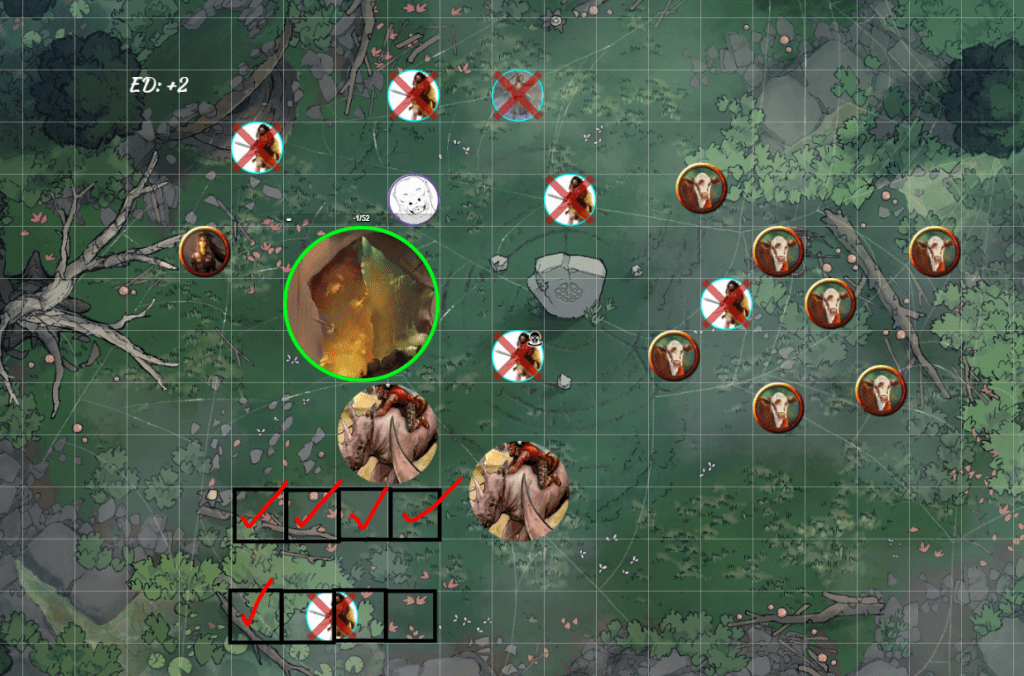
Starting the campaign with a cattle raid, classic Glorantha. The presence of two rhino riders is a result of Roll20 teething problems.

Then Prep A Session At A Time

After that sketch was done, I stuck to only going one session ahead at a time. Why? Well, this allowed me to reincorporate player ideas. 13th Age has montages, hazards, and other opportunities for players to add elements to the story, and this let me re-use them in following sessions. I’ve written before about how effective reincorporation is, and this let me respond to it without having to feel like I was improvising too much.

This led to an entire session changing – I’d thought of the Cackling Caves as being a Broo encampment, but this became a corrupted Brown Elf shrine when elves were introduced in a montage the session before. I did a fair bit of checking in with the players for what they wanted more of through Stars & Wishes, too – which meant I had plenty of material to work with each session. Adding parameters, like with anything creative, usually makes things easier rather than harder, and this is a campaign I’ve genuinely enjoyed prepping.

Use Random Generators

Speaking of the Brown Elf Shrine, I actually used a random dungeon generator (well, sort of) for it – and similarly for the Silver Wolf tribe. In fact, I used the same generators each time – the tools in Kevin Crawford’s excellent Worlds Without Number. There are many more available, and although I’d recommend these, use whatever you want to spike inspiration within the parameters set.

Make Up Monsters

While 13th Age Glorantha has a great bestiary in the game, it’s also been fun to lean into 13th Age’s recommended way to freeform monsters. Most of the time I’ve either reskinned existing monsters, but I’ve also used the standard stats in 13th Age core – flavour counts for more than statistics in a game like 13th Age, and so picking up a few of these has been great.

So, a run down of how I’ve prepped a full campaign for a (relatively) trad game. I’ve learned a lot from these processes, and a lot of them I’ll use again. Are there any go-to prep techniques that you use for campaign planning? Let me know in the comments.

Prep Techniques – Round-Up

Last year, I started writing about Prep Techniques – ways to structure your prep for a one-shot session to build a good structure for your session. One-shot and short-form play is all about having a clear structure of ideas so you’re not left floundering at the table, and these were designed to encourage that, with practical advice to turn an idea into a ready-to-run set of prep.

I contrast these with Table Techniques, which are things you do during the game that often don’t need any prep beyond creating the conditions for their deployment – Shared Narration is an example of this (well, several examples) – and I’ll be providing more examples of them over the next few months.

While you’re reading this, I should tell you about my Patreon. Patrons get access to content 7 days before they hit this site, the chance to request articles or content, and the chance to play in one-shot games, for a very reasonable backer level of £2 per month. If you like what you read, want to support the blog, and have the funds for it, please consider supporting here. Telling people about the blog, and sharing links/retweeting is much appreciated also – thanks!

There hasn’t been a full list of my Prep Techniques posts before now, so here’s a summary of what’s here. If you’re just starting prepping a one-shot and not sure what to do first, you could do worse than pick one of these and follow the method described.

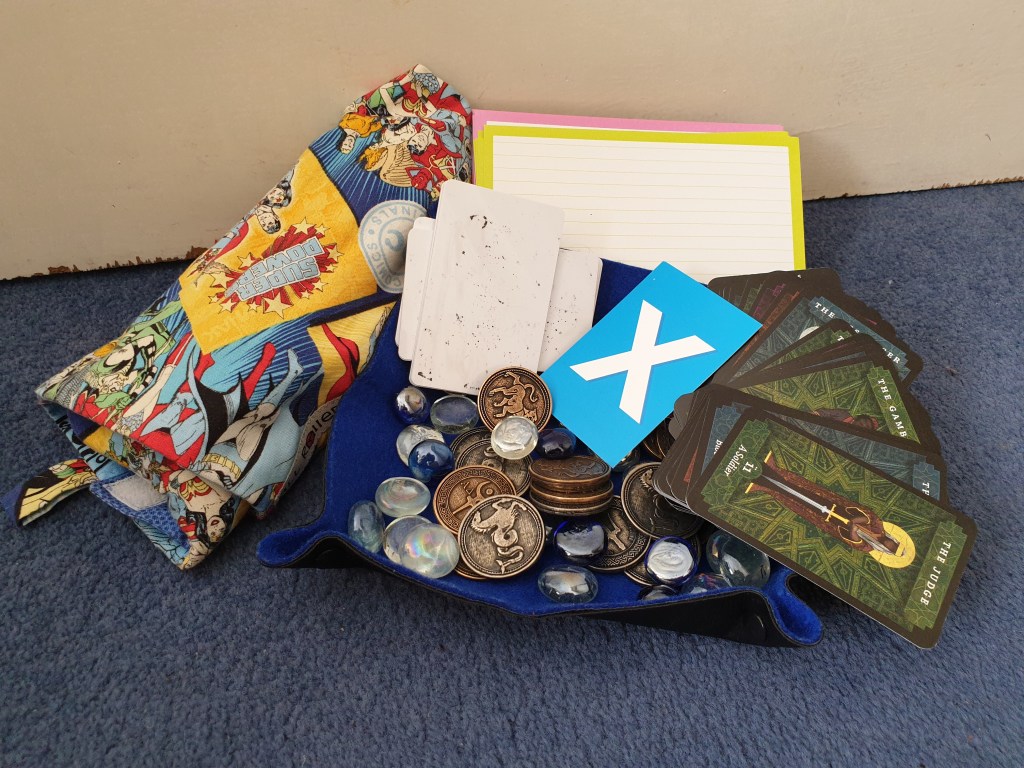
Essential prep – gathering your props

The 5-Room Non-Dungeon is Johnn Four’s 5-Room Dungeon method, applied more broadly to give a series of linked scenes. This is a great place to start if you’re beginning running one-shots. I actually think it works better out of the dungeon than for dungeon games.

Three Places is a way to structure investigative, location-based play where you want your players to have genuine choices as to how they approach the problem.

Another one that’s not mine, I did a deep dive of Sly Flourish’s Return of the Lazy Dungeon Master prep method here – even if you don’t use the whole method, the list of unconnected secrets and clues is a great technique to have in your back pocket, or to go through before a session to give things for the players to discover.

Another good way to get started is to write a convention pitch for the game, and use that to focus your thoughts – guidance here. Technique also applies for writing actual convention pitches!

For a more loosely-structured game, where you expect to think on your feet, you need a bag of tricks to throw at the players. The guidance in this post is relevant for PBTA, FitD, and other similar games like Spire and Heart. It’s easy to try and go in raw with these sorts of games, but in my experience having some prep thoughts done beforehand really help to make them sing in a one-shot.

Or for a more simple structure, start by thinking about the Boss Fight and work backwards from there. There’s a couple of examples of this approach here.

I’m not saying there won’t be more Prep Techniques shared in the future, but here’s all there are for now. My focus for the next few months is two things – putting out ready-to-run one-shots for a few systems (most of which are my own con game sessions from over the summer) and Table Techniques, which will give techniques that can be done during play to add interest and excitement to your games. Let me know if there’s anything you’d like to see!

Prep Techniques: The Boss Monster

Good antagonist design isn’t just essential for good TTRPG sessions, it can be something you base your whole session on – even if it’s a convention one-shot. I’m going to look at a method to build a session outwards from an antagonist, including looking at some rules tweaks that you might want to put in if your system isn’t as great at supporting solo monsters.

While you’re reading this, I should tell you about my Patreon. Patrons get access to content 7 days before they hit this site, the chance to request articles or content, and the chance to play in one-shot games, for a very reasonable backer level. If you like what you read, want to support the blog, and have the funds for it, please consider supporting here. Telling people about the blog, and sharing links/retweeting is much appreciated also – thanks!

In previous Prep Techniques posts, I’ve looked at 5-Room Dungeons, Sly Flourish’s Method, Three Places, Con Pitches and a Bag of Tricks. Here, I’m going to talk about using an antagonist as a starting point for your one-shot or session. This turns traditional adventure prep on its head – and gives you a stock of prep material that should let you run a flexible session, with multiple routes to take down the antagonist.

First, the Fluff

Let’s talk about the boss’s background first. Who is he and what’s his plan? What does he want to do, why is it terrible, and why can’t the PCs ignore it? A good starting point is one or more of the PCs – can you link them to their backstory to make the players care about the antagonist? If you’re in an ongoing campaign, think about linking him with previous sessions, or foreshadowing future plans.

Your boss should be tough fight, even if they’re on their own. Clever plots or schemes from the players should have the option of getting to them without his supporters – and they should still be a challenge then. So think about levels of power – they need to be a threat!

They aren’t going to be alone though, so have between 1 and 3 lieutenants – minor monsters that support him, who can be a challenge with support themselves. These lieutenants should be distinct in terms of powers and personalities from the boss – if the boss is an archmage, make his lieutenants warlords or combat monsters.

Antagonist-based plotting is a staple of superhero gaming, but it can also be used for any TTRPG genre

Plan for the PCs to deal with a lieutenant first, maybe even as the hook to discover the boss’ plans. Also, think about what their weakness is – even if it’s a tendency to monologue – and a way the PCs can find this out and use it to their advantage.

Next, the Crunch

To have a truly effective boss in a fight, you might need to bend or break your game’s action economy. In D&D, consider using Matt Colville’s excellent Villain Actions hack, so your boss can act multiple times a round – and in another system consider giving them 2 or more actions each round. If you don’t feel like doing this, or your boss has multiple attacks already, consider spreading them out across the round – you want to keep the spotlight on them during the fight, rather than it feeling like the PCs have all the actions.

They also need to be hard to kill. This might mean just more hp, or some sort of special rule. I’m a fan of Feng Shui 2’s boss rule – when they would go down, roll 1d6, and you need to get an odd result to actually defeat them. It adds a level of jeopardy and pressure to a fight and distinguishes them from lesser enemies.

As you’ve got the lieutenants sorted, almost any boss should have a numberless supply of minions – these can be added to any encounters liberally to balance to the right level of challenge you desire. With minions, I like them to sometimes be much easier to defeat than normal – don’t be afraid to send your 5th level PCs up against hordes of kobolds – often with the boss’ supporting powers they might be a challenge, and usually some PCs will still want to deal with the minions.

Third, the Adventure

Now, you want to think about some key scenes. I’d recommend having a starting scene fully prepped, where they learn about the boss’ plans in some way – maybe a fight with some minions, or one of the lieutenants. And think about mid-scenes, where they might take down a lieutenant or learn the boss’ weakness. By combining lieutenants and minions in a few different ways, you can have some options for different opposition they could face along the way.

You’ll want around 3 locations along the way that could lead to the showdown, and some things that could happen to the environment there. Some of these – or some of the lieutenants – can lend themselves to non-combat challenges (if you’re looking for rules to support these, try here or here) – that you can steer towards. Make some plans for the final confrontation – this needs to be a showcase fight scene, so bear in mind the advice here for building it.

So far, your adventure prep will look a bit like this list… next week, I’ll post up some examples for a few different systems!

BOSS PROFILE

Name:

Goal & why the PCs care:

“Secret” weakness:

Description:

Lieutenants (1-3):

Mid-range Antagonists:

Minions:

Locations:

Potential non-combat challenges: