Stay Frosty is a sci-fi OSR-ish game of shooting aliens from Casey Garske. Originally self-published, it’s been remastered and published (through kickstarter) by Melsonian Arts Council. You can get it here from Drivethrurpg, and doubtless there are places to source print copies after the kickstarter. I backed it because I’d heard lots about it (mainly from Tom on the Fear of a Black Dragon podcast) and was intrigued. I’ve since run both scenarios in the book as one-shots; as with all my reviews, this is play-informed.
While you’re reading this, I should tell you about my Patreon. Patrons get access to content 7 days before they hit this site, the chance to request articles or content, and the chance to play in one-shot games, for a very reasonable backer level of £2 per month. If you like what you read, want to support the blog, and have the funds for it, please consider supporting here. Telling people about the blog, and sharing links/retweeting is much appreciated also – thanks!
Stay Frosty casts your players as sci-fi marines sent on tense space combat missions; it positions itself firmly in a very specific genre, although whether you’re fighting bugs, infectious zombies, or demons is very much up to the scenario. It also features a procedural structure for its scenarios revolving around the rolling of a Danger Dice and the escalating player character Tension; in short, this game does a very particular type of genre and scenario, and it does it very well. The mechanics it introduces punch well above their weight in terms of complexity – and really deliver at the table. I’m going to talk about two of them, then the scenarios in the book, and finally some overall notes.
The Danger Dice
Each of Stay Frosty’s missions are similar in structure – and it offers random tables to create your own as well. The PCs enter hostile territory, represented by a pointcrawl. On every ‘turn’ (usually when they move to a new location, or spend time in one location), the GM rolls a d6 on the Danger Die table – results 1-3 give entries specific to the scenario, which could offer clues or backstory, or hostiles they could encounter. On entry 4, everyone’s Tension increases; on 5, every supply dice needs to be checked (running the risk of the APC running out of fuel, or the marines running out of air). On a 6, “Tension Explodes,” and the PCs run the risk of losing it, and their characters panicking.
This gives a really neat pacing mechanic to the game – it’s much more than a random encounter table, and drip feeds as much background information as it supplies threat. With each scenario having its own entries for 1-3, it’s a good way to offer clues, problems, and challenges in a procedural way.
Tension
How this interacts with Tension works well, too – Tension and the Danger Dice are the core of the game. Tension starts at 1 (“Warm”) and can go up to 6 (“Ice-Cold”) – each level brings associated system benefits to the characters. On a Tension Explodes result, though, PCs suffer damage depending on their Tension and it may reduce to 1. It’s a really good mechanic that tempts the players to want it to increase, but at a risk.
Alien RPG’s stress dice do a similar thing, I guess – but this is simpler and, I’d argue, more elegant. One thing that I’ve done in play is asked the players for short moments to describe how their tension increasing looks in the fiction – the bead of sweat dripping down, the pulling the helmet off in frustration – this worked really well in play.
The Scenarios
The book comes with two scenarios. I’ve run them both – one of them twice. All three games were really fun to run and got great feedback from the players. In many ways it’s the perfect one-shot setup (I used to joke that 50% of the sci fi games offered at conventions were the plot of Aliens, and I think that still stands) – and the procedural rolling alongside a simple point-crawl makes it straightforward to run. Another thing worth noting is that the two runs of GAME OVER went very differently, depending on the interaction between the player’s choices and how the Danger Dice went.
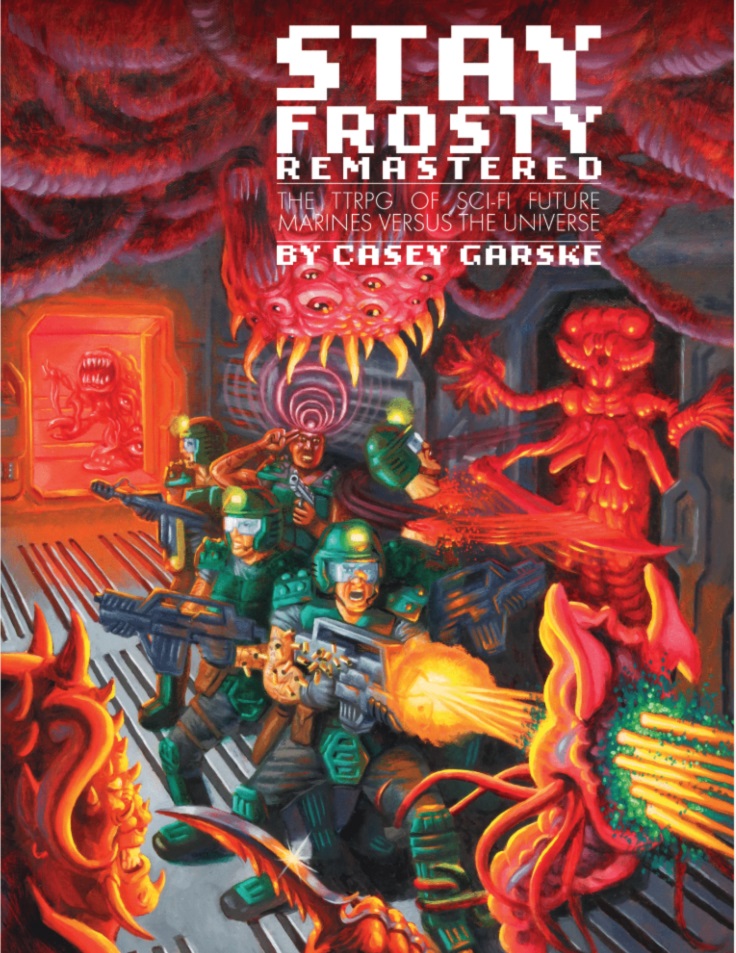
Physically, the book is a 102-page hardback in just over trade paperback size. The art is quirky and quite distinctive – I guess it might not be to everyone’s tastes, but it very much fits the game concept and some of the source material. The rules (I realise I haven’t mentioned them – but they’re similar to lots of these games – no skills, make attribute saves to do stuff, roll to hit in combat) are straightforward and explained well. But the real genius lies in the Danger Dice / Tension interaction, which makes this a fantastic game to run and play. There’s quite a few scenarios out already for it, but I’d totally recommend this – in some ways it’s an ideal one-shot game, with loads to support both players and GMs.
 Burn After Running: RPG One-Shots
[…] The Ultimate One-Shot Sci-Fi TTPRG? – Review: Stay Frosty (Remastered) […]
LikeLike