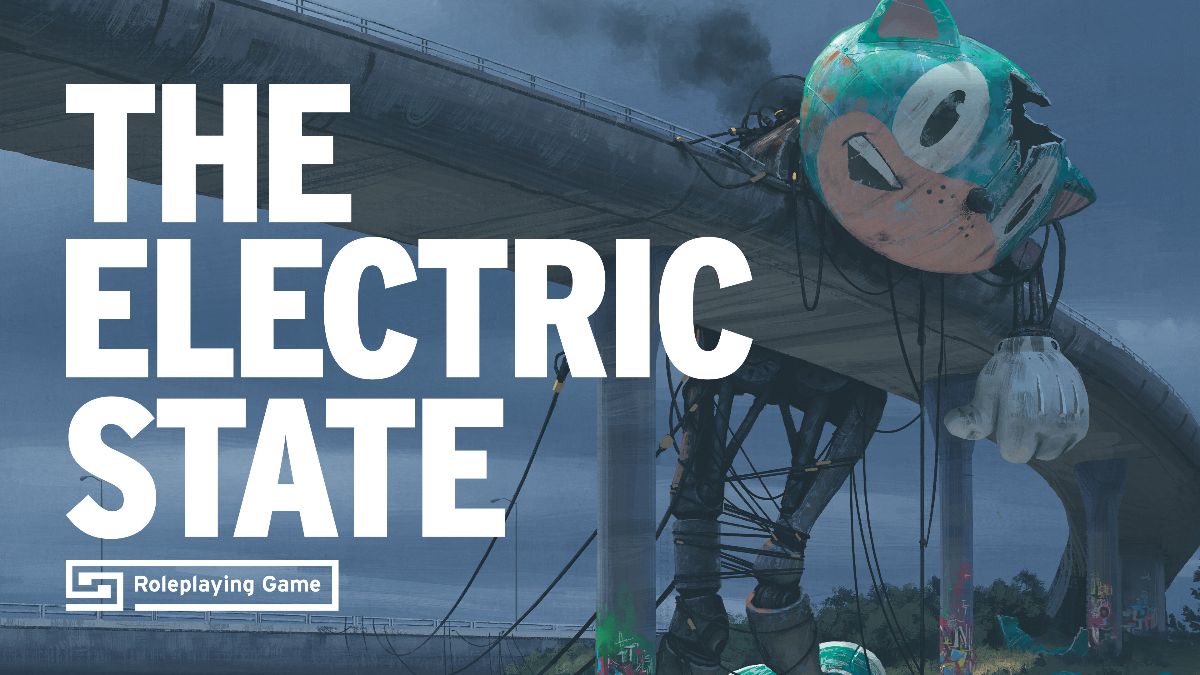
Electric State is the latest setting / art collection to come out of Simon Stålenhag, the force behind Tales from The Loop and Things from The Flood – both TTRPGs published by Free League. The artistic inspiration fits really well in converting to a roleplaying game, and it gives a chilled-out post-apoc(ish) 1990s vibe that is something genuinely different.
I’ve run this game in a one-shot, and you can watch the Actual Play of this on the Unconventional GMs channel here. We played through the first “Stop” (adventure location) from the book in just under 2 hours – and like everything we’ve done, there’s minimal editing and proper engagement with the rules – so if you want to watch it in action, check it out there.
While you’re reading this, I should tell you about my Patreon. Patrons get access to content 7 days before they hit this site, the chance to request articles or content, and the chance to play in one-shot games, for a very reasonable backer level of £2 per month. If you like what you read, want to support the blog, and have the funds for it, please consider supporting here. Telling people about the blog, and sharing links/retweeting is much appreciated also – thanks!
The Fluff
First up, the setting – it’s 1997, in Pacifica, which is what California is now. A drawn-out civil war has split up the USA, and a following rise of neurocasters – allowing people to access the VR of the Electric State – have led to a lot of people sticking where they are, plugging in, and dropping out.
The PCs have a reason to band together – they want to cross Pacifica and get to the Blackwelt Exclusion Zone, often to get to Vegas. So they’ve grouped together and got a car, and the campaign structure offered is a road trip across the land, encountering a mixture of Encounters (short scenes that bring the setting themes to them, or that show the PCs troubles coming after them), and Stops (full adventure locations – with a problem that must be solved before the PCs can leave). All this is presented refreshingly explicitly – the players have to find a solid reason for doing what they’re doing, and the GM plans the stages of their trouble catching up with them.
Campaign, adventure, and prep advice is something that Free League are really good at. There’s explicit guidance for creating Stops, different challenges grouped thematically, and how to string it together into a finite campaign. With a consistent art style (and, I should mention, this is an extremely lovely looking book) and vibe, it’s a compelling and inspiring setting with a clear idea of what players (and GMs!) actually do.
The Crunch
The system is modified from Free League’s Year Zero engine, although unlike some other recent RPGs, they’ve stripped it down significantly here. I’m not entirely sure that Tales from the Loop needed simplifying (they’ve basically removed skills – everything is a stat check), but it does allow room for some other rules that could be fiddly with more rules to hold.
To start, you’ve got rules for interacting in the neuroscape – you can search for information, hack devices and creatures you encounter, and even engage in combat there. In the neuroscape, though, you’ll accumulate Bliss points – and if your Bliss ever meets your Hope score, you can’t leave of your own accord. In play, this encourages the party to split up – you really want someone outside of the neuroscape at each stage to pull them out if their Bliss gets too much.
Hope is also what gets reduced when you Push rolls (as well as when you encounter stressful situations) – and the Hope/Bliss economy is pleasantly brutal. In a 2 hour one-shot we had two players get to Hope 0 and experience Breakdown. I’m sure this is by design – it creates a feeling where you have to really care to Push a roll when you know it might have lasting effects. In other MY0 games, the conditions you pick up from Pushing can often be easily recovered – in Electric State, after you’ve been pulled back by a friend and recovered some Hope, Hope never recovers automatically. You can share scenes and trade your Tension with other PCs for it, or use certain items (such as a Walkman, or Alcohol) to recover it.
This is balanced somewhat by the lack of skills – you’ll have decent dice pools most of the time, and usual MY0 advice applies – be generous with Gear bonuses, and stick with 1 success as all you need for most actions. Health, by contrast, recovers relatively quickly – this all fits with the vibe, as this isn’t about physical danger, but the creeping ennui and desperation that this might be all that’s left.
The One-Shot
The game contains explicit guidance for one-shot play (hurrah!) – basically, you play through a Stop. At the end of our game, we were keen to try a short campaign (they offer different lengths based on numbers of Stops) – which is only a good thing, but it does show that you miss out on engaging some of the rules in a short session.
There’s plenty of random tables, and when I run a one-shot again I’ll probably prep my own Stop for the PCs – there’s tons of ideas in the book, although the three Stops provided in the example Journey offer a good model for how to start, which is useful given the unusual setting and structure.
So, in short, I’d really recommend Electric State. I’m not sure if Free League has more planned for it, but it’d be great to see where it ends up. There’s a Netflix film planned for next year, too, so I’d hope the interest makes some supplements worth producing – it’d be great to see other parts of the former USA and more example Stops.
 Burn After Running: RPG One-Shots
[…] Existential Road Tripping – Review: Electric State RPG @ Burn After Running – I need to pick this up. I love the whole idea of it, the movie trailer has me pumped, and I love the art. This review just further whets the appetite! […]
LikeLike