DIE RPG is a bit of an odd beast – this TTRPG from Rowan Rook & Decard, written and developed from Kieron Gillen’s comics, is quite unlike anything else I’ve played on recently. It’s laser-focussed on a very specific play experience, and it’s all the better for it.
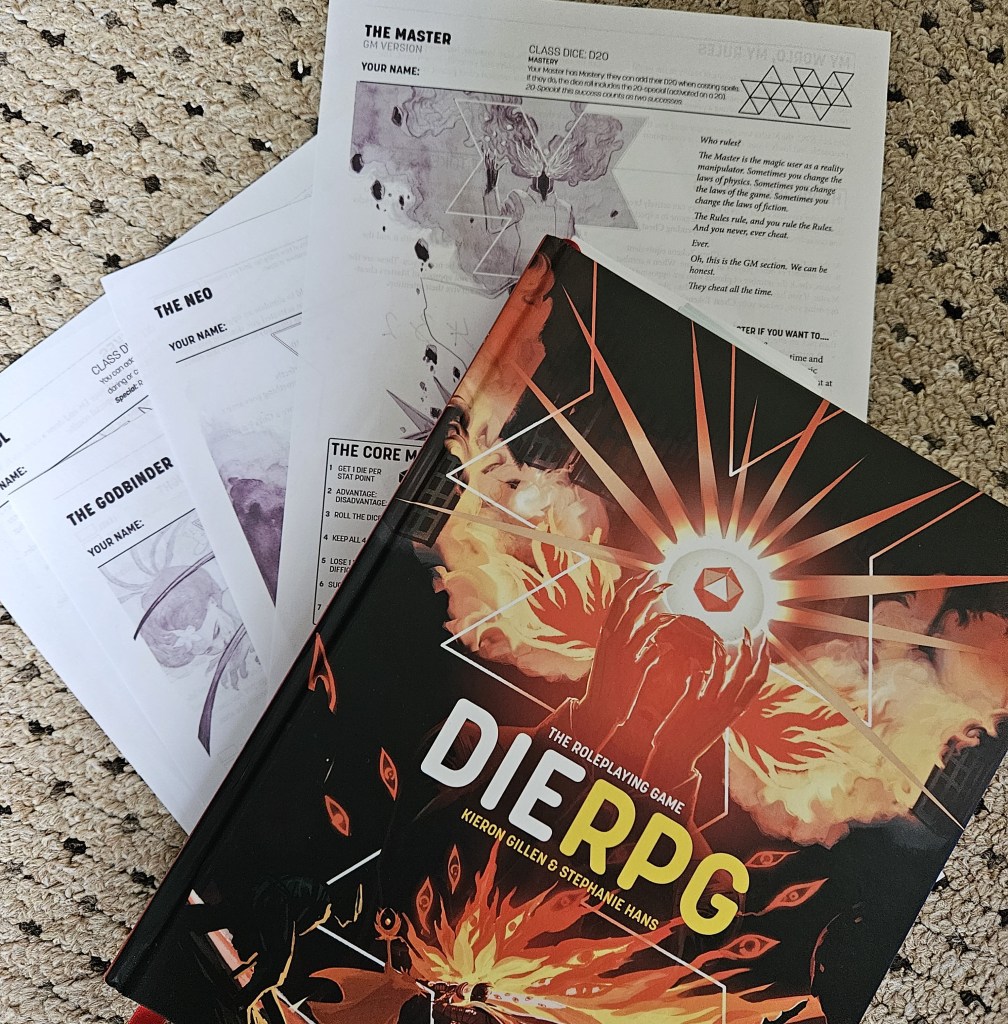
Like all my reviews, this is play-informed; I ran a one-shot of DIE for a group, and this is based on the play experience, not on reading the book. If you want a read-through, Iain McAllister from The Giant Brain, one of my players for the one-shot, has done one – so you can check that out here. Indeed, I’m going to try and not repeat stuff here – so if you want an overview of the system, or indeed the contents of the book, read that first!
While you’re reading this, I should tell you about my Patreon. Patrons get access to content 7 days before they hit this site, the chance to request articles or content, and the chance to play in one-shot games, for a very reasonable backer level of £2 per month. If you like what you read, want to support the blog, and have the funds for it, please consider supporting here. Telling people about the blog, and sharing links/retweeting is much appreciated also – thanks!
The core concept is this – you play regular folks in the real world, who play an RPG and end up trapped, or at least required to complete a quest, in the fantasy world they are exploring. While it feels unique in gaming, the “regular people trapped in a fantasy world” genre has lots of examples – from Narnia to Jumanji. So, in the game, you first generate your Persona – the person in the real world you’re playing – and then your Paragon – the character in the fantasy world your Persona becomes. If that sounds confusing, well, it is a bit – except that your Paragon is very much an extension of that Persona, and the challenges your Paragon encounters are very much echoes of your Persona’s real life woes. This extends to the GM, who gets to run The Master, the evil mastermind behind it all.
I ran the one-shot setup included in the core book, Total Party Kill, which has some quickstart rules (and pregens) to deliver a one-session experience. In no particular order, here’s what I liked about DIE, and a few things I’d bear in mind if I ran it again.
Total Party Thrill
I wish more games came with a proper one-shot setup, so I didn’t have to make them! In TPK, you’ve reunited your game group, which dissolved when the GM killed all your characters, for one last dungeon delve. Players encounter various embodiments of their Persona’s real lives, before finally facing the Dungeon Master in a final encounter.
TPK has simplified enemy statistics – everything you encounter is either Easy To Kill or Harder To Kill – and a step-by-step “scripted” start up to get through Persona creation. It’s all set up really well to get you to the table – although there were a few bits where the simplified rules, and the actual rules, didn’t seem to quite agree. Still, even with this, I wish more games did this.
It’s also got a great session timer, so you know how to pace it – so what should happen an hour from the end of the session, half way through, that sort of thing. All great work.
There’s several more set-ups in the core book for longer play, as well. A supplement has just been released with three more – and more are in the works. Each explore different aspects of the echoes of real life that you encounter in the fantasy world – there’s some really fascinating things in these, and this is a game I’d like to play as well as run.
If I Ran It Again…
So, TPK is great, but it relies on you improvising (with the help of a d20 table) a whole dungeon, with some set-piece encounters to break it up. In hindsight (and the book does suggest this), this would have been much easier to do if I’d had an actual dungeon in front of me – maybe even a classic like Tomb of Horrors, or a recognisable one like Village of Hommlett. You need some actual fantasy stuff in the dungeon as well as echoes of the Persona’s lives, and it was hard to improvise that without it going too weird or too boring.
Another thing to consciously do is reincorporate everything. The monsters that the Paragons encounter are echoes of figures in their real lives, and I was too concerned with keeping my powder dry to really lean into the past lives of their Personas. But it’s a one-shot, so I think I’d use the Persona generation more directly as an indication of the plot and what the PCs would encounter. In a one-shot, after Persona generation is definitely when to call a break and sit down and lay some track, just like if you’d started a PBTA game with some setup and then have to pull it together into a session.
Another thing this game definitely needs for convention play is clarity of expectation – the core concept just isn’t for everybody, and so (like when offering Carved from Brindlewood games) you need to be really open about this in any sort of convention pitch. With the right players though, this will really sing.
So, that’s my views on DIE – it’s really good, and does something very different from a lot of books out there. There’s clearly big plans at RRD for more stuff to support it, and I look forward to seeing what else comes out for it – this is a game everyone should try. Have you had chance to play it? Let me know in the comments below.
 Burn After Running: RPG One-Shots
I’ve had the game for a while now. As a fan of the comic, I knew I had to get it. But I haven’t played it yet. Now that I know it works well in a one-shot, I’m going to try and get a session together soon.
LikeLike
[…] although it has spent a fair bit of time on my shelf. I recently discovered, while reading the Burn After Running blog, that it is ideal for one-shots so that’s why I really want to try to bring it to the table […]
LikeLike
Having run a couple of short campaigns of DIE, I don’t want to one-shot it. The game is basically a never ending character creation session, and forgoing that with pregens is something that feels wrong to me with this game. The adventure anthology Bizarre Love Triangles presents sort of a halfway house, where the character creation has been skewed to result in specific characters, and then you can go further in preparing the game in advance before inserting the players.
LikeLike
[…] in favour of how it actually feels at the tables, which makes some of them quite vibes-heavy. This one of DIE is one I’m proud of, as it’s a game that runs very much on vibes behind an illusion of a […]
LikeLike