The Joy of Sets – Adapting Classic Modules as One-Shots

Recently, I’ve been updating some ‘classic’ adventures to newer systems. For example, Strike Force Shantipole and Tatooine Manhunt for Outgunned. I’ve got an adaptation of Rainbow Mounds for 13th Age Glorantha to write up, too. In the past, I’ve run Village of Hommlett in 13th Age, and I’ve got a session of Lost Conquistador Mine (a classic Boot Hill tournament module) to adapt for the Index Card RPG to run in a few weeks.

Changing stat blocks and balancing encounters is one thing, but what stands out in these old adventures is the structure of them – and in some cases, the sheer quantity of them. Reading through Tatooine Manhunt, it’s easy to lose track of the many, many fights with bounty hunters the players are meant to have. I’m always a fan of inserting action scenes into investigative or background scenes, but these are relentless.

While you’re reading this, I should tell you about my Patreon. Patrons get access to content 7 days before they hit this site, the chance to request articles or content, and the chance to play in one-shot games, for a very reasonable backer level of £2 per month. If you like what you read, want to support the blog, and have the funds for it, please consider supporting here. Telling people about the blog, and sharing links/retweeting is much appreciated also – thanks!

Continue reading →

The 2023 Burnies – ENnies Awards Round-Up

The ENnies have come and gone, with much discussion and reaction to them. Overall, while awards things like this are a matter of fashions, taste, and similar subjective feelings, they’re better than nothing – and I’m sure the impact of them is felt by the winners and nominees. And this year, I think they’re a really great overview of the breadth and variety in the hobby – winners and nominees from a range of play styles, approaches, and sizes.

While you’re reading this, I should tell you about my Patreon. Patrons get access to content 7 days before they hit this site, the chance to request articles or content, and the chance to play in one-shot games, for a very reasonable backer level of £2 per month. If you like what you read, want to support the blog, and have the funds for it, please consider supporting here. Telling people about the blog, and sharing links/retweeting is much appreciated also – thanks!

So, here’s what I think of some of the winners. I’ve restricted myself, as usual, to products I’ve actually used at the table in play, and stuck to winners fo brevity – so here goes:

Journeys Through The Radiant Citadel absolutely deserves it’s Silver Best Adventure – it’s probably the best product I’ve seen for 5e D&D, a selection of adventures with a lightly-sketched setting attached to each one, easily one-shotted, easily adaptable, clever structures but still approachable to run. Each adventure is set on a mini-setting inspired by diverse real-world cultures, and this really showcases how different D&D can be.

Many of the settings make me want to run whole sequences of games in them. All excellent, here’s hoping for more of this, either from Wizards or third parties. I’ve run two of the adventures as one-shots at conventions and they play really well.

It won’t surprise you that I’m a big fan of Brindlewood Bay – I’ve run a few one-shots, reviewed it here and blogged about adapting to a one-shot format here. The Brindlewood mystery system is one of the most innovative developments I’ve seen in the last few years, and it’s set to change a lot of approaches to mysteries in a way that’s really to my tastes.

Similarly, Trophy is well deserving of it’s best game silver – it’s actually two games, and the narrative steps it takes (adding a smattering of extra rules to Cthulhu Dark to make it more of a ‘game’) lead to reliable play at the table. I’ve run a two-session Trophy Gold game and a few one-shots of Trophy Dark. Also, more games, like Trophy Dark, designed for one-shot play with options for ongoing, please. They’re excellent.

Avatar: Legends is an interesting one. I ran a campaign of this, blogged about it here, and while it was fun, I’m not sure if we really clicked with the rules. Or, more specifically, the combat rules. The rest of the game was excellent, values-led PBTA, and each character’s balance track really worked to bring the drama. But the combat system felt a bit too fiddly for what it provided. We might have missed something, and I’d definitely try it again with a few tweaks to my approach, but I felt like I might have missed it – any ideas gratefully received!

I’ve played a few sessions of Wildsea, and the writing is indeed great. It’s a setting that deserves lots of attention, being really interesting and definitely original (I played a beverage specialist, essential on any tree-sailing ship). 

But for me the real winner, and one of the games I’m most excited about overall, is Fabula Ultima. Fantastic that this has won Gold for Best Game, from a relatively small production company who’ve taken a genre and produced an excellent resource. The rules (adapted from Ryuutama) emulate JRPGs like Final Fantasy really well, and play fast and fun. It’s also got the single best quickstart I’ve ever seen, with scenes gradually unlocking bits of the character sheet as it teaches the rules – great work and a model for how to run new games at conventions, too.

So, the ENnies – lots to love in these games, and a really healthy sign for the hobby that we’re so diverse and varied. And while obviously Seth Skorkowsky isn’t a podcast, and Swords of the Serpentine isn’t a supplement, they’re both really good, so who cares? Owlbear plushies all round!
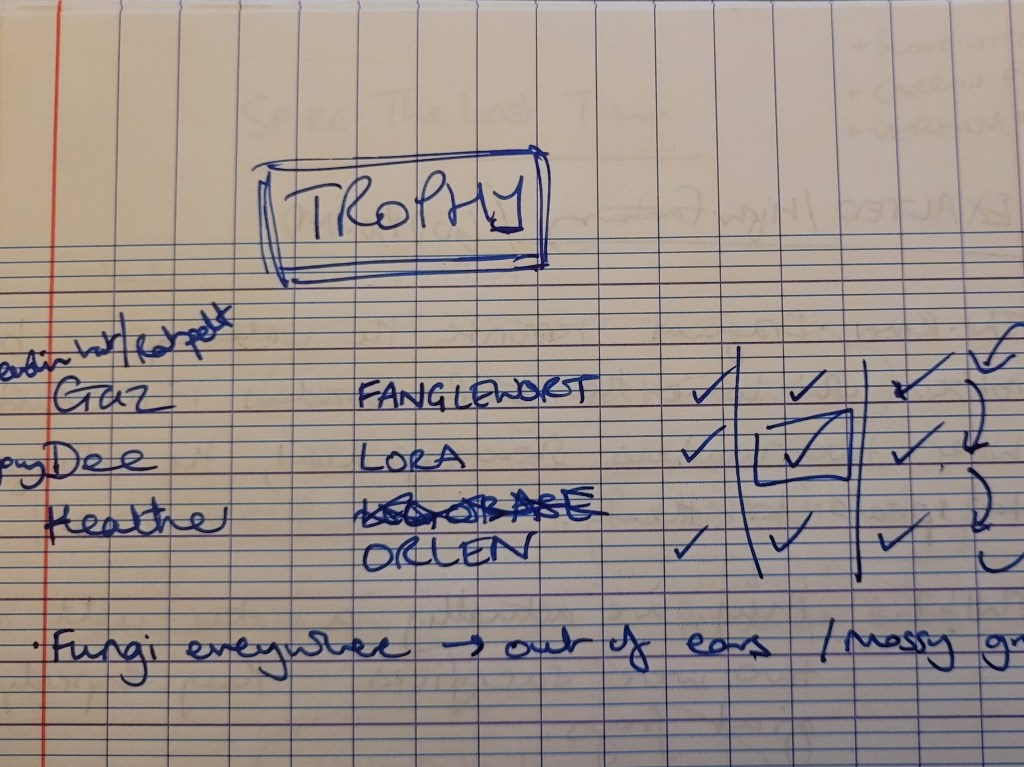
Table Techniques – Spotlighting

Earlier, along with prep techniques, I’ve talked about “table techniques” like reincorporation and sharing narration that you can do during your #TTRPG sessions to make them pop. This one is a bit different to those, in that it’s pretty fundamental. That is, do it well and it’ll have a big positive effect – but doing it competently is essential for an enjoyable session, especially in a one-shot.

Why? Well, the inspiration for this comes from a session I played at a convention recently. It was a fairly trad game, dice driven, and some time was spent explaining and teaching the system. I’m sure many of the other players had a reasonably enjoyable time – but me and another player didn’t roll dice a single time during the session. Did we get memorable roleplaying opportunities? Well, no, not really – we didn’t get to do much at all, and it was ultimately a quite frustrating experience. So, spotlight well – good. Spotlight badly – you’ll have players like me grinding my teeth all game.

What is it?

Simply put, spotlighting just means sharing the screen time that your players get around so everyone has a fair crack of the spotlight. Some players will demand more spotlight, and some will be happy to shrink and spectate – but this is one thing where the vast majority of responsibility falls on the GM – players won’t track their own spotlight. 

Actual tick list for spotlight from a Trophy Dark one-shot

So, you need to manage the amount of time players get, and be prepared to track who’s acted. It sounds like a simple thing, but from running PBTA games (and especially online) I often just have a list of the players, their characters, and a tick list, to check they’ve all had a turn at once. If you don’t do this, maybe try it – I think I’m pretty good at spotlighting, but this gives me a good safety net. But how else can we make help make spotlighting easy?

Have A System

Another way is to get into a habit of going around the table. This has the advantage of players knowing what their turn is, so they can prepare for it. If you’ve got multiple options for the next step (because you’ve designed an awesome scene with a target-rich environment), you can go round the table and get players to declare what they’re doing, and then cut to resolve them in a more logical order – you’ll get to manage what their actions are much  better in this quasi-initiative system.

Another good approach to manage spotlight is to use skill challenges liberally – scenes where everybody has to have a go to resolve the issue at hand. You’ll force yourself to give everyone a fair share of the spotlight if you use these routinely, and they’re a really strong one-shot technique anyway.

Make Fights Fighty

If you’re having a combat in your one-shot, even if it’s a ‘training’ combat to get the hang of the system, make sure everyone is going to get a go. For the initial fight, you might want to dial down (either deliberately, or in picking opposition) the damage that the enemies can do, but keep them fairly robust so that everyone will need to help if they are to be defeated – otherwise you risk some players not getting a go due to bad initiative rolls (or whatever system you’re using – I’m pretty keen on ditching initiative and going round the table in one-shots, and there’s a blog post coming around this soon).

Check In

I like to have a break every hour or so in a one-shot, and this allows a pause to check-in with your players and get some feedback – are they happy with the amount of screen time they’re getting, is there anything (in-character or out-of-character) they’d like more or less of, that sort of thing. This is general good practice, but it also helps if you think you might have players that are happier sat on the sidelines – I tend to ask for a minimum level of engagement in my games, but it’s good to know if people are happier being in a support role or letting other players lead in social situations especially. So ask how they’re going, and if you’ve got any doubts, ask again.

I think spotlighting, while fundamental, is sometimes a quite difficult thing to get right – but it’s absolutely essential to good play, and it’s something we can probably all get better at. So stick with it – and share any advice you’ve got in the comments below!