Setting, Hillfolk, no-SR, and Adventures

I’ve been deep in game prep this week, ready for a double dose of Seven Hills and then Kraken over the Easter break. And so while I’m trying to get my head down and prep, I find myself getting pleasantly distracted by game stuff. Here’s what I’m thinking about at the moment.

While you’re reading this, I should tell you about my Patreon. Patrons get access to content 7 days before they hit this site, the chance to request articles or content, and the chance to play in one-shot games, for a very reasonable backer level of £2 per month. If you like what you read, want to support the blog, and have the funds for it, please consider supporting here. Telling people about the blog, and sharing links/retweeting is much appreciated also – thanks!

Continue reading →
Five Room Dungeon Hacks, Part Two – Twisters

I’ve blogged before about the 5-Room Dungeon here, and why its structure needs a bit of help sometimes to make it really shine in one-shots. I’ve been thinking about it more lately – inspired by this post which talks about 5RDs being scene sequences instead of locations. That post was talking about location-based design… but I’m interested in scene-based design as well. So what can we do to hack 5RDs a bit more flexible and epic? We started by introducing Multiples – but now, we’re going to talk Twisters.

Not like this…

While you’re reading this, I should tell you about my Patreon. Patrons get access to content 7 days before they hit this site, the chance to request articles or content, and the chance to play in one-shot games, for a very reasonable backer level of £2 per month. If you like what you read, want to support the blog, and have the funds for it, please consider supporting here. Telling people about the blog, and sharing links/retweeting is much appreciated also – thanks!

Continue reading →
Dungeoneering Done Differently

I’m prepping some location-based adventures for Unconventional GMs at the moment, including a game of the excellent His Majesty The Worm, and one of the many interesting bits of game design it has in it is a different approach to exploring dungeons.

It made me think of other interesting ways games structure exploring locations, and how we can rig together similar systems for other games. 

While you’re reading this, I should tell you about my Patreon. Patrons get access to content 7 days before they hit this site, the chance to request articles or content, and the chance to play in one-shot games, for a very reasonable backer level of £2 per month. If you like what you read, want to support the blog, and have the funds for it, please consider supporting here. Telling people about the blog, and sharing links/retweeting is much appreciated also – thanks!

Continue reading →

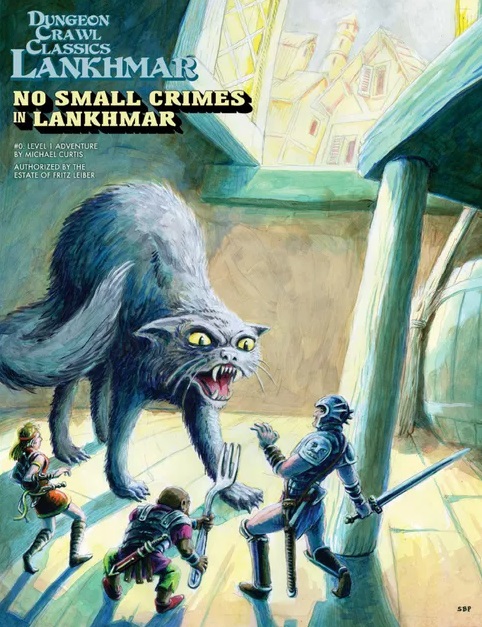
Beware of the Cat! – Review: No Small Crimes in Lankhmar, for Dungeon Crawl Classics

A slightly different review post today, being a review of a short adventure published by Goodman Games for their Dungeon Crawl Classics Lankhmar setting. As with all my reviews, this is play-informed; I ran the adventure last week at Kraken, with a total of six players. Curious patrons can find my pregens attached to this post – I wasn’t able to source a Lankhmar PC generator in the many excellent DCC websites, so you’re welcome to these!

In short, No Small Crimes is excellent, and offers many things that we can steal and adapt for a location-based one-shot.

While you’re reading this, I should tell you about my Patreon. Patrons get access to content 7 days before they hit this site, the chance to request articles or content, and the chance to play in one-shot games, for a very reasonable backer level of £2 per month. If you like what you read, want to support the blog, and have the funds for it, please consider supporting here. Telling people about the blog, and sharing links/retweeting is much appreciated also – thanks!

Patrons have also got the eight pregens and one-sheet of rules that I used to run this adventure below – if you’d like to try running it yourself, be sure to check it out!

Continue reading →

Four Things About Daggerheart

Update: You can watch us play through the Quickstart, using v1.3 rules (so some slight tweaks to the content from what’s discussed below, and more in line with the final product) here.

I’ve had a chance recently to run the Daggerheart RPG quickstart a couple of times – the playtest rules are available at the link above, and contain far more than just the quickstart – and I thought I’d pick out a few things from it. For a first impression, to be clear, I think it’s really good – it does some things in a genuinely interesting way, and it’s a really good quickstart in terms of introducing both setting and system in a concentric way.

When this first landed, there were plenty of internet commentators giving their opinion of it – but as I’ve repeatedly said, we should judge games after playing them, not before – and for me Daggerheart is something I’ll definitely be picking up, and probably running a lot of. So, here’s four things I like about Daggerheart – specifically, the quickstart.

While you’re reading this, I should tell you about my Patreon. Patrons get access to content 7 days before they hit this site, the chance to request articles or content, and the chance to play in one-shot games, for a very reasonable backer level of £2 per month. If you like what you read, want to support the blog, and have the funds for it, please consider supporting here. Telling people about the blog, and sharing links/retweeting is much appreciated also – thanks!

Continue reading →

The Clockwork Citadel – a one-shot for Fabula Ultima

I’ve been grooving on Fabula Ultima, a JRPG-style system with simple, flexible rules, since it released. As well as a nifty set of rules, it also has hands down the best quickstart I’ve ever seen, which takes players and GM through the rules, setting, and play culture of the game hand in hand and step by step.

Continue reading →

Guiding the Ironlands – how to run Ironsworn as a One-Shot

Ironsworn, Shawn Tomkin’s RPG of dark fantasy with solo, guided, and GMless modes, is one of the most exciting releases to the hobby in recent years. With its sci fi sequel, Starforged, now established it’s beginning to get some decent play on the convention circuit – and it plays really well with a GM (in ‘guided’ mode) as well. So here are some tips if you want to get it to the table.

Continue reading →

Prep Techniques: Dilemmas

Credit for this technique goes to the game in which it is most explicitly modelled, John Harper and Sean Nittner’s Agon – a game of Greek heroes travelling home by way of a series of perilous islands – and each island begins something like this:

  • Will you command Meletia to use the island’s gold to restore the ruined temple of Hera and receive divine protections? Arts & Oration vs. Meletia.
  • Or will you command Ionestes to cease speaking false promises of divine aid and instead support the construction of practical defenses? Arts & Oration vs. Ionestes

(Agon, Isle of Kryos)

Each choice offers a chance at resolving the conflict introduced, and taking sides in an ongoing dispute – the following scenes will differ depending on which approach they take (and whether or not they are successful). These happen right at the start of the adventure, as the players arrive in the isle, and thrust them directly into the action. But there’s no reason we shouldn’t use these with other games, and they’re a really effective way of launching a session.

While you’re reading this, I should tell you about my Patreon. Patrons get access to content 7 days before they hit this site, the chance to request articles or content, and the chance to play in one-shot games, for a very reasonable backer level of £2 per month. If you like what you read, want to support the blog, and have the funds for it, please consider supporting here. Telling people about the blog, and sharing links/retweeting is much appreciated also – thanks!

Why They Work

They give players clear options and genuine choices and let them engage with the adventure immediately. Particularly for one-shots, it can be easy to start with a fight that is just thrust upon the players, and they can feel like they’re just setting off on a railroad – this gives them a choice right at the start. There’s also no need for them to be limited to the options you’ve suggested – they can come up with their own approach, but you’ve given examples to help them make that decision.

By choosing one option, they also cut off the other, and there will be NPCs on each side that will want to engage with them to resolve the choice. Ultimately, either choice might lead in similar directions, but how that direction appears will be coloured by their choice – and whether or not they are successful.

How To Prep Them

Begin with your initial scene and think of a couple of ways they can be resolved. This doesn’t have to be amazingly original – your players may come up with other choices, too, when you’ve shown them two, and that’s fine. Have an immediate call to action inherent – either a threat to something the PCs care about, an ongoing mission that will take them directly into this conflict, or a personal link to the issue.

Then, give some thought to how each option could be resolved. Try to make them equally exciting – you might balance a combat with a skill challenge of some sort, or a series of skill rolls with accompanying risk. They don’t have to be equally difficult, of course – but try to avoid offering an obvious answer to the dilemma.

Examples

Let’s say you’re prepping the most vanilla D&D plot ever, of a village in danger because of raiding goblins in the forest. You’ve, correctly, thought to start with an encounter with bandits on the way to the village – who are desperate because of the goblin displacement and could even be useful to find the goblin camp later – and had originally planned for them to leap out and attack the caravan they are guarding.

Instead, let’s have the PCs come across a robbery in progress. Around the corner, they see a merchant being turned over, with crossbow-wielding bandits in the trees above trained on them as they try to bargain with them. The merchant in front is clearly having none of it, and it looks like it could turn nasty – he hasn’t seen the robbers in the trees.

Do you charge in and intercede on his behalf, and try to cow the bandits with your force of arms and courage?

Or do you sneak around and dispose of the bandits in the trees to even the odds?

Or perhaps try and tackle the leader by surprise before his archers have a chance to react?

We’ve got a trilemma there, and although most of them probably lead to combat, it’s a much more vibrant and interesting initial scene. We’re assuming that heading into the forest to avoid the bandits isn’t an option – if it is, there’s always goblins to tackle them.

In cases where the PCs have a clear mission, your dilemmas can be more like options for them to pursue. For instance, if your PCs have arrived at a party to steal a crown from the host, we should add a bit more action. So begin with them seeing a drunken guest causing trouble, about to challenge another noble to a duel.

Do you attempt to sneak behind the scenes straight away, looking for a route upstairs while the guards are distracted?

Or do you intercede on either nobleman’s behalf, trying to create more chaos and maybe win some allies here who might know about the crown?

It’s an interesting challenge to try and add this to a session you’ve already prepped – particularly in the initial scene, where it will have the most impact. As I said, for more examples, look at Agon or the Paragon family of games, who all model this excellently. Have you used dilemmas in your games during the starting situation? Let me know in the comments.

Pull the Other Warhammer: Soulbound, the Age of Sigmar TTRPG

I’ve managed to get another new game to the table this week – Soulbound: Age of Sigmar, Cubicle 7’s RPG of the Games Workshop fantasy reboot. For a wargame-inspired game, it’s a surprisingly loose-limbed high fantasy game, and one session down I think it makes a great convention game. Here’s why…

While you’re reading this, I should tell you about my Patreon. Patrons get access to content 7 days before they hit this site, the chance to request articles or content, and the chance to play in one-shot games, for a very reasonable backer level of £2 per month. If you like what you read, want to support the blog, and have the funds for it, please consider supporting here. Telling people about the blog, and sharing links/retweeting is much appreciated also – thanks!

Superheroes with Swords

This is proper high fantasy. You’re powerful heroes, and because your group is soulbound, you get tokens you can use to cheat death which you keep as a group. Every PC has at least 1 Mettle, which you can spend to get an extra action in a round, or boost your attack significantly – and PCs are properly high powered while still being pretty simple to play and run.

You Don’t Need to Sweat The Lore

As you’d expect from a GW property, there is a significant amount of lore you could delve into. But there’s no need, really. Chaos was all risen, it’s been sort of beaten back a bit, you’re heroes trying to finish the job. There’s monsters, chaos, undead everywhere, and you just need to do the right thing and kill them. We’ve seen this approach work really well in 13th Age Glorantha, where setting it in a more ballsy era means you don’t have to worry about history so much.

It’s a Zonal, Freewheeling Combat System

No minis. I repeat, no minis. It has a loose zonal combat system which I guess you could use a map and counters for, if you had them already – but it’s straightforward enough for theatre of the mind to work just as well. Simple rules for dangerous terrain are easy to implement, and combat is fast and fun with both sides potentially hitting hard.

There’s great one-shots out there

As well as the Starter Set, there’s also a couple of free RPG adventures. I ran Trouble Brewing, which while not free, is an excellent convention adventure. It’s worth giving the published adventures a read for how they structure and build combat encounters, too – you can really hit the PCs hard, and the terrain rules add a lot of options.
So, will I run Soulbound at conventions again? Strong yes! I’m looking at a Tzeentch-themed thing for Seven Hills 2023: Change, which as it happens is open for registrations if you’re near to Sheffield – or even if you aren’t.