It’s been a while since I offered a review of an adventure instead of an entire game. But in truth I’m much more interested in reading and buying adventures – they offer all the usefulness of a supplement, but with everything ready to run. And this, a DMs Guild adventure by M.T. Black and Anthony Lesink for 3rd-4th level PCs designed to take 4-6 hours, is an absolute classic. Not a classic as in a huge original – the piratey tropes are laid on thick here. Just very, very good – and a great one-shot to showcase what D&D is good at, or indeed any other TTRPG you care to run it with.
While you’re reading this, I should tell you about my Patreon. Patrons get access to content 7 days before they hit this site, the chance to request articles or content, and the chance to play in one-shot games, for a very reasonable backer level of £2 per month. If you like what you read, want to support the blog, and have the funds for it, please consider supporting here. Telling people about the blog, and sharing links/retweeting is much appreciated also – thanks!
I’ve had a game-filled summer; and now its the start of term, there’s more games to come! I’m always saying that you should play more, and more different games – and I thought it’d be interesting to review the last 5 games I played – and share what I liked about each one.
While you’re reading this, I should tell you about my Patreon. Patrons get access to content 7 days before they hit this site, the chance to request articles or content, and the chance to play in one-shot games, for a very reasonable backer level of £2 per month. If you like what you read, want to support the blog, and have the funds for it, please consider supporting here. Telling people about the blog, and sharing links/retweeting is much appreciated also – thanks!
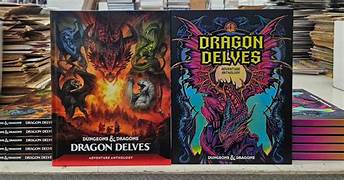
Dragon Delves is the first official “adventure book” for the 2024 D&D rules, and it’s got some interesting stuff in it – interesting enough that it bears sharing, even if you’re not a D&D player. This isn’t a review; I haven’t actually used any of it at the table – but I’m running one of the adventures tonight, so I’ll report back on that. Nevertheless, there’s some useful structural things in how it’s presented which I think make it really useful.
I’ve been deep in game prep this week, ready for a double dose of Seven Hills and then Kraken over the Easter break. And so while I’m trying to get my head down and prep, I find myself getting pleasantly distracted by game stuff. Here’s what I’m thinking about at the moment.
While you’re reading this, I should tell you about my Patreon. Patrons get access to content 7 days before they hit this site, the chance to request articles or content, and the chance to play in one-shot games, for a very reasonable backer level of £2 per month. If you like what you read, want to support the blog, and have the funds for it, please consider supporting here. Telling people about the blog, and sharing links/retweeting is much appreciated also – thanks!
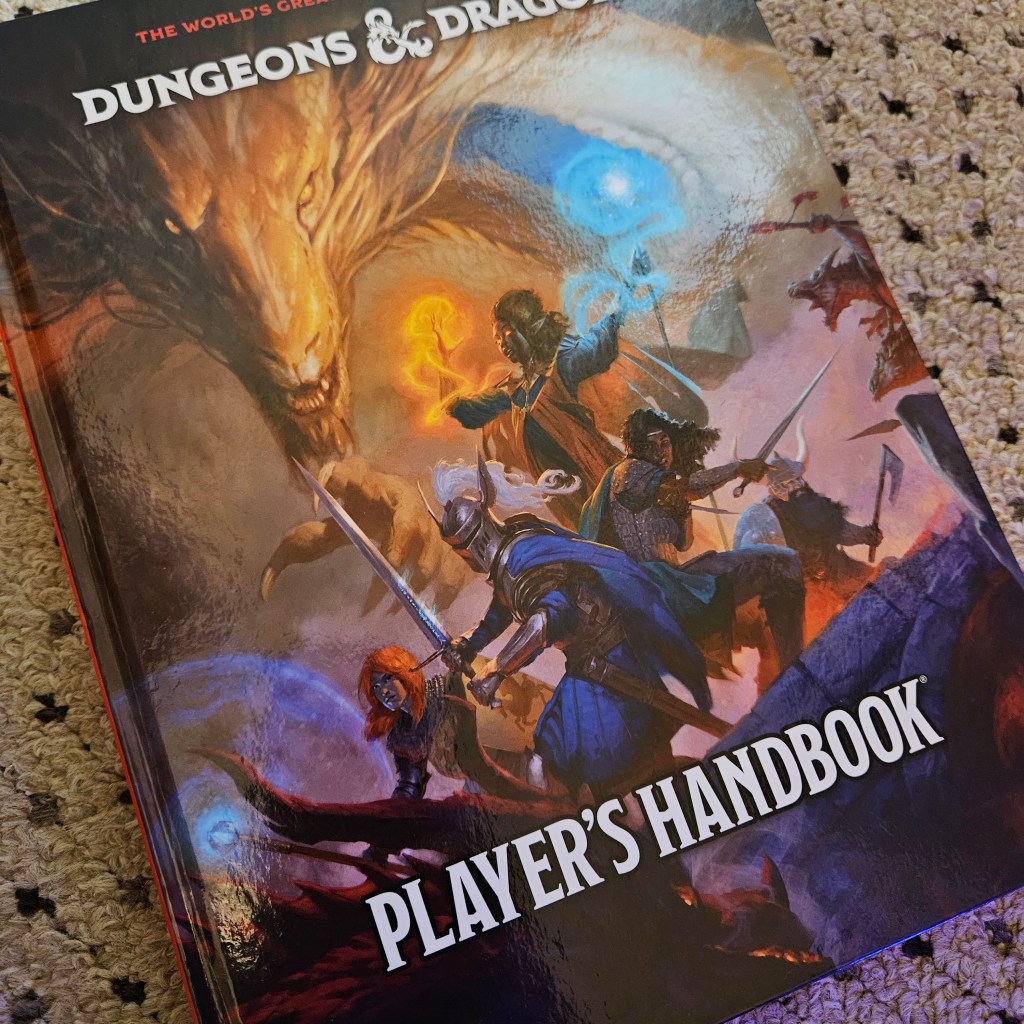
Look, it says on the top it’s “The World’s Greatest Roleplaying Game,” which is patently false (it’s not Mouse Guard). And it’s attracted it’s fair share of deserved ire with the OGL fiasco. But, it’s still the biggest game in the world in terms of market share, and what goes on in here will cause ripples through the rest of the hobby. So I got hold of it. I’ve not played, I’ve only skimmed, I know, I hate unboxing videos too. This isn’t a review.
But I’m neither in the “Never D&D!” or the “No other games exist” camps, and so I thought I’d share my impressions of the 2024 Player’ Handbook. Here goes…
While you’re reading this, I should tell you about my Patreon. Patrons get access to content 7 days before they hit this site, the chance to request articles or content, and the chance to play in one-shot games, for a very reasonable backer level of £2 per month. If you like what you read, want to support the blog, and have the funds for it, please consider supporting here. Telling people about the blog, and sharing links/retweeting is much appreciated also – thanks!
In this series, I’m going to be showcasing some techniques you can drop into almost any one-shot TTRPG session to improve it – even if the adventure you’re running is already published, these will make it better. Each one is minimum-prep, and guaranteed to be well worth it at the table.
While you’re reading this, I should tell you about my Patreon. Patrons get access to content 7 days before they hit this site, the chance to request articles or content, and the chance to play in one-shot games, for a very reasonable backer level of £2 per month. If you like what you read, want to support the blog, and have the funds for it, please consider supporting here. Telling people about the blog, and sharing links/retweeting is much appreciated also – thanks!
So here goes, with part 1 –
Give the Party Sidekicks
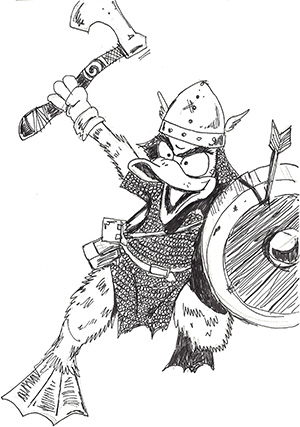
A good sidekick is great roleplaying fodder, even if they’re a hapless Duck adventurer. Image of Crontas by John Ossoway
Prepping a low-level fantasy adventure? Then you need to realise that the ultimate antagonists aren’t goblins, orcs, or kobolds – but bandits! Too often an extra in the TTRPG space, they can and should be the centre of your prep.
Over at Patreon, one of my backers requested a post about starting a new campaign. I’m always happy to take requests from my noble backers, so here’s a step by step of what I do when I’m starting to set up a campaign or longer-form game. To give my bona fides, until 2020 I don’t think I’d ever run what I’d consider a successful campaign game – but the advent of lockdown, and a dive into online gaming, has changed that. I’m currently running an ongoing D&D game, a Star Trek Adventures game (where we are skirting around the Shackleton Expanse campaign), and in the process of pulling together a One Ring game. So – what do I do to start with, when I’m about to launch a campaign?
While you’re reading this, I should tell you about my Patreon. Patrons get access to content 7 days before they hit this site, the chance to request articles or content, and the chance to play in one-shot games, for a very reasonable backer level of £2 per month. If you like what you read, want to support the blog, and have the funds for it, please consider supporting here. Telling people about the blog, and sharing links/retweeting is much appreciated also – thanks!
Set the Scope
Firstly, think about how long the campaign is going to last, and agree with your group. I’d strongly recommend splitting a longer campaign into seasons of max 8-12 sessions in order to keep things fresh, and I’d consider starting with even fewer sessions than that. Having a defined end point will stop your campaign from fizzling out, and keep everyone in the game and focussed.
Based on how often your group meets, work out how long real-time this will last for – and make sure you’re up for that. If you meet once a month and want to run a 12-session campaign, that’s a year’s worth of gaming for the group! If you’re weekly, 12 sessions is still 3 months of play. Make sure that you – and your players – are clear about that commitment and happy with it.
Of course, you might have an in-game end in mind – for my D&D campaign, we’re running through Rime of the Frostmaiden; that campaign finishes when they’ve brought the sun back to Icewind Dale and defeated Auril the Frostmaiden. Even with that, I’ve worked out that with 2 sessions at each level of character, this is about 20 sessions. I’d planned a mid-season break after 10, but as it happens we ended up cancelling some sessions anyway, so we’re good to go with the second part of it.
Get the Big Picture
The approach to this stage varies a little depending on whether you’re plotting your own campaign or running something pre-written. In either case, though, you will sketch out the broad picture of how you expect the campaign to play out.
If you’re rolling your own, a great tool to use (taken from Dungeon World) is Fronts. Consider your campaign’s big bad, and sketch out some steps that it might take. Sly Flourish also has a discussion of using this for D&D that streamlines the process a bit.
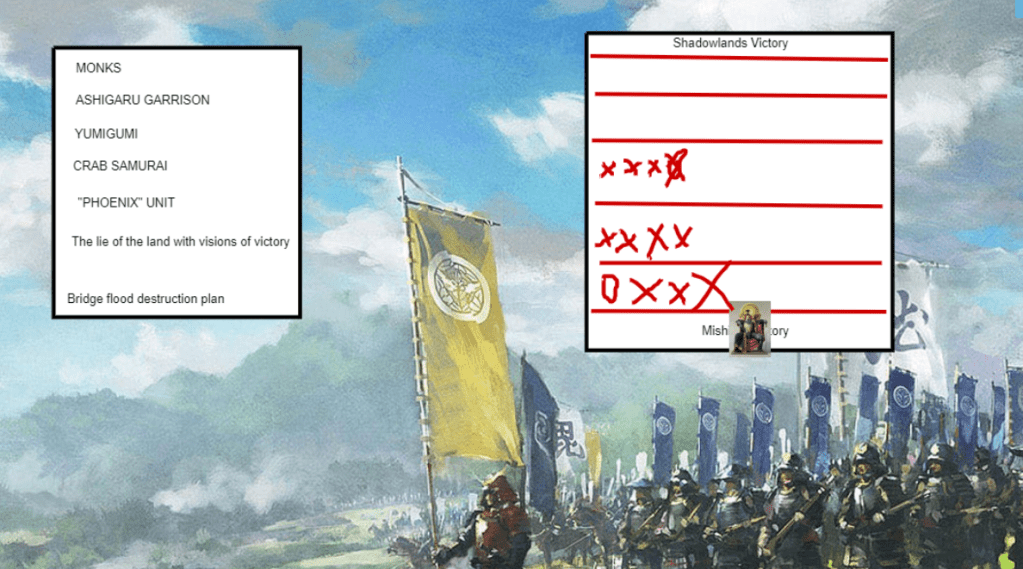
Having a campaign finale in mind helps – even if your Roll20 presentation isn’t up to much
If you’re using a published adventure, this is when you need to skim read the whole thing. If you’re running something popular (like a D&D campaign) it’s also well worth googling it to see if folks like Sly Flourish or Justin Alexander have notes on how to run it. There will be some of these on here soon as my ‘Deep Dive’ series extends – currently I’ve got Rime of the Frostmaiden Chapter 1, Shadows over Bogenhafen, and the first Vaesen adventure compendium A Wicked Secret to write up.
Once you’ve got this, sketch out how the sessions might look – for instance, I expected for Rime we’d probably hit one of the Ten-Towns quests per session, along with some additional personal stuff, for the first 6 sessions before hitting Chapter 2 and the more open-ended part of the game. As it happens in a couple of sessions we doubled up adventures, but we were able to mesh some of the scenarios into the PC backstories anyway (for a session-by-session report written by one of my players – and ongoing – check out Fandomlife’s blog here).
Running published campaigns requires slightly different prep to rolling your own
If the start of your campaign is going to branch off and be more of a sandbox, think about how you’ll structure this. I’m a big fan of getting players to decide what they’ll do next time at the end of a session, so I can focus on those bits for the following session. Also, think about how long you’re prepared to let them play in the sandbox – is there an element in your Front, or a lead you can drop, that will force them to leave and stop them wanting to talk to every NPC and find every secret?
Imagine Some Specifics
Once you’ve got your big picture, you could run right away, but now I like to start thinking about specific scenes, encounters, locations, and NPCs that might come up. These can be just sketches to start with, but by having a file ready to note these in before the session zero, you can add to it. For example, in a campaign of Legend of the Five Rings I ran a couple of years ago, I had a few scenes in mind before chargen started – but when one of the PCs had a morbid fear of dogs, of course the bandits were led by a dog-faced demon who took an instant dislike to them.
With a published adventure, you might want to think about a few NPCs using the 7-3-1 technique if they are likely to recur or be important – I’ve got a wizard lined up for the next couple of sessions who I sketched out a personality for right at the start – or how some encounters might play out in the first few sessions. This isn’t unlike the Bag of Tricks prep technique I’ve used for one-shots – it gives you some go-to scenes and moments that you’ll be able to use later in the campaign.
Session Zero
At this point, you’re ready to get the players involved. My personal agenda for a session zero covers Content / Chargen / Play, but sometimes fitting in all of these can be tricky. If character generation is something that will be dreary to all sit round and do together, get your players to come to the table with something lightly sketched out, and do a bit of in-character bonding in that first session instead. Absolutely would recommend the final part though – getting a bit of play in makes it all worthwhile!
For Content, you want to discuss any safety tools you’ll be using, as well as invite your players to contribute to Lines and Veils and Tone – again, The Gauntlet has an excellent blog on all of this. Alongside this, you want to cover housekeeping – how often you meet, who brings the snacks, what to do if you can’t make it, that sort of thing. For my games I generally have a hard rule that if 3 players and the GM can make it, we play – and we’ll work out a way for the others to catch up later. This does fall down a bit if I can’t make a session, but it gives a bit of insulation against having a run of cancellations.
For the Play bit, just a half-hour encounter is fine – but I’d go with something action-y that involves rolling the dice instead of something roleplay-focussed. Start them around a camp, and have some goblins attack, and then the goblins tell them about the problems in the area. Getting some dice rolled makes the session zero fun, and starts to build momentum for the game proper.
Session-By-Session
Now you can run it! For me, I’m never more than a session ahead of where the party is up to, and I prep in between sessions – I can’t imagine doing it any other way. I’ve blogged before about session prep for campaigns being like for one-shots, but to summarise – I’d recommend making each session a coherent episode if you can, even going so far as to give it a name.
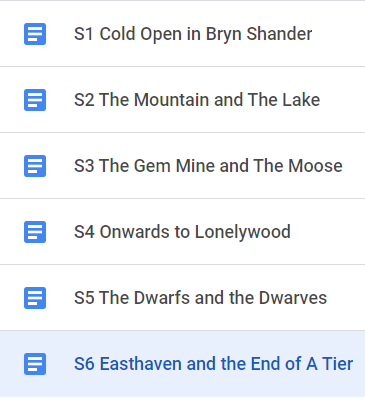
6 sessions of prep files – complete with corny titles
In my prep, each session gets a Google doc, and follows a fairly similar format, which is either a scene-by-scene breakdown followed by NPC notes, or a Sly Flourish Lazy DM set of notes. I’ve found that for my own prep, I like a defined scene-by-scene breakdown, but for published games that I’m running the Sly Flourish technique works best. I think this helps me to break down components and be a bit more prepared for players going in different directions – whereas with my own games I’m already able to do that without any help.
I’m conscious of my own practice as well (or at least try to be) – and one of the things I’m trying to work on is more memorable NPCs – so at the moment I make sure there’s a few ‘tells’ for each one in my prep notes to make sure I put the effort in to try and do this.
Be sure at the end of each session to get some feedback – either as Stars and Wishes (now rebranded to Spangles and Wangles by my Friday group) or a more informal method, and be prepared to tweak where the campaign is going if needed. I’d also recommend having some ongoing contact with your players, whether about the game or not, between sessions – it helps to keep momentum, which is one of the main things you need to keep a campaign going.
So, step by step campaign planning! I’ll try and get a couple of examples down too, and as always happy to accept Patreon post requests! Let me know in the comments if you’d like to see more.
Often in one-shots, you see two broad types of trad TTRPG game – an investigation-heavy game, and an action- (or combat-) heavy game. Both have their pros and cons – in an investigation game you often get to interact with the setting a lot, have more roleplaying opportunities with NPCs, and have the satisfaction of solving a puzzle – but pace can slow as the most cautious player tries to leverage as much information as possible before proceeding. Likewise, a combat-heavy game rarely suffers from too little pace – but the breakneck speed can leave players wondering what the purpose was of rolling all those dice.
While you’re reading this, I should tell you about my Patreon. Patrons get access to content 7 days before they hit this site, the chance to request articles or content, and the chance to play in one-shot games, for a very reasonable backer level of £2 per month. If you like what you read, want to support the blog, and have the funds for it, please consider supporting here. Telling people about the blog, and sharing links/retweeting is much appreciated also – thanks!
A solution to both sides of this problem is to incorporate Combat Clues into your one-shots. They are clues that are discovered during a combat, skill challenge, extended task, or other perilous encounter – and they don’t replace the clues you have in the game, but they add to them.
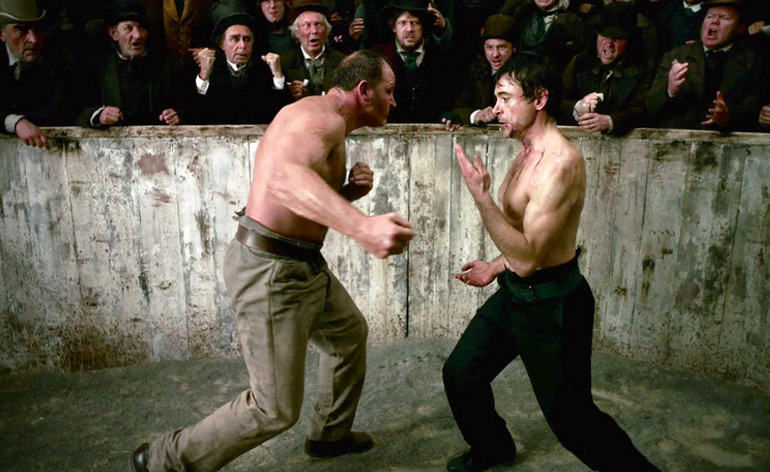
RDJ’s Sherlock Holmes is the kind of investigative game I like to run – here he’s definitely finding out some combat clues
Why Combat Clues?
For reasons that are probably apparent to regular readers, I’m a fan of the action-heavy one-shot – I cut my teeth at conventions running 13th Age, which has only the lightest suggestion of an out-of-combat game system, and often use the Feng Shui 2 “Three Fights” adventure structure. But the issues suggested above are real problems – often a trail of clues is needed to make the session have narrative sense, and you’re faced with the option of interspersing combat with slower investigative scenes, or just making them find things out straight away.
I also don’t like the post-fight interrogation scene – it never really plays out satisfactorily, and you end up with your ‘heroic’ PCs threatening the goblin with torture or worse as you frantically work out a reason why they won’t tell the entire plot to them at this point.
The other issue is that combat takes a long time in most games. If you’ve a 3-hour session of 13th Age, you’ll get two, maybe three fights in it – and maybe a montage – but you’re not going to have time for a lengthy roleplaying scene as well. Likewise, if you’ve got a murder mystery with 4 suspects, after the PCs talk to / encounter each one you’ll be struggling for time to get the action in to keep the player at the table who came for that (that’s usually me, by the way) to get it.
They also give fights a reason. I’ve written before about adding a ‘why’ to fights, and how effective this is – it’ll turn your combat-heavy tactical game into an epic exploration and mystery with multiple (well, more than one) layers of plot.
How To Prep Them?
The first step – and fair credit to Sly Flourish’s excellent Lazy DM’s Guide for this – is to dissociate your clues from locations and places. Just write a big list of what the players need to find out in the session. Ones where they need to find them to move the plot along, underline or put in a different colour or something – they’ll definitely find these, so you want to make these easy to find. We’ll call these Plot Clues – they can find these out in locations around the fight, or (if they don’t discover them through roleplay or skill checks) in combat.
Think too about clues that, while not necessary to advance the plot, will make the adventure more survivable, or give the PCs an edge in combat or a similar action scene. For example, the Living Statues are vulnerable to bludgeoning damage and resistant to slashing and piercing, to pick a fairly dull D&D-style one. Or that there are murder holes above the main chamber where goblins lair to drop oil on attackers (that can be avoided by canny PCs). Or that there’s a secret door to the crypt that bypasses the aforementioned statues.
We’ll call these Boost Clues, and they make ideal combat clues – you can discover them in fights, in action scenes, or along the way as regular clues. Make a note next to each of them how they can be discovered; maybe the statues have dents and depressions on their armour, but no signs of stabbing or slashing wounds; maybe they can notice the ground-floor goblins glancing upwards and cackling as they raise their shields to advance, and that they avoid certain positions in the chamber. Or they may notice something in an earlier fight that benefits them later – the goblin sergeant has a sketch map that shows where the secret door is, or when he runs away he seems to vanish into thin air when he gets to the guard chamber.
Don’t push these – some just won’t work to find out in combat. You need a balance of combat clues and regular clues anyway. But just adding a few will make your combats deeper and more interesting, and add depth to your one-shots without adding extra time (or, conversely, make your investigative scenario more action-packed).
How To Use Them
At the table, armed with my list of clues and a few ideas about how to reveal them, I’ll try to be liberal in throwing them out there. Usually, this will happen at the end of the round – it’s an easy marker of time, and a good way to remember to do it (and, in 13th Age, to advance the Escalation Die – something I also always forget to do).
If Boost Clues aren’t revealed, or aren’t interpreted correctly, it doesn’t matter – they can just hang about in limbo. Plot Clues, though, probably need to be thrown at players if they miss them during combat. Don’t worry about being obvious with these, although allow the players to feel like they discover them due to their actions – that is, it’s better for them to find a map or a note than to have an NPC appear and tell them the answer. It’s always better to do this.
So, Combat Clues – how have you used them in your game? Have they been successful, or do your group prefer a clean break between investigation and action? Let me know in the comments.
In this previous post, I talked about the first two “pillars” of D&D – and by association TTRPGs generally – combat and roleplaying. I’ve put a whole post into the third one, exploration, for a simple reason – I don’t think that we do exploration very well. That is, I don’t think TTRPGs do it very well, and I think there’s a lack of clarity about what it actually is.
While you’re reading this, I should tell you about my Patreon. Patrons get access to content 7 days before they hit this site, the chance to request articles or content, and the chance to play in one-shot games, for a very reasonable backer level. If you like what you read, want to support the blog, and have the funds for it, please consider supporting here. Telling people about the blog, and sharing links/retweeting is much appreciated also – thanks!
I’m going to describe why exploration is tricky, then try to suggest some ways to make it better.
Why is exploration hard?
It’s not explained well. Looking at the Exploration section of the 5e DMG, there’s two pages covering travel time outdoors, tracking (mainly DCs), visibility, noticing other creatures, and a bit about “special travel pace” to calculate daily travel times if your movement rate gets adjusted (by a spell, for instance). Setting to one side that these are all ‘wilderness adventures’ things, there’s not a lot of rules to sit alongside this. These don’t seem to be rules for exploration – more rules for travelling a long way.
It’s not supported by rules. Exploring a dungeon involves crawling from room to room and having encounters. Exploring wilderness (once you’ve worked out your special travel pace) involves walking across a map – and maybe encountering monsters or NPCs. Exploring a new city involves walking around talking to NPCs. All of the excitement in these situations comes from the other two pillars – combat or roleplay. Generally (and there are a few notable exceptions), exploration in itself isn’t rules-supported.
It’s not clear what it is. The player’s handbook gives some examples about Exploration being “the give and take of the players describing what they want to do, and the Dungeon Master telling them what happens as a result.” (PHB, p8) – this sounds an awful lot like the entire gaming experience – or Apocalypse Worlds’ roleplay as a conversation – do these things not happen during combat or roleplay?
It relies on a traditional GM vs. players model of narrative control. This control has since been shifted in so many games, and in so many play cultures, that the “wander around and find out” type of exploration now feels dull and lifeless to many of us. If I’m planning a wilderness expedition, I’m much more likely to use a 13th Age-style montage or ask my players for descriptive details with Paint The Scene questions than I am to feed information myself.
Dark forests should be scary by themselves, without needing combat or roleplaying as well
Categorizing exploration
Word lovers, look away now. I’m going to posit that exploration is too generic a term, so I’m going to create some portmanteau’s to split it into useful categories. I’m going to argue that exploration is primarily about transfer of information – that is, finding stuff out. This can happen in a few ways.
Placeploration is background learning. This can be utterly rubbish, learning what happened 200 years ago (the “Adventure Background” bit we all used to skip over before the actual adventure) – or it can be a brilliant piece of versimilitude. It can foreshadow future events, or provide details of what’s going on in the world’s metaplot. Basically, learning anything that isn’t usable this session falls into this category.
It takes a few days to cross the forest, and you find the lumber camps abandoned and empty. Make me an Intuition check (succeeds) – looks like they packed up in a hurry, and there are indistinct boots and tracks that look like goblins around here. After you’ve recovered the crown, you could come back here and look into that.
Plotsploration is directly relevant secrets and clues for the current plot. By exploring the dungeon, the city or the world you uncover secrets and clues that either bring you closer to the confrontation, or provide an advantage in it. This works best as a drip-drip of information, and can happen during, as well as in between, combat and roleplaying scenes.
This room is clearly a prison. There’s chains and manacles on the walls where prisoners must have been held, but no sign of the Prince. Closer inspection of the manacles reveals they’ve been unlocked, and there are a couple of broken lockpicks on the floor nearby – a picklock did this, and not a particularly good one at that.
Perilsploration is less about information transfer and more about crossing a barrier. You’ve got to walk across Mirkwood to get to tell the elves, and it’s going to be dangerous. These places should be dangerous even if they didn’t have combat or roleplaying in, so sometimes you might have to create a skill challenge in order to model it. Games that do this well already, saving you this time, are The One Ring, Trophy, 13th Age (montages can be switched to any system, the rules are so straightforward), Ironsworn, Mouse Guard, and a lot of the PBTA games. These are good frameworks to get some placesploration in as well, as your players try to overcome the barrier.
The signal tower is three days away, and you’ve only got two. We’ve got a skill check each – probably at DC 15 unless you try something exceptional – to try and get there in time, and you’ll need at least 3 successes to get there in time. What are you rolling?
Once you’ve got exploration split into these categories, it’s easier to incorporate it into your game – think about each instance you have in your prep, and whether its a barrier, current info, or future info – and spread out your clues appropriately. I’ll pull together some examples in a future post – in the meantime, what other fixes do you have for exploration? Or are you happy with it as it’s presented in TTRPGs generally? Let me know in the comments.

 Burn After Running: RPG One-Shots