I’ve just finished a run through of the videogame Assassin’s Creed: Mirage, having a great time running, jumping, and stabbing through 9th century Baghdad as I uncovered a sinister conspiracy of “Templars” and, mostly, stabbed them all. It’s a great series of games that I’ve loved since it started – and it’s got loads of juicy stuff in it for TTRPG GMs to steal.
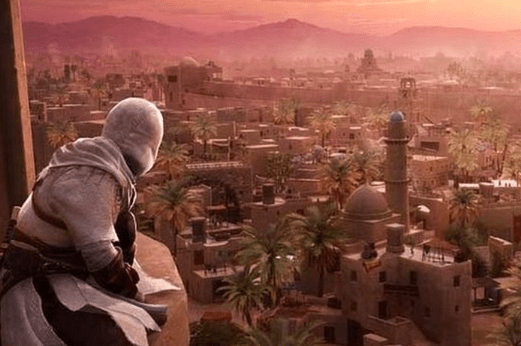
So, here’s a few things we can borrow from the Assassin’s Creed games. For this, I’m sticking to the more action-oriented ones, which Mirage harks back to – think Black Flag, Syndicate, and Unity – rather than Shadows, Origins, Odyssey, or Valhalla – which are much closer to actual RPGs.
While you’re reading this, I should tell you about my Patreon. Patrons get access to content 7 days before they hit this site, the chance to request articles or content, and the chance to play in one-shot games, for a very reasonable backer level of £2/$3 per month. If you like what you read, want to support the blog, and have the funds for it, please consider supporting here. Telling people about the blog, and sharing links/retweeting is much appreciated also – thanks!
2d3 Enemy Types
You don’t have a huge array of possible opponents in the AC games. Most are, er, “guards” – occasionally, in Mirage, with different coloured turbans to show they’re mercenaries rather than the Caliph’s guards. There’s big brutes, flamethrower guards, and some archers – and a few “boss monster” types. And this is all you need. The variety comes from how you encounter them, and the different approaches you can take to avoid and, yes, stab them.
Much like in this popular RPG blog post, imploring you to Just Use Bears, we don’t need loads of variety of monsters in our games, and especially in our one-shots. Just a few, carefully used, is enough.
Explicitly Thread Clues
As you’re investigating things in AC Mirage, you uncover more and more of sinister conspiracies. This could be maddening – you’ve got 3 different routes and orders you can approach it in, and can switch easily between them. Instead, it’s clear and satisfying – there’s an Investigation board that lays out the next steps for each thing you’re looking for.
Consider doing this in an ongoing game – you can explicitly tell players which thread stuff is relevant for, and mark it on a shared whiteboard (or Miro, if you’re playing online) for them to refer to. Don’t rely on them to do it – you’ll get player-introduced red herrings and data dropping that will be frustrating for everybody!
2 Ways In Is Enough
In Mirage, you’re often presented with multiple ways to carry out a mission; you need to get into a trading camp and draw the leader out (so you can stab him), for instance. There’s usually 3 ways you can do this, and each has it’s own little quest tree – you can bribe some merchants to smuggle you in, you can sneak in and try to buy some mercenaries from him (but you’ll need to get a special token for that), or you can set fire to his stores and hope to draw him out. In a videogame, this feels like a vast array of options! If you get stuck with one, you can always try the other – and you’re left with a satisfying feeling that you could have approached it differently.
In a TTRPG, I’d say even just 2 way is enough – and allow for the players to come up with their own option too. Similar to the dilemmas in Agon (you can do X, or Y, or choose your own path) – this makes your encounters and scenes seem much more lived in, and is enough options to make them flexible.
Easy or Hard Fights
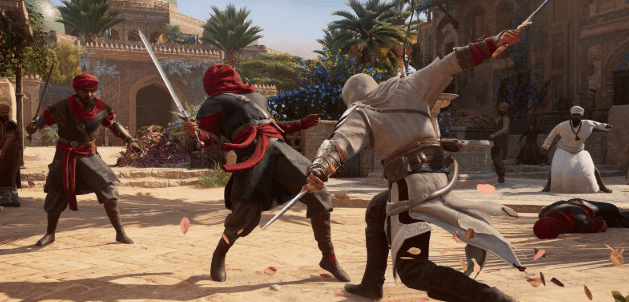
There are no “medium” fights in Assassin’s Creed. If you’re sneaking around, being careful, and using your environment, you can complete many of the missions without ever getting into a stand-up fight. Once that stand-up fight arrives, though (usually through mis-timing your stealth, or missing a guard that comes round the corner at a crucial time), things get tricky quite quickly. More than 2 or 3 opponents is really difficult to deal with, especially if one is a brute or a special troop type. So you’re constantly either feeling competent or scared.
I’ve said this before, but this is absolutely how to do RPG combat – no “medium,” grindy fights. Combat, if you’re using a system that lets you budget it (D&D, Pathfinder, that sort of thing) should be in the “Easy” or “Hard” categories – not between! Note that some systems do this naturally anyway – there are by definition no easy fights in Runequest, as limbs are on the line all the time!
Show the Map – Including Secret Doors!
Before you approach a set piece objective, all the AC games have some sort of avian companion that you can use to scout it out. You can tag enemies, making stealth easier, find secret entrances and treasure, and generally get a good idea of what the mission looks like first.
This is a great one for heist games especially, but I wouldn’t rule out doing it for dungeons – just give them a map that they’ve bought or acquired from another adventurer (maybe with teasing clues that prompt them to explore) and let them use it to guide their exploration. It’ll make them a bit more prepared, of course – so feel free to bump up the opposition.
So, five things from Assassin’s Creed – this makes me feel much better about the hours I’ve sunk into Mirage (and that I’ve just downloaded Shadows) – are there any other tips from video games that you’ve borrowed?
 Burn After Running: RPG One-Shots