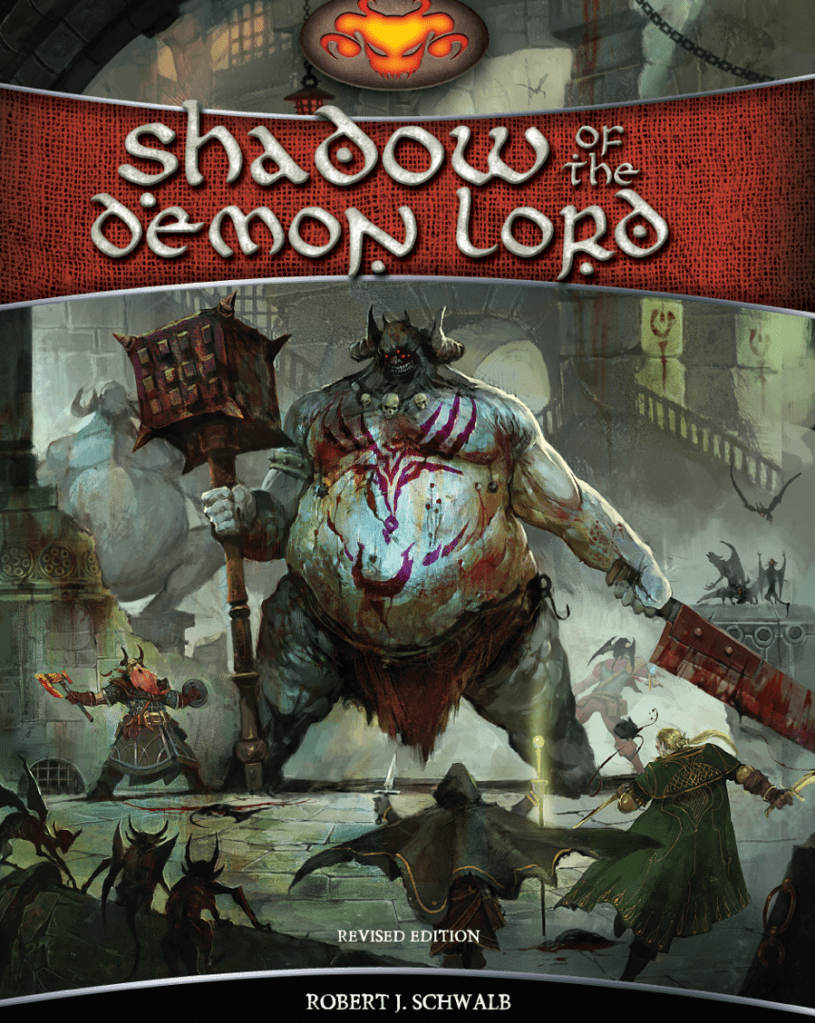
Shadow of the Demon Lord One-Shots

Rob Schwalb’s Shadow the Demon Lord (SOTDL) is an excellent system, and a great one for con games and one-shots. A grimdark fantasy world of demons and apocalypse a shade or two more gonzo than Warhammer and the like, it’s also the system for a post-apocalypse game, Punkapocalyptic. I’ve run several games of both of them as one-shots, and a full campaign of SODTL, and there’s a lot to recommend it.

It’s d20-adjacent with a Boon/Bane dice system that reduces the spread of numbers and keeps everything quick and easy, and has some really neat system tweaks that come into play. On a read through, you might think it’s a drifted d20 system game, but in play it feels very different – in a good way – and it’s built for pace. There’s plenty of examples of Rob running it on his podcast, and they are a great example of a fast-paced game. Here are five recommendations I’d made if you want to bring it to a con.

Start at the right level

Shadow has a great advancement system, where you start out at 0-level, then add a core class at 1st level, an expert class at 3rd, and a master class at 7th – making your character get gradually more defined and niched as you advance. For a one-shot, I’d start somewhere between 2nd and 4th level – 3rd level gives the Expert class, which creates some nice wedge issues between PCs, and will give players a few options in combat without being overwhelming.

In campaign play, PCs have a lot of options past 7th level, which would be a bit overwhelming in a one-shot, including options that break initiative order and allow them to make their allies make immediate attacks – I’d steer away from those as this will slow down a system that works best played at pace.

Watch balance

It would be easy to read the guidance on building encounters as gospel, and follow it rigorously for your players. But in truth, this isn’t a tightly-balanced game like D&D or Pathfinder – not all the classes are necessarily equally good in combat, for instance, and some of the monsters at a certain Threat Level can vary a lot in lethality. Use the guidance as a starting point (and, for one-shots, in all systems, you should have no medium-difficulty fights – it’s easy to let the players show off, or hard to make them sweat) and then have a careful read of the opponents powers. You might need to adjust up or down. I found running published adventures I quite often had to adjust, and often adjust up, the opposition, but that may have been informed by my group’s “play hard” approach to character building.

Reskin, reskin, reskin

The bestiary in SOTDL is generous – you have lots of easily adaptable monsters and NPCs that, as in any game, are easy to reskin to whatever you want. I made my Punkapocalyptic players fight an animatronic Owlbear that was just another stat block, and in SOTDL “Large Monster” stood in for an awful lot of opponents in my campaign. The system is sufficiently fast and loose that your players won’t know.

Fast Turns and Slow Turns
SODTL’s initiative system is weird, and took me a while to get used to. PCs take a Fast Turn or a Slow Turn; on a Slow Turn you can do two (different) actions, but Fast turns (from both the PCs and the opponents) go first. It took me a while to get this right, but in play, just shout “Fast Turns” – whichever player shouts first, they go first; then all the other player fast turns, then the opponents, then player Slow Turns, then opponent Slow Turns. If somebody takes too long to respond and doesn’t shout up for the Fast Turn, they must be taking a Slow Turn. Giving it this degree of pace really helps combat to flow fast.

I added a ‘house rule’ that I think is an actual rule in Punkapocalyptic that you could use an action to assist an ally, granting them a Boon on their next role. This worked really well and made Slow Turns worth taking, and the players narrated what they did to give their ally a bonus in the next round which was all good action scene stuff.

Steady with the dick jokes

The gonzo-ness of SOTDL, and especially Punkapocalyptic, does contain some references that you might want to shade over in convention play or in a one-shot with people that you don’t know. A PC starting the game with a gym bag full of sex toys, or a wizard losing his genitals due to Corruption, is all good clean fun if everyone at the table is up for that, but – even with safety tools in play – I’d suggest isn’t necessarily as fun for strangers.

As with every safety discussion, it’s not just how you react to it – it’s how all the players react to it that might make it an awkward situation. So in a one-shot, I’d reign in some of the more scatological aspects of the settings – it’s not as if there isn’t enough flavour there already – just to avoid any risk of this.

To conclude, SOTDL is a great one-shot, and deserves to be run more at conventions, either online or face to face. The Roll20 character sheet is a good implementation as well, and fairly straightforward for the players to use, although the system is such you could easily just use an A/V setup and have all the players roll their own dice. There’s an absolute pile of published material for it, as well, from adventures to entire campaigns and short supplements on parts of the setting – you’ll never run out of stuff for it. What have your experiences been with SOTDL / Punkapocalyptic? Let me know in the comments, or on twitter @milnermaths

“The Chest Appears to Not Be Trapped” – Fixing Perception, Part Two

In my previous post I talked about how Perception (or whatever your skill is called) is often disappointing, and made some suggestions to fix it. Since then, I’ve been very self-conscious of using perception in my own games, as you might imagine, and so have come up with a few more ideas to make perception less rubbish than it generally is.

You All Notice Different Things

I’ve found this a surprisingly decent way to fix everyone making a Perception check, which can’t always be avoided – if one player wants to make one, it’s expected all of them can make one. Just make every successful PC notice something different, ideally tied to their own specialism. You might want to plan these ahead of time, but once you know your players it’s fairly easy to just busk these as long as you’re happy to give out exposition this way.

“I inspect the battlefield” says the wizard, while the orc army charges

As an example, in a recent Shadow of the Demon Lord game, the players were accosted by Boneguards on the way up a cursed mountain. I’d reskinned them a bit to foreshadow the rest of the adventure, making them quartz-eyed and sleepwalking, as the next scene involved facing a nightmare monster that would invade their dreams.

Perception checks ensued as they rushed to battle them, and the wizard determined that, despite their quartz-for-eyes and non-decayed appearance, these were definitely undead, and likely vulnerable and immune to the regular undead stuff. The fighter noted that they appeared to be sleepwalking chaotically, making them possible to trick or evade, and the rogue noticed that their clothes were just like those of the pirates they’d seen earlier in Float Town. By spreading the information around, it made everyone’s roll feel important – and gave a mechanic to share exposition in a more interesting way than just doling it out (or, worse, the after-combat interrogation, which always bores me).

Let Perception Deliver Resolution

“I search the chest for traps” – rolls – success

“There’s a poison needle trap here, a good one, but you deftly reach in and disarm it, draining the poison reservoir and clicking the lock open.”

Consider why we have to roll to find, and then roll to disarm, a trap? Sometimes there’s even a roll to evade it in the middle as well. Fold it into one roll – the trap-disarmer is likely to be good at all the elements of it, so just roll once. Similarly, for an ambush, let the players roll to spot their ambushers, but have the consequences solid – either they’ve got a knife at their throat (or an arrow in their back) or they’ve got the drop on their attackers – with possibly different outcomes for different PCs. Make Perception lead directly into resolution, rather than being a separate information gathering check.

Perception in the Action Economy

Consider adding “assessing the battlefield” as a combat action. On a successful check, you can liberally dole out clues as to what’s going on in the scenario, along with something that will offer a mechanical benefit as well – which could be how to make a called shot to get through armour, or just something abstract like granting Advantage to the next attack.

There’s a whole other discussion about exposition through action scenes, and how much of the plot / investigation can be folded into a mid-combat revelation, but this is a good way to make your players appreciate the value of the skill – make sure it’s a generous benefit each time though – if it needs a skill check it should be more effective than, say, aiming for a round, if that grants an automatic bonus.

So, there are three more suggestions to try and “fix” Perception. I’m still moving towards just removing the skill, but these at least offer more options to make it interesting. If you’ve got other suggestions, or would like to suggest another type of skill check that needs fixing, let me know in the comments.

“You Don’t Notice Anything.” – Why Perception is Rubbish, and How To Make It Better

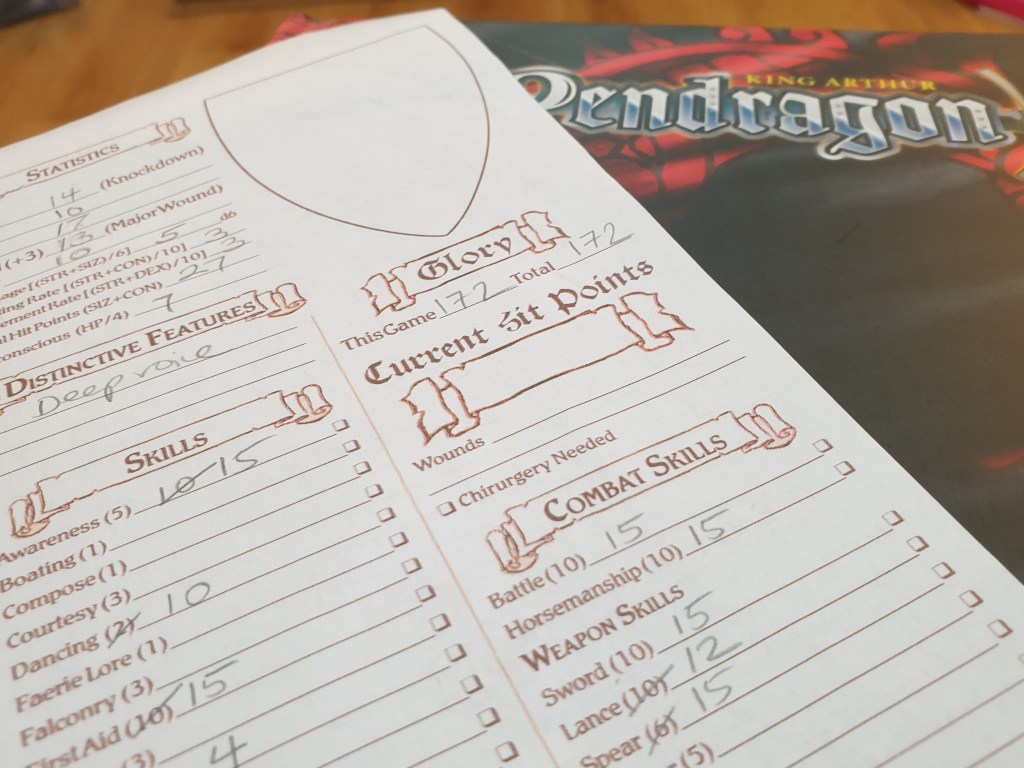
Over on his blog, @vinegarymink has posted about Failing Forward – ensuring that failed challenges are just as fun as successful ones. Half way through playing a game of Pendragon (played ‘straight’ and devoid of indie pretentions – and a fantastic game, don’t get me wrong) this week, a realisation came to me somewhere around our fifth Awareness check. Perception is a bit rubbish. It’s a ubiquitous skill in all trad systems, and one of the hardest to “fail forward” with. It’s usually quite hard to fail at all with it, which is why I think it often leaves me frustrated as a GM. I’m going to go through some of the issues with it, and then suggest some hacks that can overcome them.

Awareness 15: the essential Knightly skill
  • If it’s something the group could notice, only one player needs to notice, and they tell the others. Having everyone roll makes a group perception check trivially easy – the probabilities of just one person having to pass make them super generous. If you’ve got a 50% chance to pass the check, with the 4 players you’ve got a whopping 94% chance of at least somebody noticing – and with something harder, with a 25% chance to notice, its still at 68%.
  • Failure is usually crap. “You don’t notice anything” creates a disconnect, because by asking for the roll, the player most certainly knows there’s something to notice. D&D5e tries to solve that with Passive Perception scores, but that’s crap too – bounded accuracy means that they have a really tight range, and they concentrate the first problem – the cleric’s going to notice and tell everyone.
  • Clue restriction is rubbish. If there’s something to notice, we should want our players to notice it. When you’re negotiating with the Romulan Captain, I want my players to notice that she’s stalling for time – and even if they fail, because of the point above they know there’s something off about her.

So, how can we fix that? Here’s a few techniques.

Have Failure Consequences, or Don’t Roll

For every Perception check you call, have a clear idea of a non-restrictive consequence of failure. This is good advice for every skill check – see Alex’s blog post for more ideas – but especially important for Perception, because its failure consequences are so often not-fun. If you can’t think of a consequence for failure – don’t call for the check, and just tell them.

Have Success Benefits, or Don’t Roll

Equally, instead of just telling the players if you have a Perception check you can’t think of a cool failure condition, give them a benefit for passing instead. Maybe you accept that everyone is going to notice the bandits planning to ambush you – but if you make the check, you know which of them has decent armour under his grimy cloak, or also see the hidden archers in the trees covering the road, or you see a weak spot in the wyvern’s hide from a previous skirmish (maybe enough to make a called shot bypass some of it’s armour).

You Can’t Roll if You’re Talking/Acting

One way around the group check problem is to suggest that if you are taking action, you’re not as able to notice stuff. The players who aren’t active in the scene are the only ones that get to roll. This makes the check have closer to normal probabilities, and has the additional benefit of sharing the spotlight in a cool in-game way. Just ask any players who aren’t directly interacting with the events in play to make, as they hang back and observe.

Use it For Initiative

One of the issues with Perception checks to notice enemies trying to ambush you is that the consequences of a surprise round in most games can be enormous (notably, 13th Age avoids this, making them just inconvenient –but not entirely unbalancing). Instead, make Initiative the result of a Perception check in these circumstances. Maybe the ambushers get to roll Stealth instead, as well, for their score? There’s another blog post in my head about how initiative is also often rubbish, though, so I might come back to this.

Use it To Bank Resources

I’m running Star Trek Adventures, the 2d20 game from Modiphius at the moment, and it is (like Conan, which I posted about here) heavy on resource management. Players want to get as much Group Momentum banked early in the session, so they can spend it on extra dice for checks. The best way to get this in STA at the start of the session? Scan the planet from the ship. It’s probably low difficulty, so you can get some Momentum banked for future skill checks. In some ways, this is like designating a Success Benefit, but it fits nicely into the balance of the system. It’s accepted that there will be some easy skill checks, often for things like noticing stuff, but they have some game impact through the meta-currency of the system.

Likewise, in Fate, you can offer a Fate Point Compel to miss something – to not even make a check, and have a failure consequence ready for them. In my experience, most players will do anything for a Fate point, and it’s very likely they’ll have an Aspect you can use to get this. Other systems will have their own solutions, I’m sure.

Just Ditch It

One way to force yourself out of the habit of asking for Perception checks – just remove the skill. If it’s important enough that the players need to notice something, tell them. If it’s one of the few circumstances where failure or success can be interesting, just pick another skill relevant to the context. Ambush in the Forest? Roll Nature to notice the absence of usual sounds. Trap in an ancient tomb? Sounds like a History check, or maybe a Thieves’ Tools check to notice and disarm in one roll before it triggers.

So, a selection of ways to hack perception to make it less rubbish. Are there any more techniques that you’ve used to improve it? Any games that do it particularly well? Let me know in the comments, or get me on twitter @milnermaths.

2020: Year In Review

Okay, objectively, 2020 has been terrible, hasn’t it? Despite this, I’ve just had one of my best years in gaming – if not quite in blogging. Here are my greatest hits of 2020:

Statistics

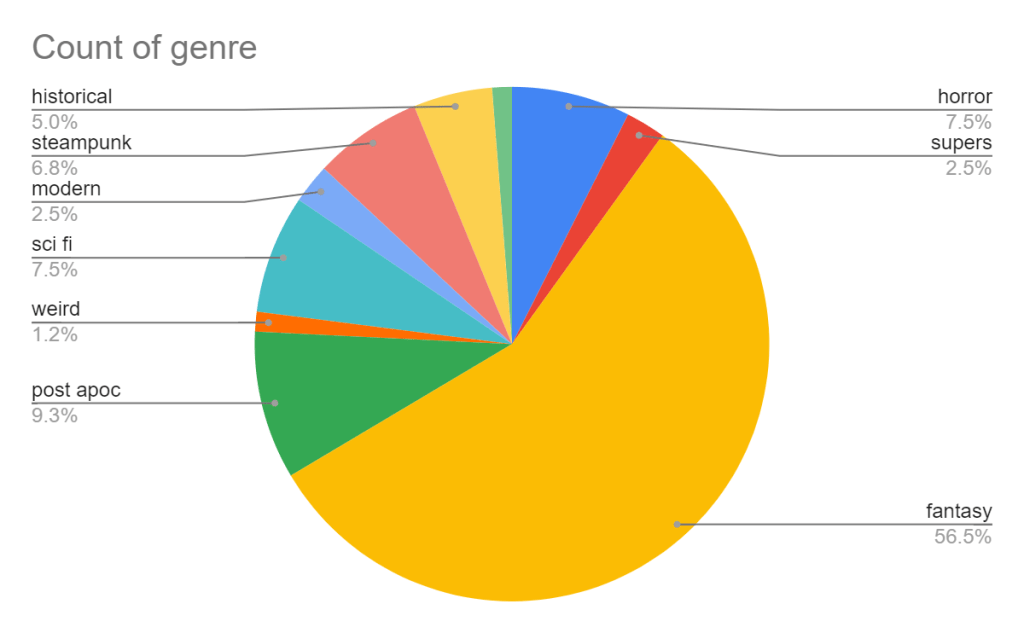
Didn’t actually realise I’d played that much “fantasy” this year until I looked at this

At the start of the year, I started logging my games on a big Google Sheet. I’ve tried to do this in previous years, but always fallen away, but I’ve stuck to it this year and it’s been fascinating to look over and remember games that I’ve played across the year.

I’ve played a total of 161 sessions of games through the year, about 65% of them ongoing campaigns. This is a lot for me, and undoubtably was affected by lockdown giving me more time to play remotely – but it’s been great. If you haven’t tried online play yet, do it.

In terms of systems run, D&D is well in the lead with 25 sessions, mostly an ongoing Friday campaign I’ll talk more about later. The One Ring and Agon are tied in second place with 13 sessions – Agon as both a player and a GM – and similarly Blades in the Dark, 13th Age, and Shadow of the Demon Lord are tied on 11 sessions. Our Shadow campaign still has 3 more sessions left, too – but those will go into 2021’s figures – I’ve just set up the spreadsheet.

Gaming Highlights

2020 became, almost by accident, the year that I got a regular ‘home group’ – a call out on Twitter to try some One Ring became a regular group, and we’ve played all year nearly every Tuesday. One Ring led to Mutant Year Zero: Genlab Alpha, to Duty & Honour (2nd edition), Wrath & Glory, and now to Shadow of the Demon Lord.

Other groups have formed, and all of them have carried on after the original games finished – from Agon (Actual Plays available here) to Unknown Armies, from Legend of the 5 Rings to Pendragon, and from Blades in the Dark to Agon. I think once you get a good group of players, it’s well worth hanging on to them, especially when remote gaming means you can continue to meet from the comfort of your own homes.

I started a D&D campaign for mostly-newcomers to the hobby (there’s a whole host of posts about running D&D for newbs here, but this is the first time it’s been a campaign). And, they aren’t newcomers now – they’re 9th level now, and I’ve discovered that Artificer, Cleric, and Rogue is a pretty lethal combo even when you only have 3 players. I’ve been running them through the Oracle of War Eberron campaign, alternating published adventures with my own sessions (usually following up loose ends or backgrounds), levelling up every couple of sessions. It’s been a lot of fun – and I maintain that the majority of problems people have with D&D5e only appear if you let them.

Media Appearances and Other Celebrity

I’ve stretched my legs out on some other media this year. I continue to be grateful to everyone who reads, engages, and helps promote this blog (I’m extending out to cover campaign play as well from next year, as well as looking at other exciting developments) – but I’ve done a couple of podcasts with the Smart Party, and dipped my toes into appearing on streamed shows.

So thanks to JamesCORP and his channel, you can see me running 13th Age Glorantha, or playing Delta Green and HELLAS. I’m also on Youtube with the Smart Party again, running “top ten fittest game books” finalist Vaesen and then setting the world to rights about investigative games discussing the Vaesen game.

I’m keen to do more of this, and I’ve enjoyed every minute of it – so let me know if you want someone to talk about one-shots, or play or run a game online.

One-Shots

With most conventions going online, I feel a bit disconnected from the one-shot calendar I’d normally be keeping. Go Play Leeds shifted online for a bit, but the balance between set-up and benefit of running monthly online meetups have put it on hiatus, and so it’s been left to online cons to give most of my one-shot games.

Highlights include an excellent game of Girl Underground run by Paul Baldowski at Revelation, a (gasps) face-to-face con in February – stunning Alice-in-Wonderland improvised gaming that Paul did brilliantly to pull out of thin air from our ideas. From the GMing side I ran a game of Punkapocalyptic last month at Furnace Online that went really well – a group of players that embraced the gonzo, brought their own ideas, and built on one anothers narrative to “play up” each other – I’ll be writing up the adventure on here.

Onwards to 2021

For next year, I’ve got a few plans bubbling away for this blog – but mainly my ambitions are around gaming. I’m looking forward to (eventually) getting back to face to face cons, and trying to keep up the online gaming schedule I’ve set for myself.

In terms of games, I’m looking forward to seeing the Shadow of the Demon Lord campaign come to an apocalyptic conclusion, and seeing what game we turn to after that. I’ve run the first session of a Star Trek Adventures campaign, with two players relatively new to TTRPGs and two more experienced players, and that is already starting to fizz.

I want to finally run some Savage Worlds this year (maybe the Pathfinder adaptation – big fan of Rise of the Runelords), and I want to get bit more handy with Modiphius’ 2d20 games – I’ve run one shots here and there, but want to see how they play in a longer form. Cortex Prime has got me wanting to run it, as has Righteous Blood Ruthless Blades – and I’ve just got hold of Eclipse Phase 2nd Edition. Eclipse Phase 1st ed was the first game I ran at a con – so in some ways it’s where this all got started – so I need to get that back to the table.

Oh, and health, and happiness, and all that. Alongside all the games!